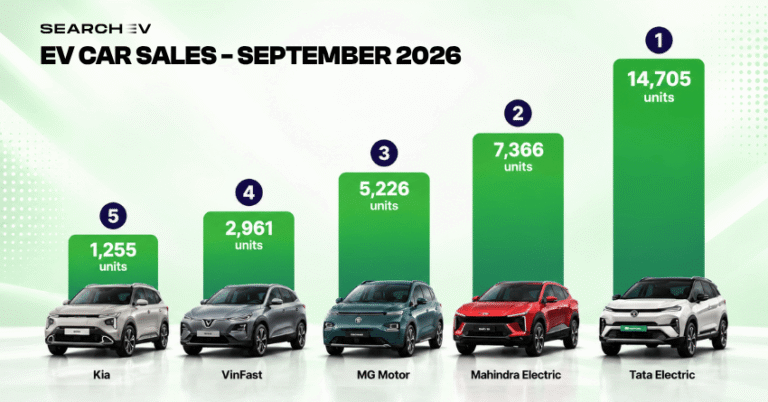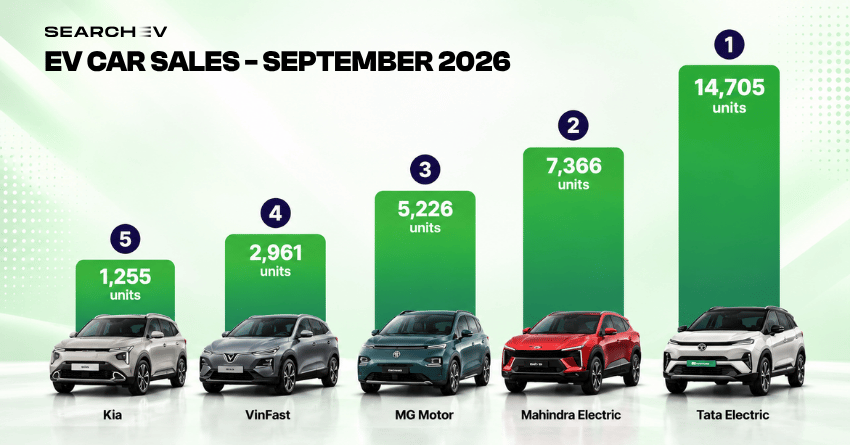

India’s electric car market has a new battle brewing. Kia has moved ahead of Maruti Suzuki in the September 2026 best-seller list, helped by a sharp increase in sales following the launch of the Kia Syros EV. According to the Vahan data as of today, Kia recorded 1,162 electric car sales, compared with Maruti Suzuki’s 998 units (only from the eVitara). Kia’s volumes increased 36.9% over August, while Maruti’s fell 32.2%, which is very interesting given the rivalry between the Koreans and the Japanese.
Kia’s EV Sales Are Picking Up
The difference becomes clearer when August and September are compared side-by-side.
| Brand | September 2026 | August 2026 | MoM |
| Kia India | 1,162 | 849 | +36.9% |
| Maruti Suzuki | 998 | 1,471 | -32.2% |
| Hyundai | 738 | 839 | -12.0% |
| BYD | 777 | 566 | +37.3% |
Kia added 313 units when compared to month-on-month sales, while Maruti lost 473 units. That creates a 164-unit advantage for the Korean manufacturer in September 2026. The timing in this matter is quite significant because Kia’s EV lineup recently added its most affordable electric car yet, the Kia Syros EV.
Kia Syros EV Is Actually Making A Difference
The new Kia Syros EV appears to be giving Kia the additional volume that was much-needed to compete with bigger players in the market. Even before September is completed, Vahan data showed Kia’s EV business gaining good momentum. Kia registered a then-record 767 EVs in August 2026, with the Kia Syros EV and Kia Carens Clavis EV making up the majority of its sales.
We also think that Syros EV had an immediate impact on Kia’s retail performance, and the sales will continue to go up in the upcoming festive season that is just around the corner.
The Syros EV also gives Kia access to a much broader buyer range than its earlier electric models, which were limited to the premium segmet.
Model-wise, all of September’s registrations aren’t available in this dataset, so the entire increase can’t be attributed to the Syros EV alone. But the timing of Kia’s rise following its launch is noteworthy.
Maruti Loses Ground While Kia Moves Up
Kia’s growth becomes more interesting because Maruti moved in the opposite direction.
Maruti’s electric car sales dropped from 1,471 units in August to 998 units in September, a decline of 32.2%. Kia, meanwhile, went from 849 to 1,162 units.
This is still a small battle compared with the leaders. Tata recorded 13,405 units, Mahindra 7,001 and MG 4,899. Kia, therefore, has a long way to go to compete with India’s top three largest electric car manufacturers. But Kia overtaking Maruti is significant because of how quickly its EV volumes have accelerated.
Kia Has Finally Found Its Best-Selling EV?
Until recently, Kia’s electric cars weren’t major volume contributors. The Syros EV potentially changes that equation. Instead of relying predominantly on expensive, upmarket EVs, Kia now has a more accessible electric mid-size SUV sitting in one of India’s most competitive price brackets, i.e., the Rs 12 to 20 lakh, which also happens to be the most lucrative one with numerous options in electric as well as ICE vehicles.
The recent sales jump doesn’t suddenly make Kia an EV heavyweight, and it isn’t enough to establish how a brand will perform long-term. But the direction is difficult to ignore. For Kia, the bigger question isn’t whether it can beat Maruti for one month. It’s whether the Syros EV can keep it above the 1,000-unit monthly mark and turn this September jump into sustained growth.