Quick reads
- Bentley’s fourth model line, and its first ground-up electric car, built on the same Premium Platform Electric architecture as the Porsche Cayenne Electric
- 113 kWh battery with a claimed WLTP range of around 600 km and 400 kW charging that adds close to 160 km in about seven minutes
- Sold as two versions, Torcal and Torcal S, the latter now officially the most powerful production Bentley ever made at 888 PS and 1,350 Nm
- The exterior features a new Floating Diamond Grille housing 76 illuminated crystal-effect elements.
- Interior pairs a curved OLED screen with real switchgear, four Experience Modes, and a synthesised engine soundtrack recorded using actual drums, viola and bass guitar
- The Torcal will arrive in India in the second half of 2027 with an expected price of Rs 4.5 crore.
For most of its 107 years, a Bentley has been defined by the noise it made getting you somewhere quickly. Thundering V8s, and for a long stretch, a W12 that few in the industry bothered building.
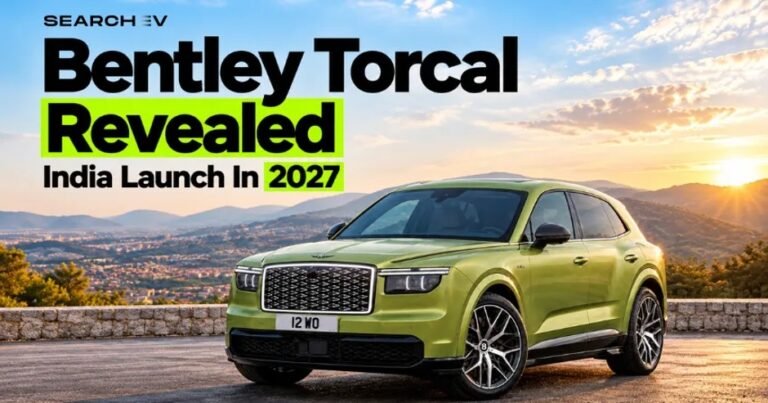
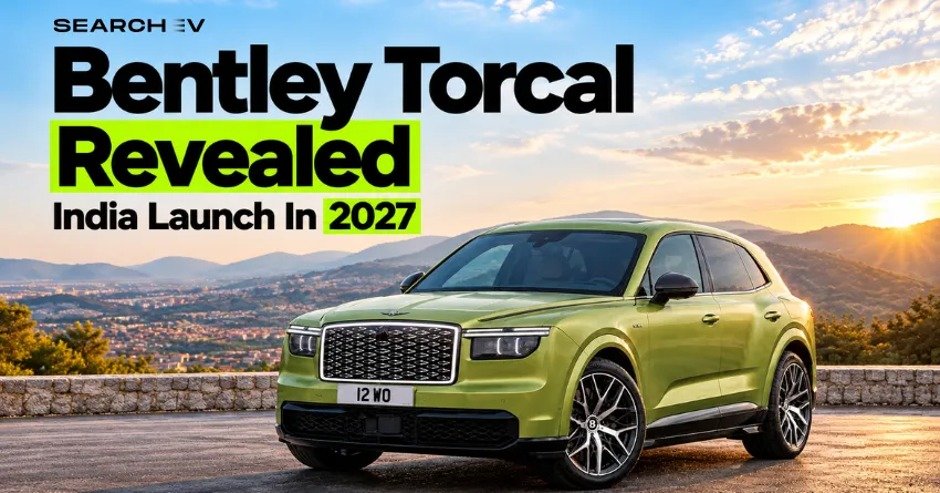
Bentley has now officially entered the zero-emission era with the global reveal of the Torcal electric SUV.
The Torcal is the first time that experience is being reimagined without a combustion engine underneath it, and Bentley has been candid that it sees this car as something of a template, a proof of concept for how every future Bentley, whatever powers it, ought to feel from behind the wheel.
What is it?
Named after the dramatic limestone landscapes of El Torcal de Antequera in southern Spain, this new model represents a monumental shift in the British marque. Slotted just below the Bentayga in size, the Torcal completely ditches traditional internal combustion engines in favour of a dual-motor electric powertrain. Bentley aims to deliver the same grand touring capability, handcrafted luxury, and effortless power that defined its historic V8 and W12 models, but through a completely modern and silent medium.
Design: A Grille That Doesn’t Need to Breathe
An electric SUV has no obvious use for a conventional grille, and Bentley’s design team, led by Robin Page, clearly decided that didn’t matter. The Torcal’s face is built around an illuminated panel using 76 individually applied LED elements set behind clear polycarbonate, giving it a crystalline, faceted look that reads almost jewel-like up close. It replaces the brand’s familiar twin-circle headlight signature with slim vertical light bars, which will likely divide opinion among traditionalists.
Proportionally, the Torcal sits 50 mm lower and 120 mm shorter than a standard wheelbase Bentayga, on a wheelbase just over three metres, with the whole car stretching close to five metres nose to tail. The SUV rides on standard 21-inch wheels, with 22-inch options available, and features a practical 90-litre front trunk.
The Torcal has a familiar Bentley SUV shape, closer in spirit to an evolved Bentayga than to anything trying to look overtly futuristic. That restraint seems deliberate. Where some rivals have leaned hard into spaceship styling for their debut EVs, Bentley appears to be betting that its existing buyers want the new car to look unmistakably like the old ones.
Cabin and Technology: Fewer Screens Than You’d Expect, More Craft Than You’d Guess
The cabin seamlessly blends traditional Bentley craftsmanship with next-generation technology.
The centrepiece is a curved 12.25-inch HD OLED touchscreen that sweeps elegantly down into the center console. Crucially, Bentley hasn’t stripped out physical switches to make room for it. The climate controls keep their knurled metal dials, and there’s a rotary collar around the starter button that cycles through four experience modes, even including Comfort with a “digital detox” option that strips the displays back to essentials and Refresh, which brightens the cabin and increases airflow.
Material choices lean heavily on Bentley’s usual playbook, pushed a bit further. There’s a world-first here in the form of a fully Merino wool automotive fabric developed with the Somerset weaving house Fox Brothers, alongside a more sustainable Dinamica suede alternative for buyers who’d rather skip leather altogether. New Mulliner finishes include an Ombre Walnut veneer built from close to a thousand layers of walnut off-cuts and recycled paper pressed together to fade from black to smoke, and a Sunburst Aluminium finish that reinterprets the engine-turned dashboards found in old Bentleys. Overhead sits a Frosted Diamond sunroof with switchable glass.
Every Torcal arrives standard with 16-way power-adjustable seats featuring integrated heating, cooling, ventilation, adaptive side bolsters, and multi-program massage routines. Choosing the dedicated wellness package takes this further by embedding active massage nodes directly into the lower seat cushion. Rear occupants now get power-folding seats, marking the first time this convenience has ever appeared in a production Bentley. Passenger air quality is continuously preserved through an electrostatic cabin filtration system.
A 16-speaker setup delivering 620 watts handles standard audio duties. Audiophiles can select a phenomenal Naim audio system that deploys 28 speakers and 1,780 watts of output.
What’s under the floor
The Torcal is built on Volkswagen Group’s Premium Platform Electric architecture, the same underpinnings as the electric Porsche Cayenne. A 113 kWh net battery operating on an 800-volt system feeds two permanent magnet motors, and in the flagship Torcal S, with launch control engaged, that combination produces 888 PS and 1,350 Nm of torque, figures Bentley now calls the highest of any production car it has built. That’s enough to send a roughly 2.7 tonne SUV from a standstill to 100kph in 2.9 seconds.
The standard dual motor configuration generates 809 horsepower and 1,155 Nm of torque, pushing the vehicle from zero to 100 kilometres per hour in 3.4 seconds. Range is claimed at around 600 km on the WLTP cycle. Charging tops out at 400 kW, enough for a 10 to 80 per cent top-up in roughly 16 minutes, or close to 160 km of range added during a seven-minute stop.
To control its heavy curb weight, Bentley equipped the Torcal with two-chamber air suspension, adaptive dampers, and active anti-roll bars.
Bentley’s engineers recorded real musicians playing drums, viola and bass guitar to build what they call the Dynamic Symphony, a synthesised soundtrack designed to respond to torque demand and speed rather than mimic a V8 outright. The reasoning, according to the brand, is that a flawless digital engine note feels artificial, while small imperfections in a real performance sound closer to something with actual character. It can be switched off entirely for those who’d rather drive in silence.
Where this leaves things
Bentley’s chairman and chief executive, Frank Steffen Walliser, framed the launch as a continuation of the brand’s identity rather than a break from it, describing the Torcal as possibly “the most considered car in our history”.
Bentley has, on paper at least, built a convincing case that an electric SUV can still feel like a Bentley rather than a badge stuck onto someone else’s platform. The restrained styling, the retained physical controls, and the deliberate under-tuning of outright power all point to a company trying hard not to alienate the buyers who’ve kept it in business for a century while still building something genuinely new underneath.
For Indian buyers, the Torcal is scheduled to arrive on the Indian shores during the second half of 2027, priced at an estimated Rs 4.5 crore ex-showroom. It’s also worth noting Bentayga’s continued presence on sale alongside the Torcal. Bentley isn’t retiring the combustion SUV to make room for this one, and the Bentayga is set to receive its own new petrol-powered generation in the coming years, suggesting Bentley expects both buyers, the traditionalists and the early EV adopters, to keep shopping from the same showroom for a while yet.