Key Takeaways
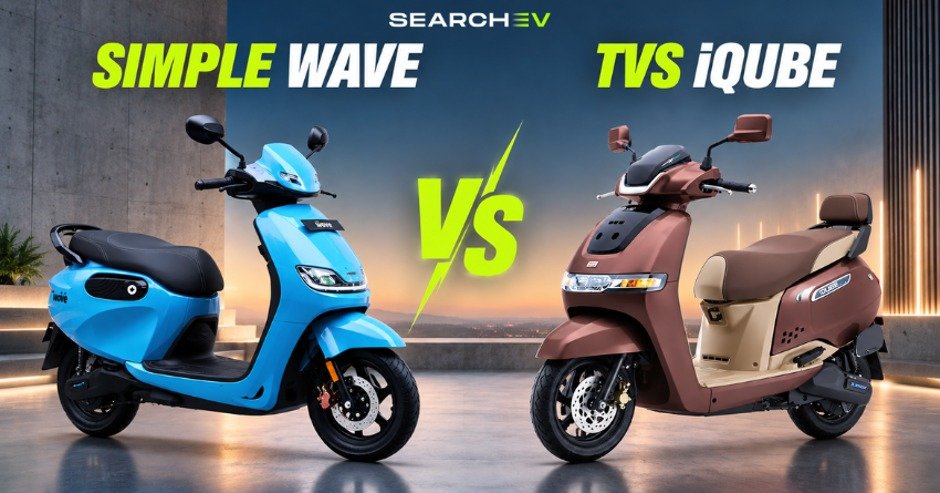
- Simple Energy enters the family segment with the Wave lineup, offering battery options from 2.2 kWh to a massive 5.0 kWh.
- The TVS matches this spread with the iQube, which is offered with battery packs ranging from 2.3 kWh to 5.1 kWh.
- The flagship Simple Wave + claims an IDC range of 243 km and a top speed of 90 kmph
- The TVS iQube ST 5.1 kWh provides 212 km of claimed range and a top speed of 82 km/h.
- Simple Energy provides a colossal 70 litres of total storage capacity, heavily outclassing the 32-litre boot of the iQube.
- The Wave utilises a chain drive transmission, whereas the iQube relies on a hub-mounted motor.
Simple Wave vs TVS iQube: Price and Value Comparison
Simple Energy has now released full pricing across its six Wave models, running from Rs 1,09,999 for the entry-level S EBN 2.2 kWh variant up to Rs 1,89,999 for the range-topping Wave+. That’s a fairly wide spread for a brand new nameplate, and it puts the Wave in direct competition with an established rival like the iQube at nearly every price point.
TVS, for its part, has kept the iQube lineup similarly broad, spanning five battery configurations from the base 2.3 kWh model to the long-range ST with its 5.3 kWh pack. TVS also runs a Battery as a Service scheme of its own, which can lower the effective starting price for buyers who’d rather subscribe to the battery than pay for it outright.
Comparable Variants and Pricing
| Simple Wave Model | Battery | IDC Range | Price | TVS iQube Variant | Battery | IDC Range | Price |
| Wave S EBN | 2.2 kWh | 110 km | Rs 1,09,999 | iQube (base) | 2.3 kWh | 114 km | Rs 1,20,124 |
| Wave S EBN | 2.7 kWh | 132 km | Rs 1,39,999 | iQube 3.1 kWh | 3.1 kWh | 123 km | Rs 1,35,465 |
| Wave S TFT | 2.7 kWh | 132 km | Rs 1,49,999 | ||||
| Wave EBN | 3.7 kWh | 171 km | Rs 1,59,999 | iQube 3.5 kWh | 3.5 kWh | 145 km | Rs 1,45,200 |
| Wave TFT | 3.7 kWh | 171 km | Rs 1,74,999 | iQube S | 4.7 kWh | 175 km | Rs 1,65,340 |
| Wave+ TFT | 5 kWh | 243 km | Rs 1,89,999 | iQube ST | 5.3 kWh | 212 km | Rs 1,75.384 |
*Note that the prices above are ex-showroom figures before government subsidies. And, the EBN models come with an LCD.
Design, Dimensions, and Practicality Comparison
A tubular steel frame forms the core architecture of the Simple Wave. Designers incorporated gentle flowing lines to minimise aerodynamic drag without compromising interior volume. Storage capacity is an absolute priority here. The scooter provides a massive 70 litres of total cargo volume. This space includes a 63-litre underseat bin, a 3-litre glove box, and an innovative 4-litre side compartment named the Pill (as of now only the left pillbox is functional; the right one is an accessory that you buy seperately). The seat measures 920 mm in length, offering expansive room for two adults.
The iQube has stuck with a fairly conservative, rounded silhouette since its 2020 launch, refreshed over the years with sharper LED lighting and a wider colour palette, but never straying too far from its original, non-threatening design brief. It features a robust tubular structure paired with 12-inch wheels.
The iQube’s hub motor and underfloor battery placement leave a fairly conventional 32-litre underseat storage. Braking hardware, interestingly, is identical on both, a front disc paired with a rear drum and CBS tying the two together, so neither has an advantage there.
Dimensions and Storage Comparison
| Dimension / Capacity | Simple Wave+ | TVS iQube ST 5.1 kWh |
| Wheelbase | 1,347 mm | 1,301 mm |
| Seat Height | 775 mm | 770 mm |
| Ground Clearance | 175 mm | 157 mm |
| Water Wading Capability | 300 mm | Not officially specified |
| Total Storage | Up to 70 litres (63 litres underseat + 4 litres pill + 3 litres glovebox) | 32 litres, extendable to 35.5 litres with an optional front storage box on the MillionR edition |
| Wheels | 12-inch alloy | 12-inch alloy |
| Braking Setup | Front disc, rear drum, CBS | Front disc, rear drum, CBS |
Simple Wave vs TVS iQube: Which EV Offers More Features?
Both scooters are aimed at the same practical, feature-conscious family buyer but have differences in their feature lists. Let’s break down the key features.
Feature Comparison
| Simple Wave + | TVS iQube ST 5.1 kWh | |
| Instrument Cluster | 7-inch TFT Display | 7-inch TFT Touchscreen |
| Riding Modes | Ride, Eco, ECOX, Sport | Eco and Power |
| Turn by Turn Navigation | Yes | Yes |
| Bluetooth Connectivity | Yes | Yes, across most variants |
| OTA Software Updates | Yes | Not specifically advertised |
| ABS | Not offered | Not offered |
| Reverse / Park Assist | Yes | Yes |
| Hill Hold Assist | Yes | Yes |
| Active Safety Telematics | Vehicle Tracking, Drop Safe | Crash, Fall and Anti-Theft Alert |
| Lighting Setup | Full LED with Light Guide DRL | Full LED Setup |
| Traction Control | Yes | Not Available |
| Removable Battery | No, fixed pack | No, fixed pack |
Unique features of the Simple Wave:
- The Pill, a dedicated 4-litre storage add-on, separate from the main underseat bay, useful for a helmet lock, rain gear or anything you’d want within quick reach.
- A 300 mm water wading rating, aimed at riders dealing with flooded streets during the monsoon.
- A chain drive PMSM motor instead of the hub motor most rivals use, which Simple Energy says helps deliver smoother, more efficient power to the wheel.
- Lifetime warranty claim on the motor and battery, which would be a first for an Indian two-wheeler OEM if the terms carry over fully to the Wave.
- GripSense Traction Control and Drop Safe Safety System
Unique features of the TVS iQube:
- Smartwatch connectivity through a partnership with Noise, letting riders check battery status, tyre pressure and safety alerts straight from their wrist, a genuine first in this segment.
- Q-Park Assist, which lets the scooter reverse out of a tight parking spot without the rider needing to physically push it.
- The top variant features a full colour touch-enabled console with intuitive joystick navigation.
- The connected software supports Amazon Alexa, allowing owners to check vehicle status via home smart speakers.
Performance, Range, and Charging Speed Comparison
Power, Range, and Charging Specifications
| Simple Wave | TVS iQube | |
| Acceleration | 3.3 seconds (higher variants) | 0 to 40 kmph in 4.2 seconds, consistent across variants |
| Battery Sizes | 2.2, 2.7, 3.7 and 5 kWh | 2.3, 3.1, 3.5, 4.7 and 5.3 kWh |
| Official Claimed Range (IDC) | 110 to 243 km | 114 to 212 km |
| Top Speed | 90 km/h (Wave+) | 82 km/h on the ST |
| Peak Motor Power | 6.4 kW on higher variants, 4.5 kW on the base model | 4.4 kW peak, 3 kW rated, consistent across the range |
| Peak Torque | 179 Nm at the wheel (Wave+) | 140 Nm peak at the wheel |
| Vehicle Warranty | Not separately detailed for the Wave at launch | 3 years or 50,000 km |
| Charging time | 0 to 80 percent in 2 hours 15 minutes (Fast Charging) | 0 to 80 percent in 4 hours 18 minutes (ST) |
| Battery Warranty | Segment-first lifetime warranty on the motor and battery | 3 years or 50,000 km standard, extendable up to 5 years or 70,000 km |
Simple Wave vs TVS iQube: Which Electric Scooter is the Better Buy?
Simple Wave Pros and Cons
Pros:
- Faster charging on the flagship model.
- Delivers an enormous 243 km certified range on the flagship 5.0 kWh model.
- Offers a class leading 70 litres of total cargo space.
- Backed by an industry-first lifetime warranty covering both the motor and battery
Cons:
- Smaller dealer and service network than TVS
- Higher introductory pricing across the mid and top-variants compared to legacy rivals
- Relies on a chain drive mechanism that requires periodic lubrication and tension adjustments
TVS iQube Pros and Cons
Pros:
- Hub motor design with no transmission loss
- Backed by the massive nationwide service and sales network of TVS Motor Company
- Aggressive pricing across the range
Cons:
- Smaller underseat storage due to the hub motor and battery placement
- Only two riding modes against the Wave’s four
- Slower acceleration times compared to performance-orientated family scooters
Expert Take on the Best Electric Scooter for You
If you value proven reliability, silent operation, and a vast service network, the TVS iQube remains an incredibly dependable daily commuter.
However, if you prioritise cargo space and maximum driving range, the Simple Wave is overall a great package, especially with the lifetime battery and motor warranty coming in. The flagship model delivers a massive 243 km range, while the 70 liters of combined storage space makes it the ultimate electric workhorse for heavy household errands.