Quick reads
- Both cars will launch together on October 12, 2026, as Volvo’s new range toppers in India.
- The EX90 is a three row SUV that effectively takes over from the XC90 as Volvo’s flagship, though it will be sold alongside it.
- The ES90 is a five seat sedan with a fastback tail, and it fills the gap left by the S90, which stopped selling in June 2025 in India.
- Globally, both cars share Volvo’s SPA2 platform, an 800V electrical system, and a choice of 92kWh single motor or 106kWh twin motor powertrain.
- Claimed charging speed is up to 350kW DC, enough for a 10 to 80 percent top up in about 22 minutes.
- Both will come in as CBU imports.
Volvo has confirmed a date, October 12, for what is arguably its most important electric product moment in India since it entered the country. Two cars, not one, will be unveiled that day: the EX90, a large electric SUV that seats up to seven, and the ES90, a sedan that brings back a body style Volvo had stepped away from.
Both cars are coming in through the completely built unit (CBU) route. In terms of rivals, the EX90 is expected to be cross shopped with the Mercedes-Benz EQS SUV, while the ES90 lines up more directly against the EQS sedan and the BMW i5.
Volvo EX90 and ES90: Platform and Powertrain
The version headed to India is the updated model year, built on Volvo’s SPA2 architecture around the newer 800V setup and the smaller but more efficient 92kWh and 106kWh packs. An 800V architecture is what allows a car to accept very high charging currents without the cables and components overheating, which is why Volvo can quote a 22 minute top up time from 10 to 80 percent at up to 350kW.
On power, the entry level 92kWh, single motor, rear wheel drive version of both cars makes around 333hp and 480Nm. Step up to the 106kWh pack and you get a twin motor layout with roughly 456hp and 670Nm, and a Twin Motor Performance variant pushes that closer to 680hp and 870Nm.
The EX90 gets from 0 to 100kph in a claimed 6.6 seconds in its base form, dropping to 5.3 seconds for the Twin Motor and around 4 seconds for the Performance version. The ES90 is marginally slower in twin motor guise, clocking 5.4 seconds. Range figures, measured on the WLTP cycle, run from 565km for the base EX90 up to 608km for the Twin Motor, while the ES90 does noticeably better thanks to its shape, rated between 664km and 696km depending on battery.
Volvo EX90 and ES90: Exterior Details
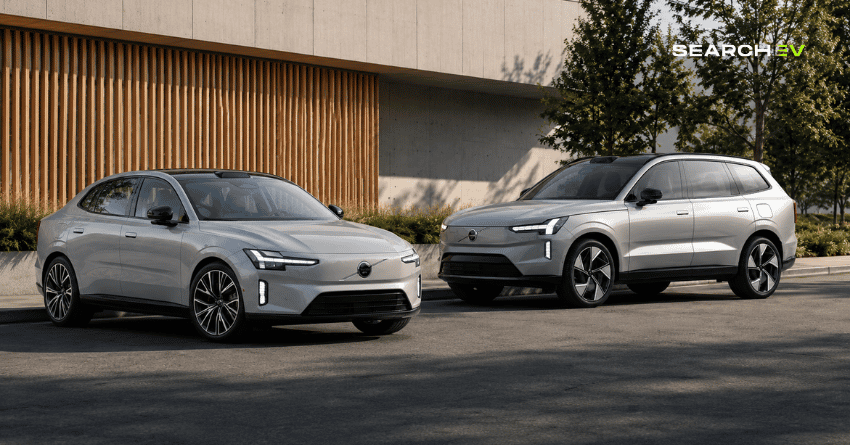
Both get the brand’s now familiar Thor’s Hammer” signature LED daytime running lights, sitting above a front end with no visible grille, just a badge and a slim air intake below. Look closely at the EX90’s roofline and you’ll spot a small sensor housing at the front edge, which is the car’s LiDAR unit, a laser based sensor used for its advanced driver assistance systems. The EX90 measures just over 5 metres long, 1.96 metres wide and 1.74 metres tall, with a wheelbase just short of 3 metres, dimensions in the same ballpark as the XC90 but wrapped in a noticeably cleaner, less chiselled body. Volvo quotes a drag coefficient of 0.29 for the SUV.
The ES90 borrows the same face and rear light treatment but wears them on a sedan body with a sloped, coupe-like roofline and door handles that sit flush until you need them. Its drag coefficient comes in at 0.25, which Volvo says makes it the most aerodynamic car it has ever built; the reason why the sedan manages a longer claimed range than the SUV despite using a similar battery.
Volvo EX90 and ES90: Features, Space and Tech
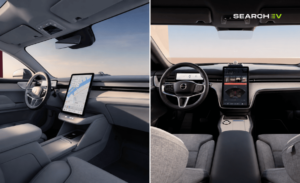
Step inside either car and the layout is nearly identical. A 14.5 inch touchscreen, mounted portrait style, dominates the dashboard and handles most functions, from climate to drive settings. Behind the wheel sits a 9 inch digital instrument display, and there’s also a head up display measured at 13.2 inches, which is unusually large. The infotainment system runs on Google’s built in software stack, gets a 5G connection for over the air updates, and reportedly renders parts of its interface using Unreal Engine, the same graphics engine used in video games. Processing is handled by a mix of Nvidia and Qualcomm Snapdragon chips, one of the reasons Volvo is pitching both cars as software defined vehicles, meaning features can be added or improved after purchase through updates rather than only at the factory.
Both get four zone climate control, a cabin air purifier, wireless charging, a 360 degree camera system, powered front seats, a panoramic glass roof, and connected car tech. Both cars are also being sold abroad with what Volvo calls Level 3 driver assistance; level 3 in theory allows a driver to take their attention off the road for short stretches under specific conditions.
Where the two cars differ is majorly the seating. The ES90 is a five seater throughout, while the EX90 offers seven seats as standard, with a six seat captain’s chair layout available in some markets, and even a four seat version with a rear console fridge sold overseas, aimed at buyers who might otherwise look at something like the Mercedes-Maybach EQS SUV. Boot space is rated at 384 litres for the EX90 with all three rows up, plus a 45 litre front trunk, while the ES90 offers 424 litres at the back and 27 litres up front.