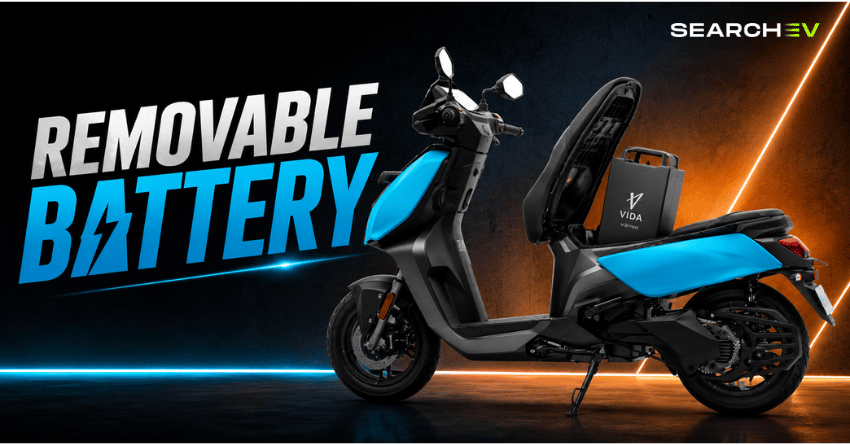
Most people buying an electric scooter for the first time focus on the range, the top speed, and the price. The battery is almost an afterthought. It is just there, right? It charges, and it powers the scooter—end of story.
But here is what nobody tells you at the showroom. How the battery is designed — whether it can come out or not — affects your daily life more than almost any other feature on the scooter. Where you charge it, how convenient owning it is, what happens when it needs replacing, and even how much you eventually spend—all of it connects back to one simple question. Can the battery come out or not?
This article explains exactly what a removable battery is, how it works, and why so many Indian riders are specifically looking for scooters that have one.
So What Exactly Is a Removable Battery
A removable battery is exactly what the name says. It is a battery pack inside the electric scooter that you can physically take out with your hands—no tools, no mechanic, and no service center visit needed.
You park your scooter downstairs. You slide out the battery. You carry it up to your flat. You plug it into a normal wall socket. By morning, it is fully charged. You slide it back in and ride to work.
That is the whole idea. The battery travels with you instead of the scooter traveling to a charger.
Compare that to a fixed-battery scooter. With a fixed battery, the battery is permanently sealed inside the scooter body. You cannot take it out. The only way to charge it is to either park the scooter near a power socket — which is a serious problem if you live in a flat on the fourth floor with no charging point in the building — or find a public charging station nearby.
For millions of Indian city riders who park on the street or in a building basement with no electricity access, a fixed battery scooter creates a charging problem that nobody warned them about before buying.
How Does It Actually Work
The removable battery is built like a large rectangular box — roughly the size of a thick laptop bag or a small suitcase, depending on the scooter model. It slides into a slot inside the scooter body, usually under the seat or along the side panel.
Inside this box are hundreds of small battery cells—usually lithium-ion or LFP chemistry—all connected and managed by a small computer called the Battery Management System. The BMS monitors temperature, charge level, and the health of every cell inside.
When you slide the battery into the scooter, the battery’s metal connectors click into the matching connectors inside the scooter’s body. This is how electricity flows from the battery to the motor when you ride. When you pull the battery out, those connectors separate cleanly — no sparks, no danger, no complicated steps. Most removable battery systems have a simple lock or latch mechanism to prevent the battery from accidentally falling out while riding.
The charger that comes with the scooter plugs directly into the battery when it is removed. Some batteries also have a charging port built into the scooter, so you can charge without removing it—giving you the best of both worlds.
Why Is This a Big Deal for Indian Riders Specifically
Charging infrastructure in India is still catching up to the number of EVs on the road. Most apartment buildings — especially older ones — do not have dedicated EV charging points in the parking area. Many riders park on the street or in shared basement parking with no access to electricity at all.
For these riders, a fixed-battery scooter is genuinely inconvenient. You either spend money getting a dedicated charging point installed—which requires landlord permission, electrical work, and ongoing cost—or you ride to a public charger every day and wait for it to charge there.
A removable battery solves this completely. No charging infrastructure needed. No permissions required. No waiting at a public station. You just carry the battery upstairs the same way you carry a laptop bag and plug it in next to your bed.
This is why removable battery electric scooters have become extremely popular with delivery riders, daily office commuters, and anyone living in a multi-story building without dedicated parking facilities. The convenience is not a small thing. For many riders, it is the deciding factor between buying an EV or sticking with petrol.
What Are the Other Benefits
Beyond the charging convenience, removable batteries offer a few other advantages that are worth knowing before you buy.
Replacement is much simpler. Every battery degrades over time. After a few years of daily use, a battery that once gave 80 km of range might only give 60 km. With a fixed battery scooter, replacing the battery means a full service center visit, heavy labor charges, and a long wait. With a removable battery, you order a new pack, slide the old one out, and slide the new one in. Done in two minutes.
You can buy a second battery. Some riders — especially delivery workers who cover high daily distances — keep a spare battery at home or at work. When the first one runs out, they swap it in and keep going. Zero downtime. This is something that is simply not possible with a fixed battery design.
Safety at home feels more manageable. Charging any lithium battery carries a very small risk of overheating in rare cases. When the battery is inside the scooter parked downstairs, you have less control over the environment. When the battery is with you at home, you can charge it in a well-ventilated space, keep an eye on it, and unplug it when done.
Are There Any Downsides
Honest answer — yes, a couple.
Removable batteries are usually slightly smaller than fixed ones because they need to fit inside a portable form factor. This can mean slightly less range compared to a fixed battery scooter of a similar price. Not always, but sometimes.
Carrying the battery up and down stairs every day is not ideal for everyone. Most removable scooter batteries weigh between 7 and 14 kilograms. For most adults, that is manageable. But if you live on a high floor without a lift, or if you have physical limitations, it can get tiring.
Is a Removable Battery Scooter Right for You
If you live in a flat without a dedicated charging point, the answer is almost certainly yes. The convenience of charging at home without any infrastructure changes your EV ownership experience completely.
If you have a dedicated parking space with a power socket right next to it, a fixed-battery scooter works just as well and may offer slightly more range for the same price.
The battery is not just a technical detail. It is the part of the scooter you interact with every single day. Understanding what type you are buying before you sign the papers is one of the smartest things you can do.