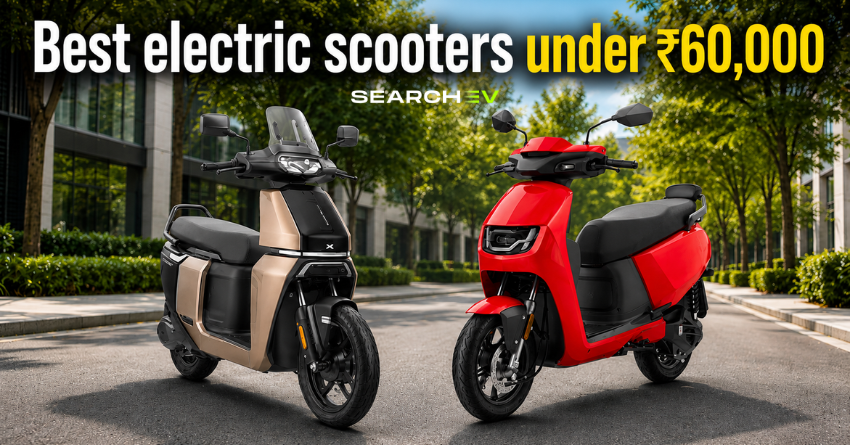
The short answer: From a major brand, the only electric scooters you can realistically get for under ₹60,000 right now are Battery-as-a-Service (BaaS) deals. The two to look at are the Hero Vida VX2 (Go from ₹44,990, Plus from ₹57,990 on Hero’s introductory BaaS pricing) and the TVS Orbiter V1 (launched at ₹49,999, though TVS raised prices on 1 August, so confirm today’s quote). Buy the battery outright and the same scooters cost roughly ₹75,000 to ₹1 lakh. The Ola S1 Z, which many lists still show at ₹59,999, is now ₹79,999.
That’s a very different picture from even six months ago, so let’s go through what changed and what it means for your wallet.
Quick comparison
| TVS Orbiter V1 | Hero Vida VX2 Go | Hero Vida VX2 Plus | TVS Orbiter V2 | |
|---|---|---|---|---|
| BaaS price (last reported) | ₹49,999 at launch | ₹44,990 (intro offer); ₹59,490 at launch | ₹57,990 (intro offer); ₹64,990 at launch | ₹59,664 at launch; likely higher now |
| Outright price | ₹84,500 at launch; about ₹95,000 to ₹1 lakh after August hike | ₹99,490 at launch | ₹1,09,990 at launch | ₹99,900 at launch; about ₹1.14 to ₹1.18 lakh now |
| Battery | 1.8 kWh | 2.2 kWh, removable | 3.4 kWh (two removable packs) | 3.1 kWh |
| Claimed range (IDC) | 86 km | 92 km | 142 km | 158 km |
| Realistic city range* | 55 to 65 km | 60 to 65 km | 90 to 100 km | 100 to 110 km |
| Top speed | 68 kmph | 70 kmph | 80 kmph | 68 kmph |
| Charging | 0 to 80% in about 2 h 20 min | Portable charger, any plug point | Portable charger, any plug point | 0 to 80% in about 4 h 10 min |
| Battery plan | From ₹862/month, unlimited km | Pay per km (about ₹0.96 to ₹1.47) | Pay per km (about ₹0.90 to ₹1.41) | From ₹1,155/month, unlimited km |
| Warranty with BaaS | Up to 5 years / 70,000 km | 5 years / 50,000 km; free battery swap below 70% health | 5 years / 50,000 km; free battery swap below 70% health | Up to 5 years / 70,000 km |
Realistic range applies a 65 to 70% factor to the claimed figure for Indian traffic, heat and a pillion now and then. Your mileage will vary.
A quick note on the older version of this table: the ₹59,490 Vida price belongs to the Go variant (92 km, 2.2 kWh), not the 142 km Plus. If you’ve seen ₹59,490 paired with 142 km anywhere, those two numbers belong to different scooters.
What’s Actually Available — Verified Prices Only
| Scooter | BaaS Price | Outright Price | IDC Range |
| TVS Orbiter V1 | ₹49,999 | ₹84,500 | 86 km |
| Hero Vida VX2 | ₹59,490 | ₹99,490 | 142 km |
| TVS Orbiter V2 | ₹59,664 | ₹99,900 | 158 km |
All prices ex-showroom Delhi, inclusive of PM e-Drive subsidy where applicable. BaaS = Battery-as-a-Service. Outright = full purchase including battery. On-road prices will be higher after registration and insurance.
One scooter conspicuously missing from this list: the Ola S1 Z, which was announced at ₹59,999 and generated enormous buzz. As of mid-2026, it remains postponed with no confirmed launch date. We’re not going to list a scooter you can’t actually buy.
The BaaS Reality — What “Under ₹60K” Actually Means in 2026
Before we get into individual scooters, this needs to be said plainly.
BaaS (Battery-as-a-Service) is a model where you purchase the scooter without its battery pack and instead pay a monthly subscription for battery access. TVS starts their Orbiter V1 BaaS plans at ₹862 per month. Hero Vida has its own subscription tiers. These aren’t bad deals — but they are fundamentally different from owning a scooter outright.
When you buy on BaaS, you don’t own the battery. You’re paying the scooter’s sticker price upfront and then paying every single month for the right to use the battery inside it. The advantages are real: lower upfront cost, battery replacement handled by the brand within the subscription, and in TVS’s case, a 5-year or 70,000 km battery warranty built into the plan. The disadvantage is equally real: you’re locked into a recurring cost that, depending on your usage, may or may not work out cheaper than buying outright.
We’ve broken down exactly how BaaS works and when it makes financial sense — but the short version is this: if you’re riding under 1,000–1,200 km a month, BaaS can genuinely work in your favour. Beyond that, the monthly cost starts compounding against you. Run your own monthly km number before you sign anything.
This context matters for everything that follows. Every major-brand scooter in this bracket is BaaS pricing. If you want outright ownership under ₹60,000 from a name you’ve heard of, we’ll address that separately below.
TVS Orbiter V1 — ₹49,999 (BaaS) / ₹84,500 (Outright)
The TVS Orbiter V1 is the most significant thing to happen to the budget EV scooter segment in a while — not because of its specs, which are modest, but because of the name behind it.
TVS Motor Company has over 4,000 service touchpoints across India. When you buy a TVS product, you’re buying into a service network that exists in cities, towns, and places where most EV brands don’t have a single authorised centre. That matters enormously at this price point, where most of the competition comes from brands still building out their infrastructure.
The V1 runs on a 1.8 kWh battery, delivers 86 km of IDC-certified range, and charges from 0 to 80% in 2 hours and 20 minutes on the standard charger. Real-world city range — with the usual Indian traffic, stops, occasional pillion, and summer heat factored in — will likely settle between 55 and 70 km. That’s enough for a 25–30 km daily commute with a nightly charge. It’s not enough for someone doing 50 km a day who can’t charge at work.
The design is deliberately practical rather than stylish — flat-form seat at 845 mm, 34 litres of under-seat storage (enough for two helmets), and a straightforward upright riding position. It’s not the scooter you buy because it turns heads. It’s the one you buy because it starts every morning and someone answers the phone when it doesn’t.
For a rider whose daily commute is under 30 km and who wants the security of TVS’s after-sales network at the lowest possible entry point, the V1 on BaaS is a compelling case. Just go in knowing you’re not owning the battery — and calculate the monthly plan into your total cost before you book.
Hero Vida VX2 — ₹59,490 (BaaS) / ₹99,490 (Outright)
The Hero Vida VX2 is backed by Hero MotoCorp, which makes it the product in this guide with the deepest service reach in India — over 6,000 touchpoints, including in Tier 2 and Tier 3 cities where the Vida brand is still building awareness but the Hero network already exists.
At ₹59,490 under BaaS, it’s the most feature-complete scooter in this bracket by a clear margin. The 3.4 kWh battery delivers 142 km of IDC range — apply the 65–70% India city reality filter and you’re looking at 90–100 km of practical range, which is meaningfully more than the TVS Orbiter V1. It supports fast charging, reaches 80 kmph, and comes with connected features including OTA updates that actually improve the scooter’s behaviour over time.
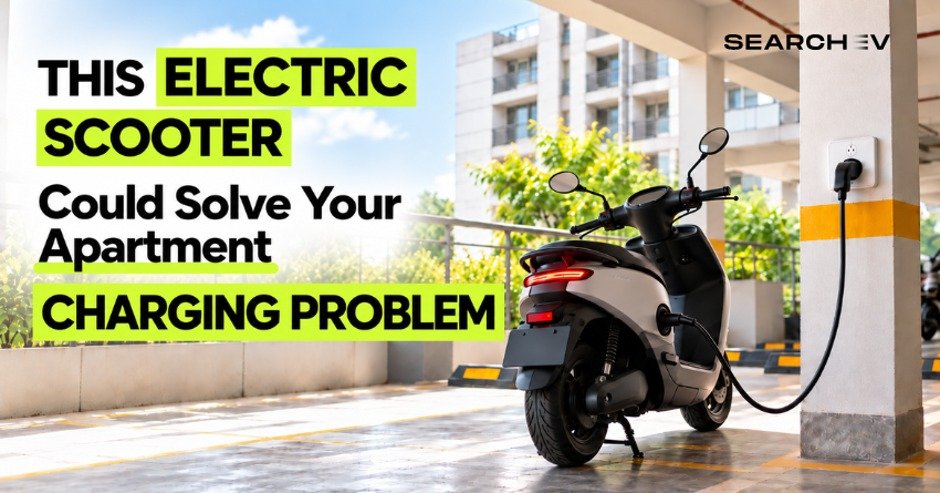
The removable battery is one of the most practical features on any scooter at any price right now. If you live in an apartment without a dedicated charging point in the parking lot, you can physically lift the battery out, carry it upstairs, and charge it from a standard 5-amp socket overnight. That’s a real-world problem solver for a large chunk of Indian urban riders who would otherwise be dependent on public charging infrastructure.
Hero Vida also ran a limited-period introductory price bringing the BaaS entry down to ₹44,990 — worth checking whether this is still active at your nearest Vida showroom, as it occasionally resurfaces with dealership-level offers.
The honest catch: Vida as a brand — separate from Hero MotoCorp’s main dealer network — has a more limited footprint in smaller cities. Hero MotoCorp’s own dealers are everywhere; dedicated Vida showrooms are fewer. Confirm availability in your city specifically before making the trip.
For a buyer who needs more range than the V1 offers, wants a removable battery, and values Hero MotoCorp’s backing, the Vida VX2 at ₹59,490 BaaS is the best overall product in this bracket. Understanding how to keep that battery healthy from day one will matter here more than it does on a scooter with simpler chemistry.
TVS Orbiter V2 — ₹59,664 (BaaS) / ₹99,900 (Outright)
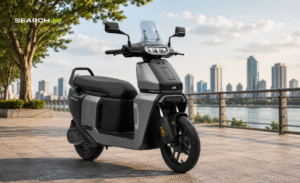
The TVS Orbiter V2 is the older sibling that launched before the V1 and offers a more substantial real-world proposition. The 3.1 kWh battery delivers a claimed 158 km IDC range — real-world city riding will bring you into the 105–120 km band, which covers most dual-use buyers who commute daily and occasionally run errands on weekends.
At ₹59,664 BaaS, it’s essentially the same entry bracket as the Hero Vida VX2. The choice between them comes down to priorities: TVS’s denser service network and proven reliability record versus Vida’s removable battery and slightly more feature-forward tech package.
If service network density matters most, Orbiter V2. If removable battery and connected features matter more, Vida VX2. Both are from brands that will actually answer when something goes wrong.
Does BaaS actually save money? The honest math
Here’s something older articles (including the earlier version of this one) get slightly wrong. It’s tempting to say “the V1 saves you ₹34,501 upfront, ₹862 a month eats that in 40 months, so buy outright after that.” But TVS plans run for 24, 36 or 60 months, and ₹862 is the lowest tier. You can’t just stop paying at month 40.
Take the longest plan and assume ₹862 applies to it:
- BaaS over 60 months: ₹49,999 + (60 × ₹862) = about ₹1,01,700
- Outright at the launch price: ₹84,500 (more now after the hike)
So over five years, buying outright can be cheaper on paper. What BaaS gives you is a lower entry cost and the bundled extended battery warranty. Check what happens to the battery when the plan ends before you sign.
The bigger question is how far you ride. Here’s the monthly battery bill, not counting electricity:
| Km per month | TVS Orbiter V1 (flat, from ₹862) | Vida VX2 (about ₹0.96 to ₹1.47 per km) |
|---|---|---|
| 600 | ₹862 | ₹576 to ₹882 |
| 900 | ₹862 | ₹864 to ₹1,323 |
| 1,200 | ₹862 | ₹1,152 to ₹1,764 |
The pattern is clear. Light riders pay less on Vida’s per-km plan. Once you pass roughly 900 km a month (about 30 km a day), TVS’s flat fee starts winning, and the gap widens the more you ride. Pick the model that matches your actual riding, not the lowest headline number.
And versus petrol? Using petrol at about ₹102 a litre and a 45 km/l scooter, running costs come to around ₹2.27 per km. At 900 km a month that’s roughly ₹2,040. A BaaS electric scooter plus home electricity (reported at roughly ₹0.30 to ₹0.45 per km) lands somewhere around ₹1,100 to ₹1,400 a month in this example. These are rough numbers. Plug in your own petrol price, tariff and distance.
Who should buy what
- Short commute (under 30 km a day), tight budget, want TVS: Orbiter V1 on BaaS.
- Live in a flat with no charger, want a removable battery: Vida VX2, Plus if you can get it under budget, Go if you can’t.
- Longer commute (40 to 60 km), want unlimited km and flat billing: Orbiter V2, if the current quote fits.
- Ride under about 600 to 800 km a month: price the Vida per-km plan against TVS’s flat fee. Vida may be cheaper.
- Want to own the battery outright under ₹60,000: see the next section, and be careful.
Buying outright under ₹60,000, and low-speed scooters
From TVS, Hero MotoCorp, Ather or Bajaj, you can’t. Under ₹60,000 outright you’re looking at smaller and lesser-known brands. Listing sites currently show models such as the Komaki X One (about ₹38,000 on-road Delhi, 60 km claimed), Yakuza Rubie (about ₹41,000, 45 km), iVOOMi S1 (₹54,999, 85 km) and Zelio Eeva (about ₹59,000, 70 km). Treat those prices as indicative. Listing-site data goes stale quickly, and we haven’t verified current availability.
Two things to check on any of them:
- Battery chemistry. Some budget scooters, such as the Zelio Eeva variant listed above, use lead-acid batteries. They’re cheaper but heavier, shorter-lived and weaker on range than lithium-ion. Ask which one you’re buying.
- Service reach. Find the nearest authorised service centre before you pay a rupee, and ask owners in your city (not national star ratings) how spares and repairs went. Our used EV buying guide has a handy checklist for this.
Licence rules matter here. In India, a valid driving licence and registration are required only for scooters with a top speed above 25 kmph. Many scooters in this price range are low-speed models capped at 25 kmph, so you don’t need a licence for them. But they’re slower and suited to short local trips. Every scooter in the main comparison above is a full-speed model and needs a licence and registration.
Before you pay: a short checklist
- Ask for the on-road price in writing, including registration, insurance and any accessories pushed at the counter. Ex-showroom Delhi isn’t what you’ll pay.
- Confirm whether the quote still assumes a subsidy. Anything priced with the PM E-DRIVE incentive after 31 July is out of date.
- Read the BaaS contract. What does it cost to exit early? What happens to the battery at the end of the term? What’s the replacement process?
- Check the service network. Use the brand’s dealer locator for your pin code.
- Test ride at your usual time of day. A scooter that feels fine on an empty street can feel different in rush-hour traffic with a pillion.
- Plan your charging. Removable batteries are great if you can carry them. Fixed batteries need a socket within reach of your parking spot. Our EV battery maintenance guide covers good daily charging habits.
FAQs
1. Which is the best electric scooter under ₹60,000 in India?
For most buyers it’s between the Hero Vida VX2 on BaaS (best if you need a removable battery, or want the Plus’s 142 km range at about ₹57,990) and the TVS Orbiter V1 on BaaS (best for short commutes and flat, unlimited-km billing). It depends on how far you ride each month.
2. Is the Ola S1 Z available under ₹60,000?
No. Ola relaunched the S1 Z on 28 August 2026 at ₹79,999 (3.1 kWh) and ₹99,999 (5.1 kWh). Deliveries of the 3.1 kWh version start in December 2026, and the 5.1 kWh version in March 2027.
3. Are these really under ₹60,000, or is that only the BaaS price?
It’s the BaaS price. Buying the battery with the scooter costs roughly ₹75,000 to ₹1 lakh depending on the model and the date of the quote. Both routes are valid, but they’re different financial commitments.
4. Did the electric scooter subsidy end?
Yes. The central PM E-DRIVE incentive for electric two-wheelers ended on 31 July 2026. It was ₹2,500 per kWh, capped at ₹5,000. Some state-level incentives may still apply.
5. What’s the real-world range of these scooters?
Expect roughly 65 to 70% of the claimed range in city conditions: about 55 to 65 km for the Orbiter V1, 60 to 65 km for the Vida VX2 Go, 90 to 100 km for the Vida VX2 Plus and 100 to 110 km for the Orbiter V2. Hot weather, pillion weight and aggressive acceleration all reduce it.
6. Do I need a licence to ride these?
Yes, for the scooters in the comparison table above. They exceed 25 kmph, which means a valid driving licence and RTO registration are required. Low-speed scooters capped at 25 kmph don’t need either.
7. Is a BaaS scooter worth it?
If your budget is tight and you don’t plan to keep the scooter beyond the plan period, yes. If you’ll ride a lot and keep it for years, the total cost over the plan can exceed buying outright, so work through the maths for your own mileage before deciding.
8. Should I wait for prices to drop?
With the subsidy gone and TVS having raised prices, a quick drop looks unlikely. Introductory offers (like Vida’s) can disappear without notice. If you need a scooter now and the numbers work, waiting rarely pays. If your budget stretches a little, our guide to electric scooters under ₹80,000 is worth a look.