Key Takeaways
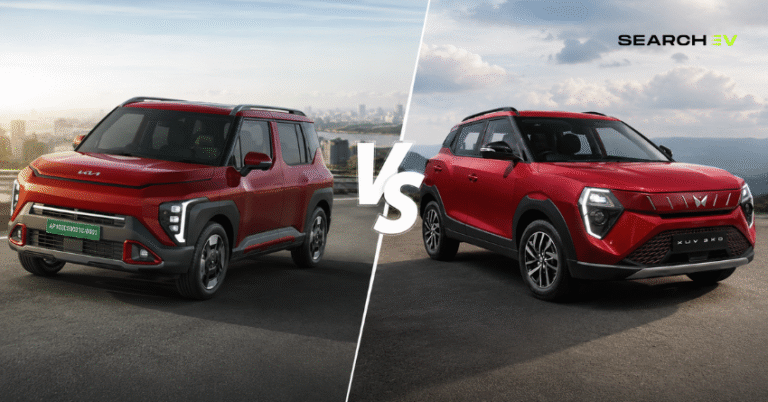
- Both models start at a similar price point, but the Kia Syros EV expands into higher price brackets since it offers a bigger battery upgrade option.
- The Syros EV has a claimed range of up to 526 km (51.4 kWh), compared to the XUV 3XO EV that offers a 456 km claimed range (39.4 kWh).
- The Syros EV can DC fast charge from 10% to 80% in just 39 minutes, while the XUV 3XO EV takes about 50 minutes.
- The Syros EV brings segment-first features like rear-seat ventilation.
Kia Syros EV vs Mahindra XUV 3XO EV: Price and Value Comparison
The Mahindra XUV 3XO EV, unlike its ICE counterpart, offers only two variant options, making the buying choice relatively simple. The Kia Syros EV, on the other hand, has many variant choices, enabling the buyer to choose between smaller and larger batteries.
| Trim Level / Variant | Kia Syros EV Price | Trim Level / Variant | Mahindra XUV 3XO EV Price |
| HTK (42 kWh) | Rs 13.49 Lakh | AX5 (39.4 kWh) | Rs 13.89 Lakh |
| HTK+ (42 kWh) | Rs 14.99 Lakh | AX7 L (39.4 kWh) | Rs 14.96 Lakh |
| HTX (42 kWh) | Rs 15.99 Lakh | — | — |
| HTK+ ER (51.4 kWh) | Rs 16.99 Lakh | — | — |
| HTX ER (51.4 kWh) | Rs 17.99 Lakh | — | — |
| HTX+ ER (51.4 kWh) | Rs 19.49 Lakh | — | — |
| X-Line ER (51.4 kWh) | Rs 19.99 Lakh | — | — |
The base Syros EV with a 42 kWh battery aligns closely in price with the entry-level XUV 3XO EV AX5. However, Mahindra caps its pricing at Rs 14.96 lakh for its fully loaded trim, whereas the Syros EV climbs up to Rs 19.99 lakh for its variants with the bigger 51.4 kWh battery pack.
Road Presence, Dimensions, and Practicality Comparison
Both SUVs sit within the sub-four-metre category, making them easy to park in busy city streets, but their interior layouts reflect different priorities.
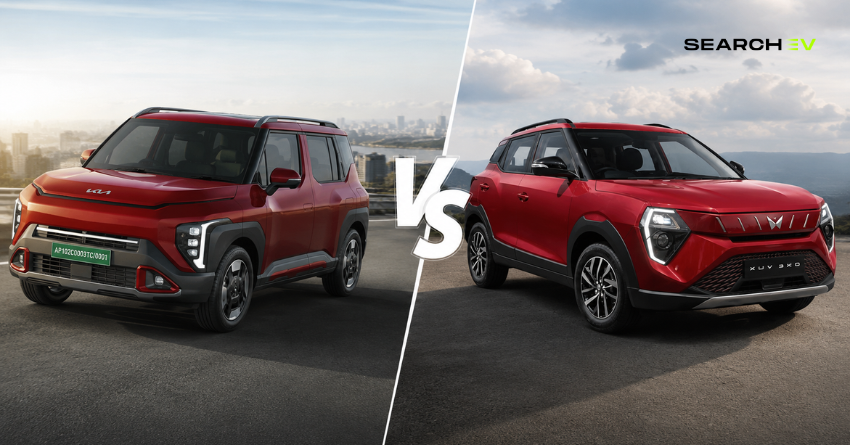
The Mahindra XUV 3XO EV has a more traditional compact SUV stance with a wider overall footprint, while the Kia Syros EV adopts a taller, boxier design, offering a more airy cabin feel.
| Dimension / Capacity | Kia Syros EV | Mahindra XUV 3XO EV |
| Overall Length | 3,995 mm | 3,990 mm |
| Overall Width | 1,805 mm | 1,821 mm |
| Overall Height | 1,680 mm | 1,653 mm |
| Alloy Wheel Size | 16-inch / 17-inch | 16-inch / 17-inch |
| Luggage Boot Space | 465 litres | 364 litres |
The Syros EV outshines the competition in terms of boot space, offering a large 465-litre boot. Its taller roofline also ensures that taller individuals get better headroom in the back row. The XUV 3XO EV, being slightly wider, can feel a bit more accommodating if you need to seat three people across the rear bench.
Kia Syros EV vs Mahindra XUV 3XO EV: Which EV Offers More Features?
Both cars come equipped with modern, tech-focused cabins featuring high-resolution screens and connected software, but they pack unique comfort additions.
| Feature Category | Kia Syros EV | Mahindra XUV 3XO EV |
| Infotainment Screen | 12.3-inch Touchscreen | 10.25-inch Touchscreen |
| Instrument Cluster | 12.3-inch Display | 10.25-inch Display |
| Panoramic Sunroof | Yes | Yes |
| Ventilated Seats | Front & Rear (Seat Base) | None |
| Audio System | 8-speaker Harman Kardon | 7-speaker Harman Kardon |
| Driving Safety | ADAS Level 2 | ADAS Level 2 |
Unique Highlights of the Kia Syros EV:
- Trinity Panoramic Display: A massive 30-inch curved panel that groups the driver display, infotainment, and climate controls together.
- Rear Seat Comfort: Sliding and reclining rear seats, along with a ventilation system (only seat base).
Unique Highlights of the Mahindra XUV 3XO EV:
- Dual-Zone Climate Control: Allows the driver and front passenger to set individual temperature preferences.
Performance, Range, and Charging Speed Comparison
Kia offers buyers the choice to extend range by stretching the budget, while Mahindra sticks to a single powertrain.
| Kia Syros EV | Mahindra XUV 3XO EV | |
| Battery Sizes | 42 kWh & 51.4 kWh | 39.4 kWh |
| Official Claimed Range | 443 km (42 kWh) / 526 km (51.4 kWh) | 456 km |
| Peak Power Output | 133 bhp (42 kWh) / 168 bhp (51.4 kWh) | 147.5 bhp |
| Peak Torque Output | 255 Nm | 310 Nm |
| Acceleration (0-100 km/h) | 8.1 seconds (51.4 kWh) | 8.3 seconds |
| Fast Charge Time | 10% to 80% in 39 minutes (100 kW) | 0% to 80% in 50 minutes (50 kW) |
The XUV 3XO EV delivers a strong 310 Nm of torque, which makes it feel sufficiently peppy and helps in quick overtakes in the city. However, the Syros EV takes the lead on long highway trips. Its 51.4 kWh variant offers a 526 km claimed range and supports faster 100 kW DC charging, getting you back on the road in 39 minutes.
Kia Syros EV vs Mahindra XUV 3XO EV: Which Electric SUV is the Better Buy?
Kia Syros EV Pros and Cons
- Pros: Top-tier 526 km claimed range; massive 465-litre boot; fast 39-minute charging times; sliding and reclining rear seats improve passenger comfort.
- Cons: The extended-range top trims ask for a notably higher budget; the boxy, tall-boy design might not appeal to all buyers.
Mahindra XUV 3XO EV Pros and Cons
- Pros: Very competitive pricing for its top variant; strong 310 Nm torque output makes it punchy to drive; includes premium features like dual-zone climate control.
- Cons: Only one battery option limits choices; slower 50 kW fast charging cap; boot space is smaller than some direct rivals.
Expert Take on the Best Electric SUV for You
If you want an electric vehicle that provides strong value, punchy city performance, and a feature-rich cabin without crossing the Rs 15 lakh mark, the Mahindra XUV 3XO EV is a smart, balanced choice. It covers all the essential family needs effectively.
However, in case you do not have any problem travelling out of the town and need additional boot space for baggage, then the Kia Syros EV would be a better choice. The increased size of its battery (51.4 kWh), ability to charge at 100 kW as well as the special features such as rear-ventilated seats will be an advantage for long highway journeys.