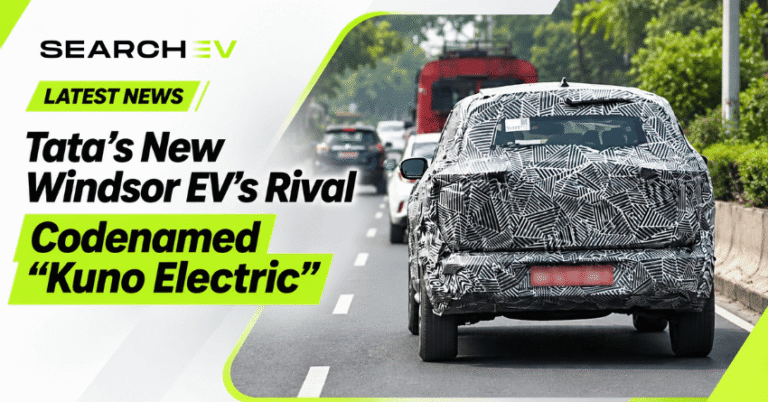
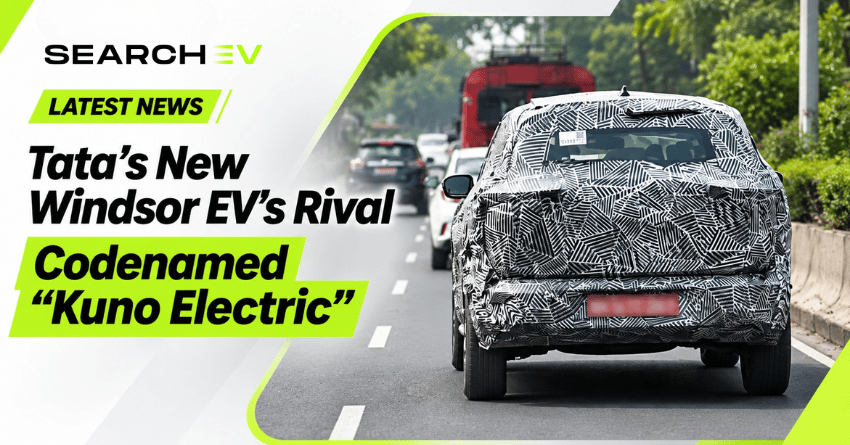
Over the past year and a half, the MG Windsor EV has outsold nearly every single electric car in the country, pulling family buyers away from traditional compact SUVs with a cabin that feels more like a living room than a hatchback on stilts. Tata now has a direct answer in development. Internally codenamed Kuno, this ground-up, 4.3-metre electric SUV is scheduled to reach showrooms between 2027 and 2028.
Kuno is only a project codename, the production model will wear a different badge, the brief behind it is clear. Tata is building a space-first, family-focused midsize crossover designed specifically to neutralise the Windsor EV’s biggest cabin advantages.
Why Tata Needs Another 4.3-Metre EV
Why build another 4.3-metre electric SUV when the company already sells the Nexon EV, the Curvv EV, and the Sierra EV?
The Nexon EV is boxed in by the sub-four-metre rule and an internal-combustion platform that leaves the rear floor slightly raised. Step up to the 4.3-metre Curvv EV, and you get a big 500-litre boot and a 55 kWh battery, but its sloping coupe roofline eats into rear headroom and shrinks the side glass area. The newly launched Sierra EV offers loads of presence and cabin volume, yet its higher starting price pushes it past the budget of many upgrade buyers.
MG exploited that exact gap. Priced between ₹14-19 lakh (ex-showroom), or starting at ₹9.99 lakh plus ₹3.99 per km under its Battery as a Service rental plan, the Windsor EV skipped rugged SUV styling altogether. Instead, it gave Indian families a long wheelbase, a dead-flat floor, rear seats that recline to 135 degrees, and up to 604 litres of boot space. Chauffeur-driven commuters and joint families bought it in primarily because if the back-seat comfort.
Platform and Packaging: Built Around the Back Seat
To beat a born-electric crossover on interior room, you cannot start with a converted petrol chassis. The Kuno will sit on Tata’s dedicated Acti.ev pure-electric architecture, the same underlying skateboard structure that underpins the Punch EV, Curvv EV, Harrier EV, and Sierra EV.
Acti.ev platform gives designers a completely flat cabin floor. While the exterior will measure roughly 4.3 metres, the Kuno will ditch the Curvv’s fastback tail and the Sierra’s upright, boxy off-road stance for a conventional, cab-forward SUV silhouette.
Expect a taller roofline over the second row, wider rear door apertures for elderly passengers, and a focus on knee room and under-thigh support. Under-thigh support has long been a sore spot in several floor-mounted EVs where the battery pack pushes the floor pan upwards. If Tata gets the seat-to-floor height right on the Kuno while matching the Windsor’s airy glasshouse, it will fix the single biggest complaint Indian buyers have with existing compact electric SUVs.
Inside the cabin, the Kuno is expected to draw heavily from Tata’s current parts bin, though Tata has not confirmed the final equipment list yet. Based on what already sits in the Curvv EV and Sierra EV, buyers can expect:
- Infotainment and displays: A large free-standing central touchscreen (likely 12.3 inches or larger) paired with a full digital instrument cluster.
- Comfort hardware: Ventilated front seats, a panoramic sunroof, dual-zone climate control, and reclining rear backrests.
- Safety and driver aids: Six airbags as standard, a 360-degree camera setup, electronic stability control, and Level 2 ADAS on top trims.
- Electrical features: Vehicle-to-Load (V2L) and Vehicle-to-Vehicle (V2V) bi-directional charging capability, which comes baked into the Acti.ev electrical architecture.
One of the Windsor EV’s most annoying quirks in daily traffic is that basic cabin functions, including headlight and AC adjustments, are buried inside its 15.6-inch touchscreen. Keeping tactile switches on the dashboard can be an easy win for Tata.
Expected Battery, Powertrain and Range
By 2027 to 2028, Tata’s electric showroom will have four models sitting in or around the sub-four-metre to 4.3-metre band. Kuno will slot right above the next-generation Nexon EV (internally codenamed Garud) and sit alongside the Curvv EV and Sierra EV as the sensible, family-first alternative.
Tata Motors has kept official battery capacities, motor outputs, and range figures for the Kuno under wraps, as the vehicle is still in its development phase.
Right now, the MG Windsor EV gives buyers two battery choices: a standard 38 kWh pack with a claimed range of 331 km, and a larger 52.9 kWh pack in the Pro variants that stretches claimed range to 449 km. Both versions use a front-mounted motor making 136 PS (134 bhp) and 200 Nm of torque, with DC fast charging peaking at 60 kW for a 20 to 80 percent top-up in 50 minutes.
For the Kuno to outgun the Windsor EV Pro on highway runs without pricing itself out of the segment, borrowing the Curvv EV’s powertrain is the most logical route:
- Likely base and mid-spec setup: A 45 kWh to 55 kWh battery pack paired with a front-axle-mounted electric motor. In the Curvv EV, the 55 kWh pack drives a 167 PS (167 hp), 215 Nm motor and delivers a certified MIDC range of 502 km, which translates to roughly 350 to 380 km on the road with the air-conditioning running.
- Upper-spec possibilities: If Tata wants to stretch the Kuno higher up the price ladder, the Sierra EV’s 65 kWh battery pack (535 km claimed range) with a single rear-mounted motor producing 209 hp and 315 Nm is also compatible with the platform. A dual-motor AWD setup (349 hp and 504 Nm in the Sierra EV) is technically supported by the chassis, though highly unlikely for a value-focused family crossover.
Sanand Production Plans, Timeline and Expected Price
Perhaps the biggest clue to how seriously Tata is taking the Kuno lies in its planned factory allocation. The SUV is slated to roll out of Tata Motors’ Sanand plant in Gujarat, the former Ford India manufacturing facility that Tata acquired and retooled for high-volume passenger vehicles and EVs.
Internal planning points to an annual production capacity target of 80,000 to 1,00,000 units for the Kuno programme. Break that down by the calendar, and Tata is gearing the assembly line for 6,600 to 8,300 units a month, more than double what the MG Windsor EV averages today and higher than the combined monthly run rate of the Curvv EV and Harrier EV. While Tata Motors has not officially confirmed the plant allocation or volume targets yet, setting aside that kind of capacity at Sanand signals two possibilities: either Tata expects the Kuno to become its primary volume driver above the Nexon EV, or the body shell is also being engineered to accommodate export markets or multi-energy derivatives down the road.
The Kuno forms a core pillar of the product offensive Tata outlined at its Investor Day in June 2026, where the company committed to expanding its electric car portfolio from six nameplates to 10 models by FY2031. Alongside Kuno, that roadmap includes the next-generation Nexon EV (Garud), the three-row Safari EV, and the premium Avinya range.
As for pricing, Tata will have to price the Kuno aggressively if it wants to unseat the Windsor EV. The Kuno will almost certainly need a starting sticker around ₹15 lakh (ex-showroom), with top-spec 55 kWh variants topping out near ₹19.50 lakh.
What SearchEV Thinks
Tata Motors built its early electric lead by converting familiar petrol cars into EVs before anyone else showed up. Now that MG, Mahindra, and Maruti Suzuki (with the e Vitara) are fighting for every family buyer under ₹20 lakh, one size no longer fits all.
Still, 2027 to 2028 is a long wait in a segment moving this fast. By the time the Kuno hits the road, the MG Windsor EV will have had more time to cement its foothold, and rivals from Mahindra, Hyundai, and Kia will have matured too.