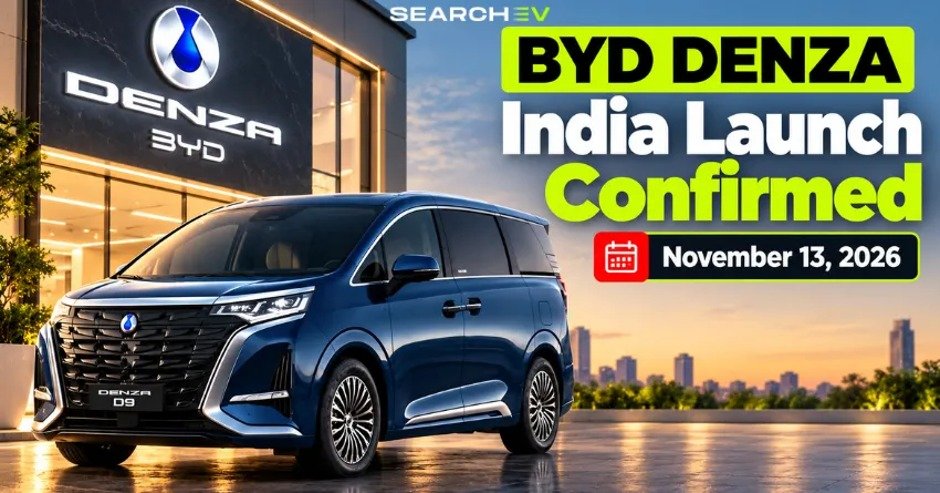
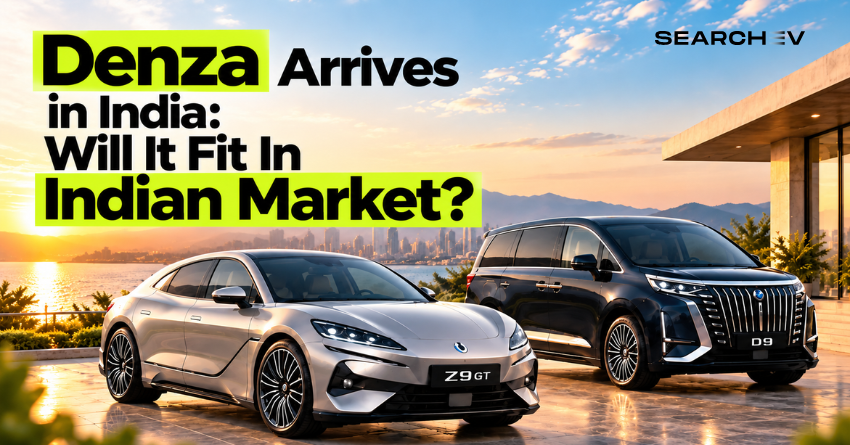
For the past three years, BYD has played a measured game in India. With models like the Atto 3, Seal, Sealion 7, and eMax 7, the Shenzhen-based manufacturer positioned itself as a tech-heavy alternative to mainstream badge-engineered EVs between Rs 25 lakh and Rs 55 lakh. On 13 November 2026, that strategy moves several rungs up the ladder. BYD has officially confirmed that its luxury marque, Denza, will make its Indian debut on that date.
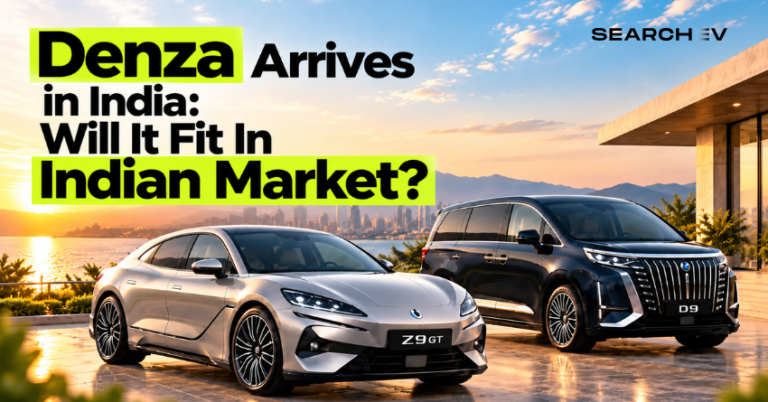
Moving into the Rs 80 lakh to Rs 1.50 crore bracket is a very different proposition from selling mid-size electric crossovers. Buyers in this territory are notoriously loyal to European heritage badges like Mercedes-Benz and BMW or Japanese reliability (Lexus and Toyota’s flagship products). Denza plans to open its Indian innings with two models at opposite ends of the luxury spectrum: the chauffeur-focused Denza D9 luxury MPV and the 1,156 hp Denza Z9 GT electric shooting brake.
The question is simple. Can a Chinese luxury badge with almost no recognition in India convince luxury-driven buyers to walk past an MG M9 or a Toyota Vellfire? Let’s break this down.
Who Is Denza?
A Mercedes-Benz Marriage That BYD Had to Fix Himself
Denza is older than most people assume. It started in May 2010 as a 50:50 joint venture agreement in Shenzhen between BYD and Germany’s Daimler AG (now Mercedes-Benz Group). At the time, it was China’s first Sino-foreign joint venture dedicated entirely to new-energy vehicles. BYD supplied the battery chemistry and electric drive units, while Daimler contributed chassis tuning, safety engineering, and cabin ergonomics.
The Denza name was announced two years later, and the first car, an electric model built on shared know-how, was revealed at the 2014 Beijing motor show.
It did not go well. Sales were thin for most of the decade, and the product pipeline was slow. In a deal announced at the end of 2021, Mercedes cut its stake to 10 per cent, and BYD took 90 per cent. Under BYD’s direct product planning, Denza relaunched itself in May 2022 with the D9 luxury MPV. Sales took off almost immediately. By September 2024, BYD bought out the remaining 10 per cent equity held by Mercedes-Benz, making Denza a fully owned subsidiary.
What Denza sells
The turnaround came with one car. The D9 MPV went on sale in China in August 2022 and quickly became the brand’s backbone. Since then the line-up has grown to include many vehicles.
Globally, Denza organises its domestic line-up around an alphabetical naming system:
- The ‘D’ Series (MPVs): Anchored by the Denza D9, which surpassed 300,000 cumulative global deliveries in late 2025.
- The ‘N’ Series (SUVs): Includes the mid-size N7 electric crossover, the three-row N8 and N8L, and the full-size flagship N9 luxury SUV.
- The ‘Z’ Series (Saloons and Grand Tourers): Led by the Z9 GT shooting brake, the Z9 three-box saloon, the Z9S, and the newly revealed two-door Denza Z electric sports car.
- The ‘B’ Series (Export Off-Roaders): In select overseas right-hand-drive markets such as Hong Kong, Australia, and Southeast Asia, BYD also retails rugged plug-in hybrid SUVs from its Fangchengbao sister brand under the Denza badge, sold as the Denza B5 and Denza B8.
Where Denza operates
China remains the core market. Outside it, Denza moved first into Southeast Asia, with the D9 arriving in Indonesia in January 2025 and Malaysia in February 2025, along with markets such as Thailand, Cambodia and Hong Kong. Australia and the Middle East followed. In Europe the brand held a formal launch at the Palais Garnier in Paris in April 2026, with an initial rollout planned for Germany, France, Italy, Spain and the UK. It has also shown the Z9 GT and D9 in Brazil. Daniel Craig was signed as the global brand face in March 2026, which tells you how seriously BYD is taking the badge.
Denza’s India Plan: Models and Target Segment
Both the D9 luxury MPV and the Z9 GT shooting brake will be imported as completely built units, and India will get only the all-electric versions. The plug-in hybrids are sold in China, but electric cars attract just 5 per cent GST in India, which makes a PHEV much harder to price competitively.
Positioning is clear. BYD will keep its own badge in the Rs 20 lakh to Rs 80 lakh space, while Denza takes over from roughly Rs 80 lakh upwards. The D9 will square off directly against luxury people-movers like the MG M9 and the Toyota Vellfire, while offering a tech-rich alternative to the cheaper diesel Kia Carnival and the ultra-expensive Lexus LM. The Z9 GT, meanwhile, will go up against high-performance German EVs such as the Porsche Taycan, Audi e-tron GT, and BMW i5 M60.
It will also get its own showrooms, separate from BYD dealerships, and the early footprint is expected to cover only Delhi-NCR and Mumbai.
Denza D9: Overview, Specifications, and Market Rivals
The D9 is a full-size luxury MPV built around its second row and is Denza’s commercial backbone. In China, it accomplished something many industry analysts thought impossible: it ended the two-decade reign of the Buick GL8 to become the country’s highest-selling MPV for three straight years, accounting for roughly 60 per cent of China’s high-end new energy MPV market.
The India-bound D9 is expected to come in front-wheel-drive electric form. A single front motor makes 313 hp and 360 Nm, drawing from a 103 kWh Blade LFP battery. The claimed WLTP range is 520 km, and DC fast charging peaks at 200 kW.
Measuring 5.25 metres from nose to tail, the D9 makes no attempt to hide its boxy, slab-sided MPV proportions. Inside, the D9 follows a 2+2+3 seven-seat layout engineered around the second row. Key equipment highlights include:
- Second-Row Zero-Gravity Captain’s Chairs: Upholstered in Nappa leather, featuring power adjustment, heating, ventilation, and multi-point massage functions.
- 5.5-inch Touchscreen Integrated Armrest Displays
- On-Board Refrigerator
- 15.6-inch central infotainment touchscreen running Denza Link software
- 10.25-inch digital driver’s instrument cluster
- 12-inch head-up display (HUD)
- 14-speaker Dynaudio surround sound system
- 360-degree camera system and a full Level 2 ADAS suite
Expected price and rivals
The Denza D9 is expected to be priced at around Rs 80 lakh to Rs 1.05 crore (ex-showroom) in India. At that price point, it carves out a middle ground between the MG M9 (Rs 79.95 lakh to Rs 84.94 lakh) and the Toyota Vellfire (Rs 1.20 crore to Rs 1.30 crore), while sitting a full segment above the diesel Kia Carnival (Rs 59.65 lakh to Rs 63.90 lakh).
Denza D9 vs MG M9: The All-Electric Luxury MPV Battle
Until now, JSW MG Motor India had the Rs 80 lakh electric MPV niche entirely to itself with the MG M9 (sold globally as the Maxus Mifa 9). With the arrival of the Denza D9, Indian buyers looking for a zero-emission luxury van will finally have two direct Chinese-engineered contenders to weigh against each other.
The MG M9 is a rebadged Maxus Mifa 9 from SAIC Motor. Maxus built its reputation in China and Europe primarily on commercial vans and fleet people movers before moving upmarket with the Mifa 9. Denza, by contrast, benchmarked the D9 against the Toyota Alphard and Mercedes-Benz V-Class from its very first sketch.
Will the Denza D9 Be a More Sensible Luxury Electric MPV Purchase?
On paper, the M9 is the bigger car. It is 20mm longer, 40mm wider and has a 90mm longer wheelbase. However, the D9 is expected to pull forward on the mechanical front, with a bigger battery, more power, and faster charging, as well as more real-world range.
There is a chemistry difference too. The D9 uses LFP cells, which tend to tolerate frequent full charges and heat well. The M9 uses NMC, which packs more energy for its weight. MG offers a lifetime battery warranty on the M9. Denza’s India warranty terms are not yet known.
In terms of features, the M9’s Presidential seats offer 16-way power adjustment, heating, ventilation, massage, fold-out ottomans and touchscreen controls in the armrests, making the second-row experience extraordinary. The D9 is expected to match most of those features, however, it will feature a more state-of-the-art digital experience, as the brand Denza was benchmarked against the Toyota Alphard/Vellfire from day one, so its dashboard architecture will feel closer to a luxury saloon.
Is Denza’s Luxury Status Enough to Triumph MG’s Network Advantage?
MG has priced the M9 aggressively in India at Rs 79.95 lakh for the Presidential Limo and Rs 84.94 lakh for the limited Couture Edition. At an estimated Rs 90 lakh (ex-showroom), the Denza D9 will command a Rs 5 lakh to Rs 10 lakh premium over the standard MG M9.
However, MG’s head start with its MG Select retail footprint gives the M9 an early distribution advantage that BYD will have to match quickly. As far as the badge value is concerned, while Denza is still an unknown brand in India, Denza can carry the weight of a luxury badge, as the brand will only sell premium vehicles around the Rs 1 crore and beyond price range. BYD will have to market the Denza brand accordingly, and it can take some time to build that presence. A sophisticated, luxury dealership experience akin to European luxury stalwarts will be a key requirement here as well.
On the other hand, MG is a brand that majorly retails mass-market offerings with few premium exceptions, though brand familiarity and trust are higher here as of now. Plus, MG’s premium products, including both the M9 and Cyberster, have consistently sold in good numbers in terms of luxury car numbers, which do reflect the trust the brand has garnered in the NEV market.
Denza D9 vs Toyota Vellfire: Tech Disruptor vs the Established Status Symbol
If the MG M9 is the D9’s closest mechanical peer, the Toyota Vellfire is its primary philosophical target. Across Asia, the Vellfire (and its sister car, the Alphard) is the undisputed king of luxury people-movers. In India, the Vellfire is less of a car and more of a rolling boardroom for industrialists, film stars, and political heavyweights.
When the Denza D9 comes to India, it is the bigger vehicle in almost every direction compared to the Vellfire. Because Toyota designs the Alphard and Vellfire around Japanese urban parking garage regulations.
Denza D9’s Silent Electric Powertrain vs Toyota’s Hybrid System: A Double Edged Sword?
The Vellfire uses a 2.5-litre petrol engine with a hybrid system. The D9 has more power on paper in comparison and offers a silent electric ride, however, the Vellfire will never need a charger, and its 19.28 kmpl ARAI-rated efficiency (roughly 14 to 16 kmpl in the real world) gives it an effortless 800 km to 900 km highway tank range. A Mumbai to Pune run, or Delhi to Jaipur, involves no planning at all. With the D9, a 520 km WLTP claim should mean a comfortable intercity range, but real-world figures will be lower with a full cabin and the air conditioning running hard.
Who Will Trade a Toyota for a Denza?
In Singapore, the Denza D9 is priced slightly higher than the Toyota Alphard, yet buyers still line up for it. In India, the pricing dynamics flip heavily in Denza’s favour.
Price is where the Denza D9 makes its strongest business case. The Toyota Vellfire is priced between Rs 1.20 crore and Rs 1.30 crore (ex-showroom), which translates to Rs 1.40 crore to Rs 1.60 crore on-road depending on state registration taxes. On top of that price tag, the Vellfire regularly commands waiting periods of 12 to 14 months in India.
Expected at around Rs 90 lakh (ex-showroom), along with lower road tax on EVs in several Indian states, the Denza D9 could undercut the Vellfire by Rs 40 lakh to Rs 55 lakh on-road.
Will old-money industrialists ditch their Vellfires overnight? Unlikely. In India, paying Rs 1.50 crore for a Toyota badge is part of the social theatre. In fact, the Velfire crossed 5,000 cumulative sales in India in May 2026, and it is the default choice for business owners, politicians and film personalities.
Instead, expect the D9 to follow the Hong Kong pattern: five-star hotel fleets, tech founders, and existing Vellfire owners looking for a silent, instantly available second MPV for daily city runs will be the first to sign the cheque.
What SearchEV Thinks
Denza’s India entry is a smart, cautious move. BYD cannot expand freely here because of investment restrictions, so it is doing the next best thing: importing small volumes of high-margin cars into segments where competition is thin.
BYD’s decision to bring Denza to India on 13 November with the D9 and Z9 GT is the boldest move by a Chinese carmaker in our market to date. The Z9 GT will grab all the social media reels, spinning around its front wheel at launch events and terrifying supercars at traffic lights. Yet the Denza D9 is the car that truly matters for BYD’s bottom line in India.
The D9 has a sales record in China that few luxury cars can match. Price is the deciding factor. If they slot the D9 in around Rs 90 lakh, BYD they are essentially offering a vehicle that beats the MG M9 on battery chemistry, range, and cabin polish, while delivering more space than the Toyota Vellfire’s at a Rs 40 lakh to Rs 50 lakh on-road discount.
But specifications do not sell cars in this segment. Trust does. Vellfire buyers pay a premium for Toyota’s reliability, service reach and resale value, and none of those can be shipped from China. The M9 has a year’s head start and an established dealer network. Denza will begin with a few showrooms in two cities and no track record in India at all.
The Z9 GT is a fascinating machine, but in India it is mostly a talking point. Its fastest charging trick does not work here, and its likely buyers are the same people who might already own a Porsche.
If BYD gets the showroom experience right and keeps the D9 priced sensibly around Rs 90 lakh, India’s luxury MPV segment is in for a genuine shake-up on 13 November. Toyota’s Vellfire may keep the old-guard status hunters, but the smart money in the back seat will be looking very closely at Denza.