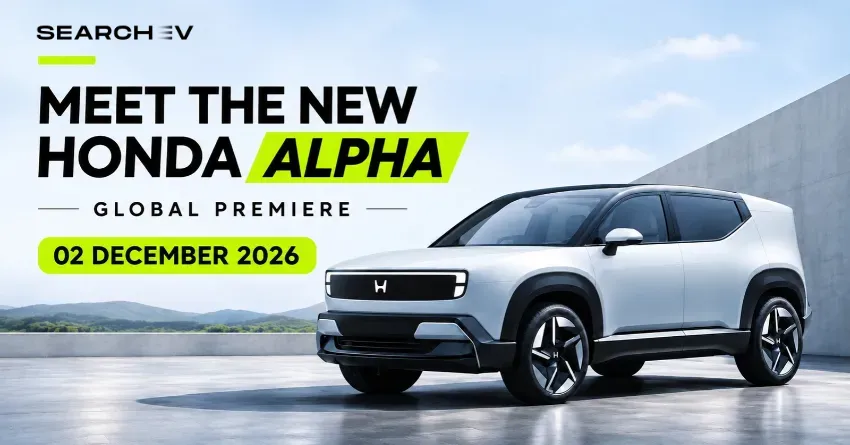
Honda Cars India has officially named its first battery electric SUV the Honda Alpha. Dropping the numerical prefix from the 0 Alpha concept shown at the Japan Mobility Show in October 2025, the production model will make its global debut in India on December 2, 2026. The Honda Alpha Electric SUV will be the brand’s first made-in-India electric SUV, and moreover, India will be the debut market worldwide for the midsize electric SUV, with showroom deliveries expected to begin in the first quarter of 2027.
Why Honda Chose the Alpha Name and the New H Mark
Derived from the first letter of the Greek alphabet, the Alpha nameplate was selected to represent a new starting point for the brand and its buyers. Honda states that the vehicle has been engineered to fit into both city traffic and outdoor environments.
The official teaser also marks a visual change for the Japanese carmaker in India. The Alpha will be the first Honda model in the country to wear the company’s redesigned, frameless H emblem. Honda first adopted the H badge for its cars back in 1963 and has updated the logo several times over the decades. This latest version was created for Honda’s global electric vehicle business to signal a break from its combustion engine past.
Tapukara Plant to Serve as the Global Production Hub
Rather than importing its first electric vehicle or assembling knocked-down kits, Honda will build the Alpha locally at its Tapukara manufacturing facility in Rajasthan. Toshiyuki Yanagisawa, President and CEO of Honda Cars India, confirmed that India will serve as the global production base for the SUV. Beyond catering to domestic buyers, the Rajasthan plant will export the electric SUV to Japan and other right-hand-drive markets.
Platform, Expected Battery Options, and Powertrain
Honda did not release technical specifications in today’s announcement, so exact power and range numbers will remain under wraps until the December 2 unveil. However, earlier company briefings and industry reports give a clear picture of what sits underneath the bodywork.
The Alpha is built on Honda’s born electric architecture developed under the Thin, Light, and Wise engineering approach. By using a slim underfloor battery pack and a compact e Axle drive unit, engineers kept the floor height low without sacrificing ground clearance or cabin headroom.
For the Indian market, the Honda Alpha is expected to offer two Lithium Iron Phosphate battery pack options ranging between 65 kWh and 75 kWh. That battery capacity should allow the larger variants to deliver a claimed driving range of more than 500 kilometres on a single charge, backed by DC fast charging capabilities as well. At launch, the SUV is expected to use a single front axle-mounted electric motor in a front-wheel-drive layout.
Exterior Styling, Cabin Layout, and Features
Prototypes caught testing show that the production model stays close to the boxy, upright proportions of the 2025 Tokyo concept. Up front, the SUV gets a flat bonnet, a closed-off grille panel housing the illuminated new H badge, and full-width LED daytime running lights. Squared wheel arches, 18-inch aero-style alloy wheels, a front fender-mounted charging flap, and a nearly vertical tailgate with a roof spoiler round out the exterior. The overall length will sit in the 4.3 to 4.4-metre midsize SUV bracket.
Spy shots of the interior point to a clean dashboard layout led by a freestanding landscape central touchscreen and a separate rectangular digital driver display. Expected equipment on higher trims includes a panoramic glass roof, ventilated front seats, dual zone automatic climate control, wireless smartphone integration, and the Honda Sensing Level 2 advanced driver assistance suite.
Conclusion (What SearchEV Thinks)
Honda took its time entering the Indian electric vehicle race, even shelving earlier plans for a simpler Elevate-based EV to focus on a dedicated, born electric platform. More importantly, making the Tapukara factory the global export hub gives Honda the manufacturing scale it needs to localise components and keep costs in check.
Expected to be priced between Rs 17 lakh and Rs 24 lakh ex-showroom, the Honda Alpha will step straight into the most crowded battleground in the Indian electric car market. It will compete directly against the Hyundai Creta Electric, Maruti Suzuki e Vitara, Toyota eBella, MG Windsor EV, Tata Sierra EV, Tata Curvv EV, and Mahindra BE 6.
If Honda pairs its expected 65 to 75 kWh LFP battery options with sensible pricing, the Japanese automaker will finally have a serious contender in India’s electric SUV segment.