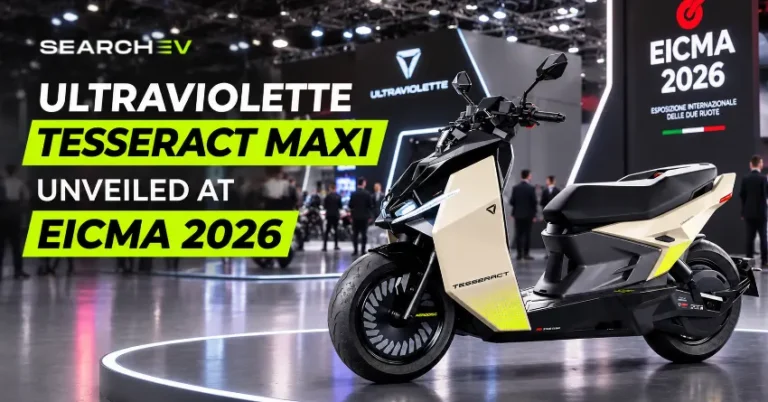
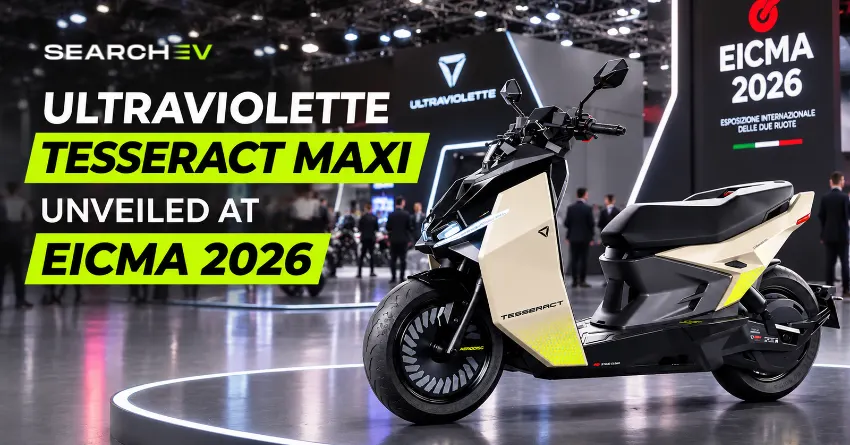
Bengaluru-based electric two-wheeler maker Ultraviolette Automotive has taken the wraps off the Tesseract Maxi at the EICMA 2026 motorcycle show in Milan. Making its European debut alongside the new X47 Venom crossover motorcycle, the electric maxi scooter previews the upgraded hardware that will head into production in early 2027. The Milan showcase features a 20 bhp electric motor, a 100-volt electrical platform, dual radars, front and rear cameras, and Type 2 onboard charging support.
100V Powertrain, Battery Range, and Type 2 Charging
At the heart of the Tesseract Maxi is a 15 kW electric motor, making it the most powerful electric scooter built by an Indian manufacturer. That output allows the scooter to reach a claimed top speed of 125 kilometres per hour, putting its highway performance on par with 150cc to 160cc petrol maxi scooters.
The EICMA display model carries a 6 kWh battery pack. While Ultraviolette has not yet published an official European WLTP range figure from the Milan floor, the 6 kWh pack is rated for a claimed 261 kilometres on the Indian Driving Cycle, which translates to a realistic range of roughly 180 to 200 kilometres in everyday mixed riding conditions. In India, the scooter will also be sold with smaller 3.5 kWh and 5 kWh battery options rated at 162 kilometres and 220 kilometres of claimed IDC range.
Moving to a 100-volt electrical system also speeds up charging and improves heat management during sustained highway runs. The scooter gets an integrated onboard charger that supports standard Type 2 AC public charging sockets, a feature first seen on the brand’s X47 motorcycle platform. Using fast charging hardware, the 6 kWh battery can be topped up to 80 per cent in less than an hour, while Ultraviolette’s Supernova fast chargers can take the pack from 20 per cent to 80 per cent in under 30 minutes.
Dual Radars, Cameras, and Adaptive Cruise Control
Safety and rider assistance form the core pitch of the Tesseract Maxi. Unlike standard scooters that rely purely on mechanical brakes, the Tesseract integrates front and rear radar sensors under Ultraviolette’s Hypersense suite, paired with dual front and rear dashcams.
This sensor array works alongside Omnisense mirrors that house multi-colour LED warning lights inside the glass. Together, the dual radars and cameras power a full package of rider aids:
- Adaptive cruise control for steady highway touring
- Blind spot detection and lane change assist
- Overtaking alerts and real-time front and rear collision warnings
- Smart dashcam recording that reads road and weather conditions
Cockpit duties are handled by a 7-inch full-colour touchscreen TFT console. The screen supports onboard navigation, ride telemetry, and the company’s Violette AI voice assistant developed in partnership with SoundHound AI. Standard electronic aids include dual-channel ABS, two traction control modes, four levels of dynamic regenerative braking, hill hold control, and park assist.
14-inch Wheels, Storage, and Touring Hardware
To match its 20 bhp output, the Tesseract Maxi rides on 14-inch alloy wheels shod with 110/80 front and 140/70 rear tubeless tyres. Stopping power comes from disc brakes at both ends. The larger wheel diameter and long travel suspension are tuned to handle broken city tarmac as well as higher cruising speeds.
Despite housing the 6 kWh battery and onboard charging hardware, the scooter retains a 32 to 34 litre underseat storage compartment capable of holding a full-face helmet. At EICMA, Ultraviolette also displayed a factory touring accessory kit for the Tesseract Maxi, adding a tall touring windscreen, handguards, a rear tail bag, and mounting racks for side panniers.
2027 Launch Timeline and Indian Market Context
Customer deliveries of the Ultraviolette Tesseract are scheduled to begin in India in the first quarter of 2027, starting in January, with European sales following later in 2027. For the Indian market, Ultraviolette has promised to honour its previously announced pricing for existing reservation holders, where standard ex-showroom prices start at Rs 1.45 lakh for the 3.5 kWh base trim and go up to around Rs 2.00 lakh for the 6 kWh version.
Why the EICMA Reveal Matters for Indian Buyers
Ultraviolette first showed the Tesseract concept in India in March 2025 and gathered more than 70,000 pre-bookings on the back of an aggressive introductory price. Deliveries were originally scheduled for early 2026. In May 2026, however, the company pushed the Indian launch window to January 2027.
That delay happened because engineers ran into space and thermal limits on the original prototype. Keeping the promised 15 kW motor output on a conventional voltage setup would have forced a major cut to the underseat storage bay, while keeping the big boot would have meant dropping peak power down to 10 kW. Instead of compromising on either front, Ultraviolette redesigned the scooter from scratch around a new 100-volt architecture called VX 100. The Tesseract Maxi shown at EICMA 2026 is the result of that ground-up engineering overhaul.
Conclusion (What SearchEV Thinks)
Pushing the Tesseract launch to 2027 was a risky call by Ultraviolette, especially with more than 70,000 Indian buyers waiting in the queue. Yet the EICMA 2026 reveal of the Tesseract Maxi shows why the company chose to wait. Packing 20 bhp, a 6 kWh battery, Type 2 onboard charging, and a 32-plus-litre boot into a scooter frame without overheating required a 100-volt architecture. While features like dual radars, dashcams, and adaptive cruise control sound like overkill for a city runabout, they make a lot more sense on a 14-inch wheeled maxi scooter capable of cruising at 125 kilometres per hour. If Ultraviolette hits its January 2027 delivery target in India without raising prices, the Tesseract will sit in a performance class of its own above regular family scooters like the Ather Rizta, TVS iQube, and Bajaj Chetak.