When people think about buying an electric vehicle, the battery is the one thing that worries them the most. It is expensive. It degrades over time. And replacing it costs a lot of money. This is exactly the problem that Battery as a Service—or BaaS—is trying to fix.
BaaS is a model where you buy the electric vehicle without the battery. Instead of purchasing the batteries, you may utilize it for a monthly membership fee. The company owns the battery, takes care of it, and replaces it when needed. You just pay and ride.
It sounds simple, and honestly, it is. But there is a lot more to it than just splitting the cost. Let us go through everything from scratch.
What is Battery as a Service (BaaS)?
Battery as a Service is a business concept in which the cost of an electric vehicle’s battery is not included in the cost of the vehicle. You pay a reduced price for the scooter, bike, or automobile since the battery is not included. Instead, you subscribe to the battery individually and spend the monthly or per-km price. Consider the way you pay for mobile internet plans. You buy the phone once, and you pay monthly for the service that keeps it running. BaaS works the same way. You buy the vehicle once, and you pay monthly for the battery that keeps it going.
The company that provides the battery takes full ownership and responsibility. If the battery degrades, they replace it. If something goes wrong, they handle it. You never have to worry about battery health or replacement costs.
How Does BaaS Actually Work?
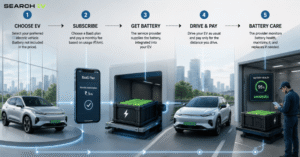
It’s an easy process. In real life, it works like this:
Step 1: Buy the vehicle without a battery
You might be able to purchase the EV for less money up front because the battery is not included. The savings can be anywhere from 20% to 40% of the total vehicle cost, depending on the battery size.
Step 2—Subscribe to the battery
You sign up for a monthly subscription plan with the BaaS provider. Plans are usually based on how many kilometers you ride per month. The more you ride, the higher the plan. Not every brand works this way: Tata, MG, Maruti, Kia, Toyota, Citroen and Hero Vida charge per kilometre, while TVS sells flat monthly plans with unlimited kilometres over 12 to 60 months.
Step 3 — Get the battery installed or swapped (Only valid for 3-wheelers or removable battery scooters)
For two-wheelers, the battery is often a swappable unit. You ride to a swap station, drop off the discharged battery, and pick up a fully charged one in under two minutes. For four-wheelers, the battery is installed once and monitored remotely.
Step 4 — Pay monthly and ride
Every month you pay the subscription fee. The company monitors battery health remotely. When the battery degrades beyond a certain level, they replace it at no extra cost to you.
Why Does BaaS Make Sense for Indian Buyers?
The biggest barrier to EV adoption in India is the upfront cost. A lot of that cost is the battery. Remove the battery from the price tag and suddenly the EV becomes much more affordable.
Here is a simple example. The Tata Punch EV starts at around Rs 9.69 lakh. Under a BaaS model, the upfront price drops by around Rs 3.20 lakh and you pay Rs 2.6 per km for the battery instead. For someone who drives 40 to 50 km daily for work, this makes total financial sense. Lower upfront cost, predictable monthly expense, and zero stress about battery degradation or replacement.
Benefits of BaaS
1. Lower purchase price
This is the biggest one. Removing the battery from the purchase price brings the vehicle cost down significantly. This opens up EV ownership to a much larger group of buyers.
2. No battery replacement worry
Battery replacement is the most expensive thing that can happen to an EV owner. Under BaaS, this is completely the company’s problem. You never pay for a replacement. (To see what an outright replacement would cost, read our EV battery replacement cost guide.)
3. Battery is always in good condition
The company monitors battery health regularly. If performance drops, they swap it out. You always get a battery that works properly.
4. Flexibility
If you sell the car or change to a new car model, just discontinue your membership. You don’t have to be concerned about the battery’s fate or how it will affect its resale value.
5. An increase in the car’s market worth
The car’s resale value is more stable and predictable when there is no battery deterioration.
Challenges of BaaS in India
BaaS is a great idea, but it comes with some real challenges too.
1. Subscription cost over time
If you keep the vehicle for 7 to 8 years, the total subscription amount can actually exceed what you would have paid for the battery outright. It is important to do the math before committing.
2. Dependency on the company
If the BaaS provider shuts down or exits the market, you are left with a vehicle and no battery. This is a real risk in India, where many startups have come and gone.
3. Availability is still uneven
BaaS has spread quickly. As of October 2026, cars from MG, Tata, Maruti, Kia, Mahindra, Toyota and Citroen come with a BaaS option, as do two-wheelers from Hero Vida, TVS, Ultraviolette, Royal Enfield and Bounce, plus many commercial vehicles. But availability still varies by city and variant, and some plans aren’t offered in every region.
4. Compatibility issues
Battery swapping only works if the battery design is standardised. Right now, every brand has its own battery design, which means you can only swap at that brand’s stations.
5. Fine print
Check whether your plan has a minimum monthly charge, and what happens if you stop driving, sell the vehicle or end the plan early. For example, launch coverage of Tata’s Rs 2.6 per km plan differs on whether a minimum of about 60 km a day (a fixed Rs 4,680 a month) applies, so ask for the terms in writing.
All Vehicles Available with BaaS in India (2026)
Four-Wheeler BaaS Vehicles
| Vehicle | Normal Price | BaaS Price | Saving | Battery Subscription |
|---|---|---|---|---|
| Mahindra BE 6 SPORTEQ ONE (59 kWh) | Rs 19.45 lakh | Rs 11.45 lakh | Rs 8 lakh | Rs 3.75 per km |
| Mahindra BE 6 SPORTEQ TWO (59 kWh) | Rs 20.95 lakh | Rs 12.95 lakh | Rs 8 lakh | Rs 3.75 per km |
| MG Windsor EV (38 kWh) | Rs 14.10 lakh | Rs 9.99 lakh | Rs 4.10 lakh | Rs 3.9 per km |
| MG Windsor EV Exclusive Pro (52.9 kWh) | Rs 15.53 lakh | Rs 11.14 lakh | Rs 4.39 lakh | Rs 4.5 per km |
| MG Comet EV | Rs 7.63 lakh | Rs 4.99 lakh | Rs 2.64 lakh | Rs 3.2 per km |
| NEW Tata Tiago EV (19.2 kWh Smart) | Rs 6.99 lakh | Rs 4.69 lakh | Rs 2.30 lakh | Rs 2.6 per km |
| Tata Punch EV (30 kWh Smart) | Rs 9.69 lakh | Rs 6.49 lakh | Rs 3.20 lakh | Rs 2.6 per km |
| NEW Citroen eC3X (29.2 kWh) | Rs 11.99 lakh | Rs 6.29 lakh | About Rs 5.3 – 5.7 lakh (reports differ) | Rs 2.26 per km |
| Maruti eVitara (49 kWh) | Rs 15.99 lakh | Rs 10.99 lakh | Rs 5.00 lakh | Rs 3.99 per km |
| Maruti eVitara (61 kWh) Alpha | Rs 19.79 lakh | Rs 14.29 lakh | Rs 5.50 lakh | Rs 4.39 per km |
| NEW Toyota Urban Cruiser Ebella (61 kWh E3) | Rs 23.60 lakh | Rs 15.25 lakh | Rs 8.35 lakh | Rs 4.99 per km |
| Kia Carens Clavis EV (42 kWh) | Rs 17.99 lakh | Rs 12.84 lakh | Rs 5.15 lakh | Rs 3.3 per km |
Note: Prices are approximate and may vary by city and variant. Always confirm with your dealer before purchase.
Updated October 2026: we added the Tata Tiago EV (May 2026 facelift), Citroen eC3X (June 2026) and Toyota Urban Cruiser Ebella, replacing the MG ZS EV, MG Windsor EV Essence Pro and Kia Carens Clavis EV (51.4 kWh) rows. Launch reports for the eC3X differ (some quote Rs 10.25 lakh normal and Rs 6.89 lakh BaaS), so confirm with Citroen. Toyota has so far published BaaS pricing for the top E3 variant only.
Two-Wheeler BaaS Vehicles
| Vehicle | Normal Price | BaaS Price | Saving | Battery Subscription |
|---|---|---|---|---|
| Hero Vida VX2 Go | Rs 99,490 | Rs 59,490 | Rs 40,000 | Rs 1.24 per km |
| Hero Vida VX2 Plus | Rs 1,09,990 | Rs 64,990 | Rs 45,000 | Rs 0.90 per km |
| NEW TVS Orbiter V1 (1.8 kWh) | Rs 84,500 | Rs 49,999 | Rs 34,501 | From Rs 862 per month, unlimited km (12 to 60 month plans) |
| NEW TVS Orbiter V2 (3.1 kWh) | Rs 99,900 | Rs 59,664 | Rs 40,236 | From Rs 1,155 per month, unlimited km |
| NEW Royal Enfield Flying Flea C6 | Rs 2.79 lakh | Rs 1.99 lakh | Rs 80,000 | Not stated in launch coverage |
| Hero Vida V2 Pro | Rs 1,34,990 | Rs 94,990 | Rs 40,000 | Rs 1.5 per km |
| Ultraviolette X-47 | Rs 2.50 lakh | Rs 1.49 lakh | Rs 1.01 lakh | Rs 2,499/month (Rs 2.5 per km) |
| Ultraviolette F77 Original | Rs 2.99 lakh | Rs 1.99 lakh | Rs 1.00 lakh | Rs 2,678/month |
| Ultraviolette F77 Recon | Rs 3.49 lakh | Rs 2.49 lakh | Rs 1.00 lakh | Rs 4,016/month |
| Bounce Infinity E1 | Rs 68,999 | Rs 45,999 | Rs 23,000 | Swap per use |
Note: Two-wheeler prices are ex-showroom approximate figures. BaaS plans vary by city. Ultraviolette BaaS (Battery Flex) is available in partnership with Ecofy. Battery ownership transfers to customers after subscription tenure ends. Not available in East India, North-East India and Union Territories.
Updated October 2026: we added the TVS Orbiter V1 and V2 and the Royal Enfield Flying Flea C6, replacing the Yulu Miracle, Yulu Dex (both subscription-only rentals, not scooters you buy) and the Hero Vida V2. The TVS prices are launch prices that included the PM E-DRIVE subsidy, which was reported to have ended on 31 July 2026, and TVS raised prices from 1 August, so confirm current figures. TVS BaaS plans include an extended battery warranty of up to 5 years or 70,000 km.
Three-Wheeler and Commercial BaaS Vehicles
| Vehicle | Segment | BaaS Model | Subscription Type |
|---|---|---|---|
| Sun Mobility E-Rickshaw | Passenger 3-wheeler | Battery swap at kiosk | Per swap / per km |
| Sun Mobility E-Auto | Passenger 3-wheeler | Battery swap at kiosk | Per swap / per km |
| Euler Motors HiLoad EV | Cargo delivery | Battery subscription | Monthly / per km |
| OSM Rage+ | Cargo 3-wheeler | Battery subscription | Per km |
| OSM Stream City | Passenger 3-wheeler | Battery subscription | Per km |
| Zypp Electric Scooter | Last mile delivery | Battery swap | Monthly fleet plan |
| Baaz Bikes EV | Delivery / gig worker | Battery subscription | Per km |
BaaS Monthly Cost — Real Numbers
If you drive 1,200 km a month — which is about 40 km a day — here is what your monthly battery subscription cost looks like:
| Vehicle | Cost per km | Monthly cost (1,200 km) |
|---|---|---|
| Mahindra BE 6 SPORTEQ | Rs 3.75 per km | Rs 4,500 |
| Tata Punch EV | Rs 2.6 per km | Rs 3,120 |
| Ultraviolette X-47 | Rs 2.5 per km | Rs 3,000 (min Rs 2,499) |
| Ultraviolette F77 Original | Rs 2.6 per km | Rs 3,120 (min Rs 2,678) |
| MG Comet EV | Rs 3.2 per km | Rs 3,840 |
| MG Windsor EV | Rs 3.5 per km | Rs 4,200 |
| Kia Carens Clavis EV | Rs 3.3 per km | Rs 3,960 |
| Maruti eVitara (49 kWh) | Rs 3.99 per km | Rs 4,788 |
| Hero Vida VX2 Go | Rs 1.24 per km | Rs 1,488 |
| Hero Vida VX2 Plus | Rs 0.90 per km | Rs 1,080 |
Compare this to petrol. A petrol motorcycle doing 1,200 km at Rs 100 per litre and 40 km/litre spends around Rs 3,000 on fuel alone — and that does not include maintenance. With BaaS, your EV running cost is similar or lower, and you get zero maintenance stress on top of it.
BaaS vs Owning the Battery — Which is Better?
This really depends on how you use your vehicle.
If you drive a short daily distance and plan to keep the vehicle for 3 to 4 years, BaaS makes good financial sense. Lower purchase cost, no replacement worries, and predictable monthly expenses.
If you drive long distances daily and plan to keep the vehicle for 7 to 8 years, owning the battery might actually work out cheaper in the long run. You pay more upfront but spend nothing extra after that.
The smartest thing to do is calculate your total cost over the number of years you plan to use the vehicle before deciding.
Is BaaS the Future of EVs in India?
Honestly, it could be a big part of it. The Indian market is price-sensitive. Anything that brings down the upfront cost of an EV will push more people to make the switch. BaaS does exactly that.
As charging infrastructure grows and more brands bring in BaaS options, the model will become more practical for a larger number of buyers. Four mass-market car brands — MG, Tata, Maruti, and Kia — already offer BaaS in India as of 2026. That number is only going to grow.
For commercial users — delivery partners, e-rickshaw operators, fleet companies — BaaS already makes complete sense today. For personal users, the model is still evolving but the direction is clear.
Final Word
BaaS is not a gimmick. It is a real solution to a real problem. High battery costs have been holding a lot of people back from buying EVs. BaaS removes a barrier, allowing more Indians to obtain access to electric automobiles.
Whether you are considering purchasing an EV and are concerned about the upfront cost, check to see whether your desired brand has a BaaS option. It can be the factor influencing your decision.
Stay on top of every EV ownership tip and technology update — SearchEV covers what actually matters for Indian EV owners.