You may have seen the word “LMFP” somewhere recently. Maybe in an EV news article. Maybe in a comparison chart. And your first thought was probably, “What now?”
Fair enough. Most people have just started getting comfortable with LFP. And now there is a new name to learn.
But here is the thing. LMFP is not something totally new or complicated. It is actually just an improved version of LFP — the same battery already inside your Ola scooter, Tata Nexon, or TVS iQube. The upgrade is real, and it matters for Indian roads and Indian weather. This article explains everything in plain words.
First, What Was LFP and Why Did India Love It
LFP means Lithium Iron Phosphate. It became the go-to battery for Indian EVs because it suited this country perfectly.
It does not overheat easily. That is huge when you are riding in 40-degree summer heat in Chennai or Nagpur. It lasts for thousands of charge cycles. That means even if you charge every single night, the battery holds up for years. And it does not use cobalt, which keeps the cost down.
This is why almost every affordable Indian electric scooter and car runs on LFP today. It is safe, long-lasting, and does not burn a hole in the manufacturer’s pocket.
But LFP has one problem that nobody loves talking about.
It is a bit heavy for the range it gives you. A scooter with a 3 kWh LFP pack gives you maybe 70 to 80 km in real Bengaluru traffic. That is okay for most people. But just okay. Not great. On a long day or a hot afternoon, that number drops further. And that feeling of watching the battery percentage fall too fast — that is an LFP limitation showing up in real life.
Engineers knew this had to change. So they started adding one new ingredient to the formula.
What Is LMFP and What Makes It Different
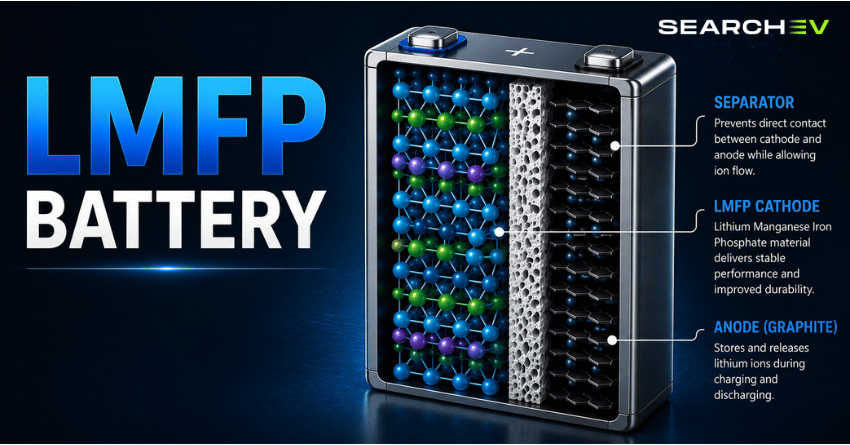
LMFP stands for Lithium Manganese Iron Phosphate.
Read that slowly, and you will spot what changed. There is a new word in the middle—manganese.
That one addition changes the battery in a meaningful way. In a regular LFP battery, the voltage runs at around 3.2 volts per cell. When you add manganese, that voltage goes up to around 3.8 to 4.0 volts. More voltage means more energy is stored in the same amount of space and weight.
In everyday language, it’s the same size battery but with more range.
An LMFP pack stores roughly 230 to 250 units of energy per kilogram. An LFP pack stores around 150 to 200 units per kilogram. That difference is big. You feel it as an extra 20 to 30 km on a single charge compared to an LFP battery of the same size and weight.
And here is the part worth getting excited about. LMFP keeps everything that made LFP good. It does not need cobalt, stays cool in hot weather, & it handles daily charging without degrading fast. The only thing that changed is that it now holds more energy inside.
Think of it like this. LFP is a good water bottle that holds 500 ml. LMFP is the same bottle, same weight, same design—but now it holds 700 ml. Same bottle. More water.
Why India Specifically Needs This Upgrade
Most people buying EVs in India are not buying premium long-range cars. They are buying a scooter for the office commute. A small car for the family. A delivery bike for 8 hours a day.
For these buyers, range is the number one worry. Not the screen. Not the colors. The range.
With an LFP scooter giving 70 to 80 km of real-world range, a lot of riders feel nervous. One long errand, one extra stop, one hot day — and they are watching the battery like a hawk.
LMFP changes that without changing the price much. Same scooter body. Same battery size. Just more range because the cells inside hold more energy. For the everyday Indian commuter, that could mean the difference between a confident daily rider and someone always calculating whether they will make it home.
This is why the Indian battery market is moving toward LMFP fast. Industry data shows LMFP is growing at nearly 50% year-on-year in India. That is not slow adoption. That is manufacturers racing to put it inside their next models.
How LMFP Compares to LFP and NMC in Simple Terms
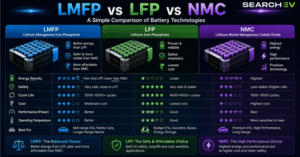
There are three main battery types in EVs today. Here is how they compare on the things that matter:
Range per kilogram of battery: NMC is the best. LMFP is close behind. LFP is the lowest of the three.
Safety in heat: LFP and LMFP are both very safe in hot weather. NMC is more sensitive to heat and needs better cooling systems.
How long it lasts: LFP wins here — up to 5,000 charge cycles. LMFP is slightly lower at around 2,000 to 3,000 cycles. NMC is the shortest at around 1,000 to 2,000 cycles.
Cost: LFP is cheapest. LMFP costs a little more. NMC is the most expensive.
Cold weather performance: LMFP actually performs better than LFP in cold temperatures. Both beat NMC in winter conditions.
So LMFP sits right in the sweet spot. Better range than LFP. Safer and cheaper than NMC. Lasts long enough for years of daily use. For India — with its heat, its daily commuters, and its price-sensitive buyers — that combination makes a lot of sense.
Who Is Already Using LMFP
CATL — the biggest battery maker in the world — has been making LMFP cells since 2023 and is scaling up fast through 2026. BYD has already put LMFP into cars it sells in China and is bringing those vehicles to India.
Indian manufacturers are testing LMFP packs in scooter and compact EV platforms right now. Most vehicles you can buy in an Indian showroom today still use LFP. But the shift is happening quietly behind the scenes, and industry insiders expect LMFP to become the most common battery in mid-range Indian EVs somewhere between 2027 and 2029.
Should You Wait Before Buying an EV
No. If you need an EV now, buy it. Today’s LFP vehicles are genuinely good. They will last for years and handle Indian roads and weather without trouble.
But if you are the kind of person who plans — and you are thinking about a scooter or compact EV purchase in 2027 or later — LMFP gives you something real to look forward to. The range problem that frustrates so many Indian EV owners right now has a solution on the way.
It is not a revolution. It is just a better battery. And sometimes, better is exactly enough.