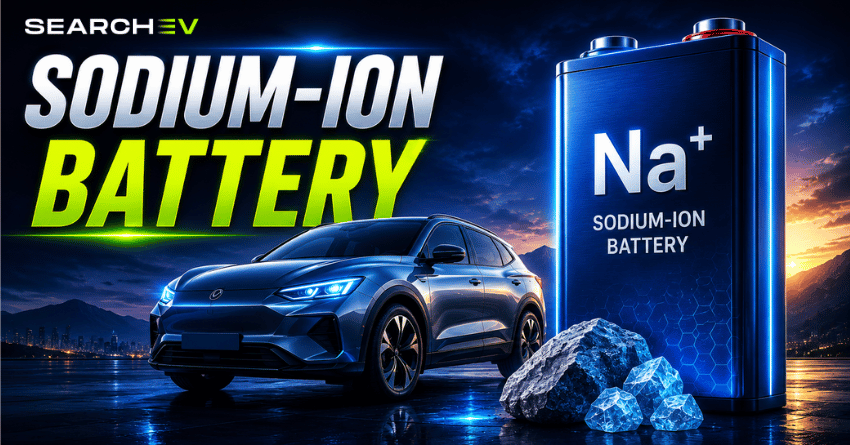
Every few years, something comes along in the EV world that makes people sit up and pay attention. Sodium-ion batteries are the thing right now. You are hearing the name everywhere — from CATL announcements to EV news headlines —, and if you are wondering what all the fuss is actually about, you are not alone.
The good news is that sodium-ion batteries are not complicated once someone explains them without the technical jargon. And once you understand how they work, you will immediately see why the entire EV industry is paying close attention to them in 2026.
Let us start from scratch.
Where Does Sodium Even Come From
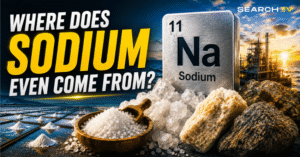
Before getting into how the battery works, here is the most interesting thing about sodium as a material—it is everywhere.
Sodium is the seventh most abundant element on Earth. It is literally in seawater, in salt, and in rocks all around us. Compare that to lithium, which is found in concentrated deposits in just a handful of countries — mostly in South America and Australia — and you already start to see the appeal.
When you build a battery around an abundant material that does not require mining from remote corners of the world, the potential for lower costs and more stable supply chains is enormous. That single fact is what has research labs and battery companies so excited.
How a Sodium-Ion Battery Actually Works
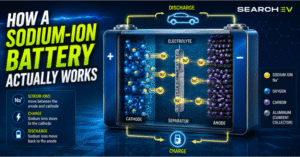
Here is the honest explanation without the textbook version.
Every battery — whether it is in your phone, your laptop, or a 70 kWh EV pack — works by moving charged particles called ions from one side of the battery to the other. When you charge the battery, ions move in one direction. When you discharge it to power the motor, they move back the other way. This flow of ions is what creates electricity.
In a lithium-ion battery, the particles doing all that travelling are—as the name says—lithium ions.
In a sodium-ion battery, sodium ions take that job instead.
The basic structure is the same: you have an anode on one side, a cathode on the other, and an electrolyte in the middle that the ions pass through. The key difference is what the anode is made of. Lithium-ion batteries typically use graphite as the anode material, and it works brilliantly with lithium ions. Sodium ions, however, are larger than lithium ions — they do not fit neatly into graphite in the same way.
So sodium-ion batteries use a different anode material—usually a hard carbon, sometimes called “disordered carbon”—that has a slightly more open structure and can accommodate the bigger sodium ions comfortably.
That one design change is the fundamental reason sodium-ion batteries differ from what powers your EV today.
What Sodium-Ion Batteries Are Good At
This is where it gets genuinely interesting, especially for EV buyers in India.
They handle heat much better. Sodium-ion chemistry is naturally more thermally stable than NMC lithium-ion batteries. In simple terms, they are less likely to overheat and far less prone to thermal runaway that can cause battery fires. For anyone driving in Indian summers—where temperatures regularly hit 40 to 45 degrees—this is not a small thing.
They perform much better in the cold. One of the known weaknesses of lithium-ion batteries is that they lose range and struggle to charge quickly in cold weather. Sodium-ion batteries handle low temperatures noticeably better, which makes them attractive for markets with harsh winters. The ions simply move more freely at lower temperatures in sodium-based electrolytes.
They can be charged to 100% regularly without the same stress. Unlike NMC lithium-ion cells, which degrade faster when kept at very high states of charge, sodium-ion cells are more tolerant of being fully charged regularly. This is a genuine quality of life improvement for daily EV users who want to plug in and forget about it.
They cost less to produce. Sodium is dramatically cheaper than lithium. Cobalt — one of the most expensive and ethically complicated materials in current EV batteries — is not needed at all in most sodium-ion designs. As production scales up, the cost per kWh for sodium-ion packs is expected to fall below even the cheapest lithium-ion options available today.
Where Sodium-Ion Batteries Fall Short
Fairness requires talking about the limitations, too, because there are real ones.
The main weakness is energy density. A sodium-ion battery currently stores less energy per kilogram than a comparable lithium-ion battery. The latest sodium-ion cells reach around 175 Wh/kg. Meanwhile, LFP batteries—the most affordable lithium chemistry—reach around 205 Wh/kg, and NMC batteries push up to 265 Wh/kg.
What that means practically is that a sodium-ion battery pack needs to be physically larger and heavier than a lithium-ion pack to deliver the same range. For a compact electric scooter or a budget city EV, that is manageable. For a long-range premium EV trying to squeeze 600 km into a sleek sedan body, it is a more significant problem.
This is why sodium-ion is not replacing lithium-ion entirely—at least not yet. It is filling a specific role: affordable, safe, thermally stable batteries for shorter-range vehicles and entry-level EVs where maximum range is not the top priority.
Where You Will Actually See Sodium-Ion Batteries in EVs
CATL—the world’s largest battery manufacturer—began commercial production of sodium-ion batteries at scale in 2026. Their first passenger EV with a sodium-ion battery is already on Chinese roads. BYD is developing sodium-ion packs for budget vehicles. Hero MotoCorp has publicly discussed sodium-ion technology for future electric two-wheelers in India.
The pattern here is clear. This is entering the market from the bottom up—starting in affordable scooters, entry-level city EVs, and short-range vehicles where the lower energy density does not limit the ownership experience. From there, as the chemistry matures and energy density improves, it moves upmarket.
For the Indian market specifically, this matters a lot. A sodium-ion powered electric scooter that handles summer heat gracefully, costs ₹5,000 to ₹8,000 less than a comparable lithium-ion model, and does not need cobalt in its supply chain, is a genuinely compelling product for the Tier 2 and Tier 3 city buyer.
Should You Be Excited About Sodium-Ion Batteries
Honestly—yes, but with realistic expectations.
This is not going to power a 500 km range electric car next year. But it is going to make affordable, safe, heat-tolerant electric scooters and city EVs significantly better and cheaper over the next two to three years. For the majority of Indian EV buyers who drive under 60 km a day and care more about reliability than headline range numbers, sodium-ion might end up being the most personally relevant battery development in years.
It is early. But the direction is clear, and the momentum is real.