Here’s a thought experiment. Take two electric vehicles with identical battery packs, identical motors, identical charging hardware. Same specs on paper, line for line.
Now give one of them better software.
In six months, that car charges faster. Its ADAS reacts more accurately. Its range prediction is tighter. It learned your commute and adjusted its energy recovery accordingly. The other one is exactly what it was on the day it left the factory.
That gap — created entirely by software — is now the most important differentiator in the EV industry. And most buyers still don’t know to ask about it.
The Old Model Is Dead
For over a century, the automotive pecking order was simple. Better engine, better transmission, better suspension — better car. Hardware was everything. Once a vehicle left the production line, it was a finished product. What you bought on day one was what you owned forever.
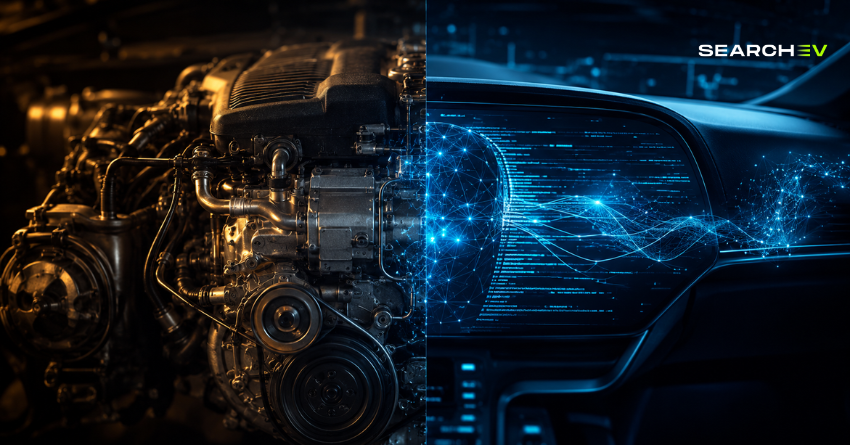
EVs broke that model. Not immediately — early EVs still followed the same hardware-first logic. But once manufacturers figured out that an electric vehicle is, at its core, a computer on wheels, everything changed.
A significant turning point came in 2017 when Tesla shifted from a distributed electrical architecture to a centralised, software-defined approach. The car stopped being a finished product at delivery. It became a platform — one that could be updated, improved, and fundamentally changed through software long after the purchase.
Every major manufacturer is now chasing that model. Software-defined vehicles could account for nearly 90% of vehicle production by 2029, up from just 3.4% in 2021. That’s not a gradual shift. That’s an industry rewriting its own rulebook.
What Software Actually Controls Now
This is where the argument gets concrete, because “software-defined” can sound abstract until you see what it actually touches.
In a modern EV, software governs how the motor delivers torque — which directly affects how the car feels to drive. It controls the charging curve — which determines how fast the battery fills and how aggressively it tapers at 80%. It manages the thermal system, the regenerative braking behaviour, the sensitivity of every ADAS feature, the accuracy of the range prediction. Updates can adjust energy consumption patterns and charging curves, leading to improved range and more consistent performance.
None of this requires opening the bonnet. It happens through an OTA update while the car sits in your garage overnight.
In a software-defined vehicle, fragmented control systems are replaced by centralised high-performance computers that coordinate everything from traction control to seat heaters. The hardware is the foundation. Software is what determines how well that foundation is used — and whether it gets better or stays static.
The Argument Nobody Wants to Make But Should
Here it is plainly: a well-maintained software platform on average hardware will outperform excellent hardware on a neglected software platform. Every time.
Volkswagen learned this the hard way. VW scaled back its ambition to develop core vehicle software in-house through its CARIAD division and shifted to a partnership model, including a joint venture with Rivian. Ford abandoned its fully networked vehicle project in 2025. These weren’t hardware failures — they were software failures, and they cost both companies years of ground lost to manufacturers who got the software architecture right first.
Long-term advantage will favour OEMs that own the platform, the talent, and the release discipline — not just the mechanical engineering.
For a buyer, this translates to something specific: an EV with a strong software platform is a better long-term asset than one with marginally better specs but weaker software infrastructure. Because the specs are frozen. The software isn’t.
What This Means When You’re Buying
When you’re comparing EVs, the questions that actually matter have changed.
Does this manufacturer have a track record of consistent, meaningful OTA updates? Not just bug fixes — real improvements to range, charging speed, or driving behaviour? How deep does the update capability go — infotainment only, or the full drivetrain and battery management system?
How the vehicle uses AI to improve over time is now as relevant a purchase question as horsepower or 0–100 time. A car that gets smarter is fundamentally different from one that doesn’t — and the hardware spec sheet won’t tell you which one you’re buying.
The Honest Caveat
Software-defined doesn’t mean hardware is irrelevant. A battery with poor chemistry can’t be saved by a great algorithm. A motor with substandard efficiency doesn’t improve through an update. The hardware floor still matters.
But above that floor — and most major EV manufacturers clear it — software is what separates a good EV from one that keeps getting better. The real transformation in software-defined vehicles lies in the decoupling of hardware and software — allowing capabilities to be upgraded or introduced over time without changing physical components.
That decoupling is the biggest shift in automotive history since the internal combustion engine. And it’s happening right now, in vehicles already on Indian roads.
The Bottom Line
The EV you buy today is not the EV you’ll own in three years — if the software platform is good enough. That’s either a reassuring thought or a reason to choose very carefully, depending on which car you’re looking at.
Hardware gets you in the door. Software determines what happens after.
Stay on top of every EV technology insight — SearchEV covers the developments that actually move the needle.