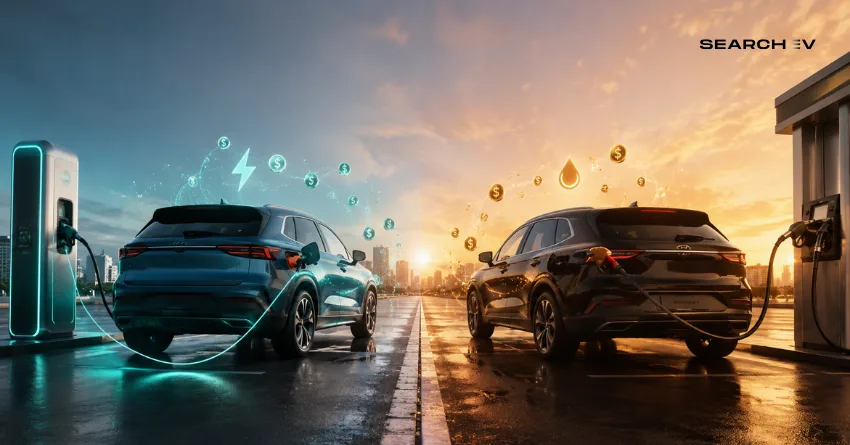
The days of simply pulling up to a fuel pump, filling the tank to the brim, and not thinking twice about the bill are fading. And while many believed the traditional internal combustion engine would ride out the storm of emission regulations unchanged, the electric shift is well and truly here.
Today, the debate has moved to primarily whether the switch to an EV is really saving your wallet. Let’s walk through the actual mathematics of the electric car’s charging cost compared to running a traditional petrol car and, more importantly, what that means for you as a buyer.
The Baseline: The True Cost of Running on Petrol
To understand the savings, we first need to look at the incumbent. Petrol engines have become incredibly refined, but they are still inherently bound by the volatile price of crude oil. In most metropolitan areas, a litre of petrol hovers around the Rs 100 mark.
If we consider a compact SUV, in real-world city driving, with usual stop-start traffic, idling at signals, and the air conditioning working overtime, you are realistically looking at an efficiency of about 12 to 14 kilometres per litre (km/l). Out on the highway, that might stretch to 16 or 17 km/l.
If we take a conservative average of 14 km/l at Rs 100 per litre, your running cost is roughly Rs 7.14 per kilometre. If you drive 1,500 kilometres a month, you are parting with over Rs 10,700 every single month just to keep the wheels running. This is the financial weight that EVs promise to lift.
How is EV Charging Cost is Calculated?
Before we dive into the costs, it is vital to understand exactly how electric vehicle charging is measured and billed.
When you buy petrol, you buy it in litres. When you charge an EV, you buy electricity in kilowatt-hours (kWh). Conveniently, on your domestic electricity bill, 1 kWh is exactly equal to 1 Unit of electricity.
Therefore, if you have an EV with a 40 kWh battery pack, it will theoretically require 40 units of electricity to charge from completely empty to completely full. In the real world, we also account for “charging losses”, which is a small amount of energy lost as heat during the transfer process (usually around 5%). So, a 40 kWh battery might actually draw about 42 units from the grid to reach a 100% charge.
Electric Cars Charging Cost: A Tale of Two Plugs
When we talk about the running costs of an electric vehicle, there is no single, flat rate. Your cost per kilometre is dictated entirely by where and how you charge.
1. Home Charging (AC Slow Charging)
Charging your car at home via a standard 3.3 kW or 7.2 kW AC wall box is where the actual major cost savings happen.
To understand the costs, let’s use the MG Windsor EV as an example, since it’s also amongst the best-selling electric cars in India currently. Taking the 52.9 kWh version of the Windsor EV as a reference and an average domestic electricity cost of Rs 8 per unit (kWh), here is how the home charging math works out:
| Parameter | Value / Calculation |
| Battery Capacity | 52.9 kWh |
| Electricity Consumed | 55.5 units (accounting for minor charging losses) |
| Cost per Unit (Domestic) | Rs 8 |
| Total Cost for Full Charge | 55.5 units × Rs 8 = Rs 444 |
| Real-World Range | 350 km |
| Final Cost Per Kilometre | Rs 444 ÷ 350 km = Rs 1.26 |
*These are approximate values. Your actual charging cost will vary depending on your state’s electricity provider and your specific billing slab.
Compared to our petrol baseline of Rs 7.14, home charging reduces your running costs by more than 80%.
2. DC Fast Charging (Public Infrastructure)
If home charging is your daily bread, DC fast charging is the expensive restaurant you visit on road trips. A 50 kW fast charger can charge a Windsor EV from 0 to 80% in about 50-55 minutes. However, you pay a premium for this speed.
Public charging operators typically charge anywhere from Rs 18 to Rs 24 per kWh. However, public charging operators don’t just charge for electricity, as they also bill you for the service, convenience, and maintenance of the infrastructure. Furthermore, EV charging services in India attract an 18% Goods and Services Tax (GST), and many apps apply a small convenience or session fee.
Let’s assume a base public charging rate of Rs 20 per kWh for a full charge on our 52.9 kWh battery.
| Parameter | Value / Calculation |
| Battery Capacity | 52.9 kWh |
| Base Cost per Unit (Public DC) | Rs 20 |
| Cost with 18% GST Applied | Rs 23.60 per unit |
| Total Energy Cost (52.9 units) | 52.9 units × Rs 23.60 = Rs 1,248 |
| Operator Session/Platform Fee | Rs 25 (approximate) |
| Total Estimated Cost for Full Charge | Rs 1,273 |
| Real-World Range | 350 km |
| Estimated Cost Per Kilometre | Rs 1,273 ÷ 350 km = Rs 3.63 |
*These are approximate values. Public charging rates are highly dynamic and vary significantly based on the operator, the speed of the charger, and the location
While Rs 3.63 per km is still roughly half the cost of running a petrol car, relying heavily on fast chargers eats into the long-term financial benefits of owning an EV.
A Crucial Caveat on Fast Charging Behaviour: In the real world, you rarely charge a battery from 0% to 100% on a DC fast charger. Because of battery management systems, charging slows down drastically after 80% to protect the battery chemistry. For maximum efficiency and to save time, drivers typically charge from 20% to 80%. The 0-100% calculation provided below is strictly for cost reference and easier comparison against petrol.
Head-to-Head: EV vs Petrol Running Costs
Let’s look at how the numbers stack up across some of the most popular mass-market platforms.
| Model Pair | Petrol Real-World Efficiency | Petrol Cost per km (Rs 100/L) | EV Battery Size | EV Real-World Range | Estimated EV Cost per km (Home Charge) |
| MG Astor vs MG Windsor EV | 12 km/l | Rs 8.33 | 52.9 kWh | 350 km | Rs 1.26 |
| Tata Nexon vs Nexon EV (LR) | 13 km/l | Rs 7.69 | 40.5 kWh | 310 km | Rs 1.10 |
| Hyundai Creta vs Creta EV | 13.5 km/l | Rs 7.40 | 51.4 kWh | 400 km | Rs 1.08 |
| Kia Clavis vs Clavis EV | 14 km/l | Rs 7.14 | 51.4 kWh | 360 km | Rs 1.20 |
*Efficiency figures are based on real-world estimates. EV charging costs are calculated using the approximate home charging rate.
Why Home Charging is the Keystone of the EV Promise
If you are buying an electric vehicle strictly to save money, let’s be absolutely clear: you must have access to home charging.
The entire mathematical justification for buying an EV rests on paying domestic electricity rates. If you live in an apartment complex where installing a private charger is impossible, and you plan to rely entirely on public DC fast chargers, the reality is not as green as the EV promise. Not only does your running cost jump to Rs 3 or Rs 4 per kilometre, but you also lose the primary luxury of an EV: waking up every morning with a “full tank”.
Without home charging, the convenience factor plummets. You will find yourself spending an hour or more every week sitting at a public charging station. For the numbers to truly work in your favour, home charging is a prerequisite.
The Upfront Premium: When Does the Shift Make Sense?
EVs are cheaper to run, but they are significantly more expensive to buy. Batteries are incredibly costly to manufacture. Because of this, the EV variant of a car typically demands a premium of Rs 2.5 lakh to Rs 4 lakh over its automatic petrol counterpart.
To figure out if an EV makes financial sense, you have to calculate your break-even point; the distance you need to drive where your fuel savings cover the extra money you spent at the showroom.
Let’s say the EV costs Rs 3,00,000 more upfront than the petrol version.
- Petrol cost per km: Rs 7.50
- EV cost per km: Rs 1.26
- Savings per km: Rs 6.24
To recover that Rs 3,00,000 premium at a saving of Rs 6.24 per kilometre, you need to drive roughly 48,000 kilometres.
- The Low-Mileage Driver: If you only drive 10 kilometres a day (around 3,600 km a year), it will take you over 13 years just to break even. From a purely financial standpoint, an EV makes no sense for you.
- The High-Mileage Driver: If your daily commute is 50 kilometres (around 18,000 km a year), you will recover the premium in less than 3 years. After that, every kilometre driven is putting money back into your pocket.
But It’s Not an Apple-to-Apple Comparison
It is tempting to look at a spreadsheet, see the massive per-kilometre savings, and declare the EV the undisputed winner. But a car is not just a math equation; it is a lifestyle tool. Comparing a petrol car and an EV is rarely a straightforward apples-to-apples comparison.
1. The Convenience Tax
A petrol car offers unparalleled freedom. You can point the bonnet in any direction, drive until the low-fuel light comes on, and refill the tank in five minutes flat. An EV requires meticulous planning for long trips. You have to map out fast chargers, pray they are in working order when you arrive, and be prepared to wait 45 minutes while the car juices up.
2. Driving Dynamics and Refinement
In the city, an EV offers a fundamentally different driving experience, which many drivers would appreciate. An electric motor delivers 100% of its torque instantly. There are no gears to kick down, no turbo lag to wait for, and no engine noise. An EV will leave its petrol sibling in the dust at a traffic light, all while delivering a silent, vibration-free cabin experience that rivals luxury cars twice its price.
3. Service and Maintenance
An internal combustion engine is essentially a box containing thousands of tiny controlled explosions. It requires engine oil, oil filters, spark plugs, and complex gearboxes to function. An EV motor has roughly a dozen moving parts. There is no oil to change, and thanks to regenerative braking, even your brake pads will last twice as long. The annual service bill for an EV is often a fraction of what you would pay for a petrol car.
4. Depreciation and Battery Anxiety
While ICE engine cars have already shown that they are capable of lasting up to a decade or more with just standard maintenance, the lack of information on gradual degeneration of the EV’s batteries has made some customers hesitant. While the good news is that the battery pack usually comes with an 8-year/1,60,000 km warranty from the company, providing much relief, the used car market of EVs is yet to fully develop.