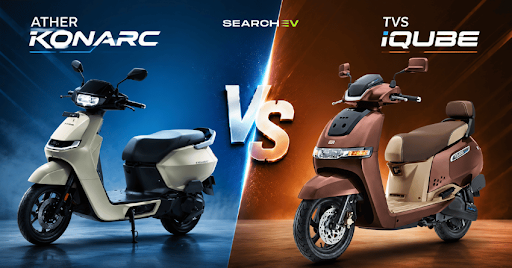
The electric family scooter segment features two of the most exciting rivalries: the latest Ather Konarc locking horns with the TVS iQube 3.5 kWh – a tried-and-tested two-wheeler in India. Built around an advanced EL platform designed to hit mass production as a budget-friendly two-wheeler, Ather Energy’s all-new Konarc is meant to give tough competition in the segment. With a fresh structural and practical design, the new Konarc is poised to take the market by storm.
Pondering whether the Ather Konarc is the choice you have to stick with, or should you choose the already well-established TVS iQube 3.5 kWh electric scooter for your family’s commuting needs? This detailed comparison conducted below can help you make the right decision:
Ather Konarc vs TVS iQube 3.5 kWh: Pricing
| 2026 Electric Scooter Models | Ex-Showroom Price |
| Ather Konarc S-line (161 km) | Rs 1.45 Lakh |
| TVS iQube 3.5 kWh | Rs 1.42 Lakh |
Ather Konarc vs TVS iQube 3.5 kWh: Design And Build
Exterior Design
The Ather Konarc: The two-wheeler shifts away from featuring a razor-sharp design architecture usually popular with Ather’s 450 series. But it now features a much more contoured geometry. The Konarc also gets a handlebar-mounted LED headlight setup, with an LED lighting bar incorporated on the front apron structure; these help with its established, simple but effective design language.
Additionally, the fitted body panels prominently feature metal construction, delivering high durability under rugged conditions and reducing the possibility of city-run wear and tear. With large wheels, measuring 14 inches (front) wrapped around wide tyres, the new Konarc offers a strong design appeal; it makes sure the vehicle has a rugged stance while being practically useful for underbody clearance and stability.
The flat floorboard of the new 2026 Ather Konarc is another aspect that has practical use, offering enough space to carry smaller luggage or packed consumer essentials without a lack of space. The wide and long single-piece seat construction also offers decent city ride comfort with sufficient cushioning. Also, the Ather Konarc offers well-finished fitment, an attribute established by Ather.
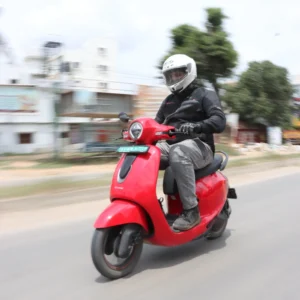
TVS iQube 3.5 kWh: The design of the TVS iQube emphasises a well-contoured structure and understated appeal, resembling traditional ICE scooters in India. To enhance its appeal, the iQube gets horizontal LED lighting strips in the front and rear, offering a much more contemporary look. Built with high-grade plastic composite body panelling, it features a strong chassis underneath; the TVS iQube 3.5 kWh variant is hence deemed strong for city usage, also being lighter than its rival.
Running on standard 12-inch wheels wrapped around tubeless tyres, the TVS iQube 3.5 kWh offers good ground clearance of 157 mm, sufficient clearance to tackle potholes and uneven routes seamlessly. With wider seating and generous floorboard space, the iQube is super comfy. Hence, the iQube is suitable for riders of all age groups in India with a valid licence wanting to experience it.
Takeaway: The Ather Konarc is meant for riders wanting a strong, family-oriented electric two-wheeler for city use, featuring strong build quality and metal panelling. Meanwhile, the TVS iQube 3.5 kWh offers a much more conventional design which is timeless in appeal.
Cockpit Design
Ather Konarc: This new electric scooter features a large 7-inch ‘Deep View’ display functioning on AtherStack, offering good touch response, a seamless user interface, and multiple connectivity features and alerts; it provides crash or tow-away alerts and potential pothole detection alerts, all while providing ergonomic switchgear to navigate the system.
TVS iQube 3.5 kWh: This well-established electric scooter is equipped with a 12.77 cm TFT instrument cluster offering functionalities such as turn-by-turn navigation, incoming phone call alerts, Bluetooth connectivity, and range/state of charge details. While the user interface functions decently, it still has a slightly slower touch response when compared to the 2026 Ather Konarc.
Takeaway: The new Konarc has a significant advantage in terms of cluster engagement, offering a seamless user interface with adequate touch response. The iQube, with a straightforward user interface easy to navigate, has a slightly slower touch response than the all-new Konarc.
Ather Konarc vs TVS iQube 3.5 kWh: Performance And Range
| Criteria | Ather Konarc | TVS iQube 3.5 kWh |
| Motor Type | PMSM | BLDC Hub-Mounted Motor |
| Peak Power | 4.7 kW | 4.4 kW |
| Torque | 16 Nm | 33 Nm |
| Battery Capacity | 3.5 kWh | 3.5 kWh |
| Range | Up To 161 Km / Full Charge (IDC Range) | Up To 145 Km / Full Charge (IDC Range) |
| Charging Time | 5 Hours And 40 Minutes (0-80% SOC) | 4 Hours And 40 Minutes (0-80% SOC) |
| Top Speed | 70 Kmph | 82 Kmph |
| Braking And Safety | Disc (Front) Drum (Rear) With AeBS | Disc (Front) Drum (Rear) |
Note: AeBS stands for advanced electric brake-assist system; this is a proprietary tech integrated in Ather Konarc which resists wheel lock-up and improves braking
Riding Dynamics
- Ather Konarc: The Konarc is designed with optimal weight distribution, reducing unsprung mass induced by the rear wheel assembly. It features a swingarm-mounted motor to enhance vehicle stability through optimal load distribution. With such a motor setup, the Ather Konarc is designed to tackle uneven routes and large potholes without stressing the chassis architecture or the motor construction.
- TVS iQube 3.5 kWh: The iQube integrates a hub-mounted electric motor to ensure seamless and predictable acceleration, making it ideal for city stop-and-go traffic. Due to these characteristics, the iQube 3.5 kWh is perfect for elderly persons as well. In fact, the iQube feels gentle for new riders seeking a commuter for city environments and conditions.
Charging Convenience:
The Ather Konarc comes with an onboard charger, meaning riders will only need to carry a cable rather than the entire electrical brick – the charging adaptor and its counterparts. As for the TVS iQube 3.5 kWh, it comes with an off-board charger, meaning there is more hassle in carrying the entire hardware. What about the features offered? Which electric two-wheeler has the most:
Ather Konarc vs TVS iQube 3.5 kWh: Features
| Features | Criteria | Ather Konarc | TVS iQube 3.5 kWh |
| Hill Hold Assist | Yes | No |
| Pothole Alerts | Yes | No |
| Riding Modes | Yes | Yes |
| Voice Command Cluster | Yes | No |
| Magic Key (Auto Functions) | Yes | No |
| Front Glove Compartment | No | No |
| Underseat Storage | Yes (31 Litres) | Yes (32 Litres) |
| Adjustable Backrest | Yes | No |
| Centre Stand | Yes | No |
| Geo Fencing | Yes | Yes |
| AirWalk (Auto Roll Front/Back) | Yes | No |
Ather Konarc: The two-wheeler comes with multiple feature integrations to enhance user appeal and the overall experience. The Konarc gets an advanced electric brake-assist system (AeBS), hill hold assist, access to Ather Grid charging infrastructure, and comes with over-the-air updates. These features are designed to suit the Ather Konarc and enhance rideability and safety.
TVS iQube 3.5 kWh: The iQube 3.5 kWh variant comes with equally appealing feature integrations to enhance the rideability, safety, and performance. This includes features such as park assist (reverse and forward crawler), geo-fencing for setting a fixed route with active alerts when diverted, and crash alerts, among others.
The Verdict: Which Electric Two-Wheeler To Choose?
Pick The Ather Konarc:
- If you need an electric family scooter built with a strong metal body for durability
- For superior software with OTA (over-the-air) updates for improved system efficiency
- If you value convenience, featuring onboard charging
- Excellent riding dynamics from a family electric scooter
Pick The TVS iQube 3.5 kWh:
- If you need a hassle-free track record of delivering high reliability from an e-scooter
- If you prefer a gradual throttle response and seamless rideability
- Need large underseat storage space to accommodate essentials
- If you require multiple colour schemes to choose from to suit your colour taste