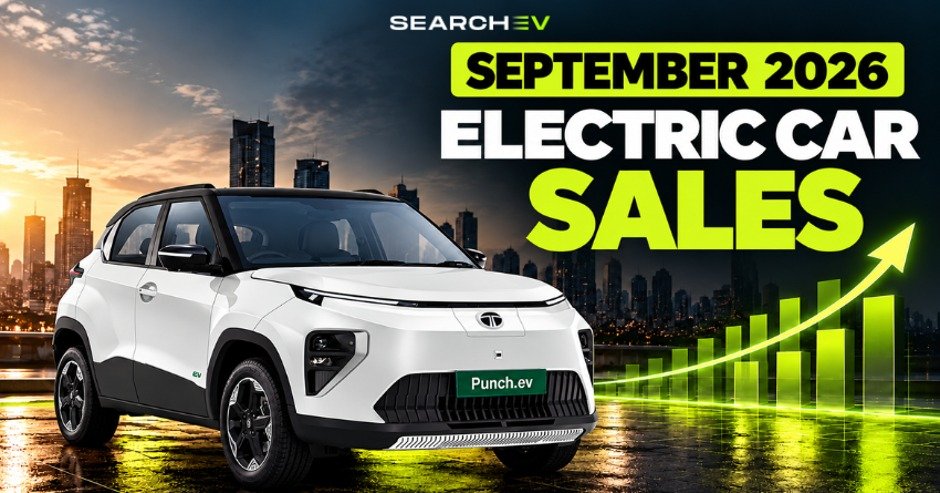
Electric car wholesale dispatches in India reached 35,256 units in September 2026. That figure marks a 62 per cent year-on-year increase compared to the 21,757 units shipped in September 2025. Dealer inventory stocking ahead of the October festive season played a major role in this push, alongside a wave of recently launched options across multiple price brackets. While Tata Motors defended its overall lead with 14,973 dispatches, a fierce battle at the top of the model charts saw the Tata Punch EV edge past the Mahindra XEV 9S by just 66 units.
Top 10 Best-Selling Electric Cars in September 2026
| Rank | OEM | Model | September 2026 Dispatches | September 2025 Dispatches | Year on Year Change |
| 1 | Tata Motors | Punch EV | 4,702 | 1,223 | Growth 284% |
| 2 | Mahindra | XEV 9S | 4,636 | 0 | New |
| 3 | Tata Motors | Nexon EV | 3,926 | 3,251 | Growth 21% |
| 4 | MG Motor | Windsor EV | 3,300 | 4,741 | Decline 30% |
| 5 | Mahindra | XEV 9e | 1,975 | 2,619 | Decline 25% |
| 6 | Tata Motors | Sierra EV | 1,908 | 0 | New |
| 7 | Tata Motors | Curvv EV | 1,536 | 376 | Growth 309% |
| 8 | Mahindra | BE6 | 1,517 | 1,701 | Decline 11% |
| 9 | Tata Motors | Harrier EV | 1,452 | 2,363 | Decline 39% |
| 10 | Maruti Suzuki | e Vitara | 1,342 | 0 | New |
Punch EV and Mahindra XEV 9S Fight for Model Leadership
The headline battle in September took place between two very different SUVs. After the Mahindra 9S briefly grabbed the top spot in August, the Tata Punch EV climbed back to number one in September with 4,702 units. Its dispatches grew 284 per cent compared to the 1,223 units recorded a year ago. Alone, the micro SUV accounted for 13.3 per cent of all electric cars shipped in the country last month. Much of that volume comes from budget buyers who find the Punch EV’s starting price of Rs 9.79 lakh quite lucrative for what it offers on paper.
Mahindra stayed right on its tail. The newly introduced XEV 9S secured second place with 4,636 units, capturing a 13.1 per cent share of total industry volume. Selling over 4,600 units of a larger, premium-born electric SUV shows that Indian family buyers are willing to spend more when a vehicle offers big cabin space and long highway range. In fact, even though the XEV 9S lost to the Punch EV this month, its overall monthly numbers grew from 4,508 dispatches in August.
The Tata Nexon EV held onto third place with 3,926 dispatches, posting a 21 per cent annual gain over its 3,251 unit tally from September 2025. Fourth place went to the MG Windsor EV at 3,300 units. Although the Windsor remains the core volume pillar for MG, its dispatches fell 30 per cent from the 4,741 units shipped a year earlier as new SUV rivals pulled buyers away. Mahindra rounded out the top five with the coupe-styled XEV 9e at 1,975 units, which saw a 25 per cent dip from last year as showroom traffic shifted toward its three-row 9S sibling.
SUVs Dominate the Top 10 Chart
Together, the top 10 models generated 26,294 units, or 74.6 per cent of the entire electric car market in September. Every single vehicle in the top 10 is an SUV or crossover.
Tata Motors placed five models inside this top bracket. Beyond the Punch EV and Nexon EV, the reborn Sierra EV took sixth place with 1,908 units. Right behind it sat the Curvv EV at number seven with 1,536 dispatches, up 309 per cent from a low base of 376 units in September 2025. The flagship Harrier EV finished ninth at 1,452 units, recording a 39 per cent annual decline from 2,363 units. Expanding the decoupled battery rental option to the Nexon, Curvv, Sierra, and Harrier EVs has helped Tata keep showroom interest high across four overlapping SUV price points.
Mahindra claimed its third top 10 spot with the sporty BE6 at number eight, shipping 1,517 units compared to 1,701 units a year ago. Meanwhile, Maruti Suzuki secured the tenth spot with the e-Vitara at 1,342 units. Accounting for 3.8 per cent of total industry dispatches, the e-Vitara gives India’s largest automaker a steady foothold in a segment it previously watched from the sidelines.
Mid-Tier Contenders and Positions 11 to 30
Outside the top 10, fresh, compact and midsize launches reshaped the middle of the chart. The new Kia Syros EV landed in eleventh place with 1,060 dispatches. Built on a localised platform with 42 kWh and 51.4 kWh battery options, the tallboy SUV pushed past the entry level Tata Tiago EV, which slipped 29 percent year on year to 1,052 units at twelfth place. The two-door MG Comet EV took thirteenth place with 978 units, down 19 per cent from 1,203 units last year.
Hyundai doubled its Creta EV dispatches to 935 units in fourteenth place, up 113 per cent from 440 units in September 2025, helped by the recent addition of its rear seat-focused Lounge Edition. Vietnamese carmaker VinFast clustered two models right behind the Creta, shipping 850 units of the Limo Green crossover in fifteenth place and 625 units of the VF7 SUV at sixteenth place. Kia followed at seventeenth with 621 units of the three-row Carens Clavis EV.
Further down the order, BYD posted strong gains with the Sealion 7 at 530 units and the Atto 3 at 519 units. Mahindra shipped 406 units of the sub-four-metre XUV 3XO EV in twentieth place, while its older XUV400 dropped 91 per cent to just 13 units near the bottom of the list. Toyota also made an appearance at twenty-fourth place by dispatching 166 units of its new eBella electric SUV, sharing its core hardware with the Maruti e Vitara.
Electric Car Dispatches Ranked 11 to 30 in September 2026
| Rank | OEM | Model | September 2026 Dispatches | September 2025 Dispatches | Year on Year Change |
| 11 | Kia | Syros EV | 1,060 | 0 | New |
| 12 | Tata Motors | Tiago EV | 1,052 | 1,485 | Decline 29% |
| 13 | MG Motor | Comet EV | 978 | 1,203 | Decline 19% |
| 14 | Hyundai | Creta EV | 935 | 440 | Growth 113% |
| 15 | VinFast | Limo Green | 850 | 0 | New |
| 16 | VinFast | VF7 | 625 | 158 | Growth 296% |
| 17 | Kia | Carens Clavis EV | 621 | 716 | Decline 13% |
| 18 | BYD | Sealion 7 | 530 | 216 | Growth 145% |
| 19 | BYD | Atto 3 | 519 | 199 | Growth 161% |
| 20 | Mahindra | XUV 3XO EV | 406 | 0 | New |
| 21 | Tata Motors | Tigor EV | 397 | 328 | Growth 21% |
| 22 | VinFast | VF6 | 323 | 218 | Growth 48% |
| 23 | MG Motor | ZS EV | 280 | 250 | Growth 12% |
| 24 | Toyota | eBella | 166 | 0 | New |
| 25 | BYD | eMax 7 | 76 | 88 | Decline 14% |
| 26 | VinFast | MP7 | 55 | 0 | New |
| 27 | Citroen | eC3 | 55 | 17 | Growth 224% |
| 28 | Mahindra | XUV400 | 13 | 149 | Decline 91% |
| 29 | BYD | Seal | 12 | 10 | Growth 20% |
| 30 | Hyundai | Ioniq 5 | 9 | 6 | Growth 50% |
Brand Wise Market Share and Wholesale Performance
At the manufacturer level, Tata Motors and Mahindra controlled two thirds of the Indian electric vehicle market in September. Tata shipped 14,973 electric cars across seven models, up 65.9 per cent from 9,026 units in September 2025, giving the company a 42.5 per cent market share. Mahindra grew faster at 91.3 per cent year on year, rising from 4,469 units to 8,547 units to claim a 24.2 per cent share.
MG Motor finished third with 4,558 units and a 12.9 per cent market share, reflecting a 26.4 per cent drop from the 6,194 units it dispatched in September last year.
VinFast secured fourth place among automakers with 1,853 dispatches and a 5.3 per cent market share, while Kia took fifth place at 1,681 units with a 4.8 per cent share. Maruti Suzuki, BYD, and Hyundai occupied ranks six through eight, each shipping between 944 and 1,342 units. Toyota and Citroen completed the ten brand tally.
Manufacturer Wise Electric Car Dispatches in September 2026
| Rank | Manufacturer | September 2026 Dispatches | September 2025 Dispatches | Year on Year Change | September 2026 Market Share |
| 1 | Tata Motors | 14,973 | 9,026 | Growth: 65.9% | 42.5% |
| 2 | Mahindra | 8,547 | 4,469 | Growth: 91.3% | 24.2% |
| 3 | MG Motor | 4,558 | 6,194 | Decline: 26.4% | 12.9% |
| 4 | VinFast | 1,853 | 376 | Growth: 392.8% | 5.3% |
| 5 | Kia | 1,681 | 716 | Growth: 134.8% | 4.8% |
| 6 | Maruti Suzuki | 1,342 | 0 | New | 3.8% |
| 7 | BYD | 1,137 | 513 | Growth: 121.6% | 3.2% |
| 8 | Hyundai | 944 | 446 | Growth: 111.7% | 2.7% |
| 9 | Toyota | 166 | 0 | New | 0.5% |
| 10 | Citroen | 55 | 17 | Growth: 223.5% | 0.2% |
| Total | Industry | 35,256 | 21,757 | Growth: 62.0% | 100.0% |
Note: MG Motor figures exclude the Hector Tomahawk due to unavailable EV and PHEV split data.
What We Think
September 2026 proves that the Indian electric car market is no longer a one-horse race or a two-car segment. While Tata Motors and Mahindra still command 66.7 per cent of total factory dispatches, neither company can afford to relax. The 66-unit gap between the affordable Tata Punch EV and the larger Mahindra XEV 9S shows that strong demand exists at both ends of the mass-market price spectrum. At the same time, the 30 per cent drop in MG Windsor EV dispatches serves as a clear warning that even popular crossovers lose momentum quickly when buyers get fresh SUV options.