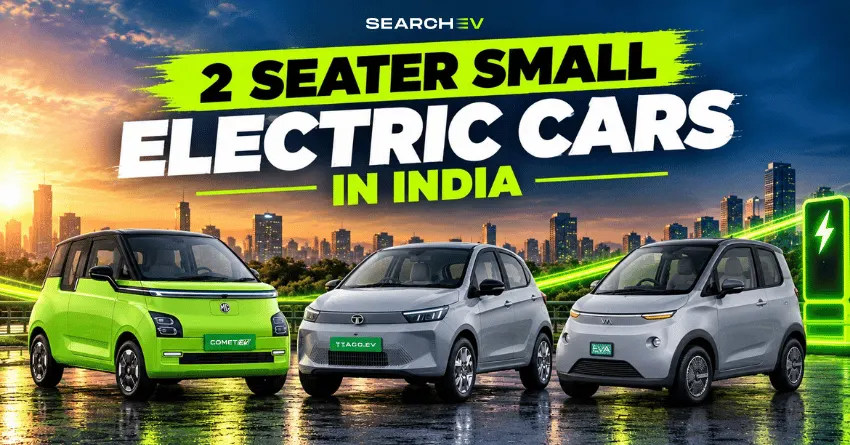
True 2 seater small electric cars are rare in India, and the list is short: the PMV EaS-E and the Strom R3 are built for two, while the MG Comet EV is the popular compact pick with rear seats. This guide covers prices, range, running costs and who each one actually suits.
What counts as a 2 seater small electric car in India?
A 2 seater small electric car is a compact, enclosed four-wheeler (or close to it) built mainly for two people, aimed at city trips and tight parking. Here’s the honest bit most listicles skip: India has very few of them.
The only genuine two-seat electric car I could confirm as on sale is the PMV EaS-E, at ₹4.79 lakh ex-showroom. Its listing shows it as available now, with specifications last verified in September 2026.
Everything else people call a “2 seater” is really something different:
- MG Comet EV: a two-door car with four seats. Most owners use it as a 2+2, with the back seats for kids, bags or short trips.
- Vayve Mobility Eva: a micro two-door EV with three seats.
- Strom R3: a three-wheeled mini EV. Pages I checked disagree on its seat count and I couldn’t confirm it’s on sale, so treat it with caution.
So if you searched for a 2 seater small electric car in India, you’re really choosing between one true two-seater and a few tiny alternatives.
Small electric cars in India compared (2026)
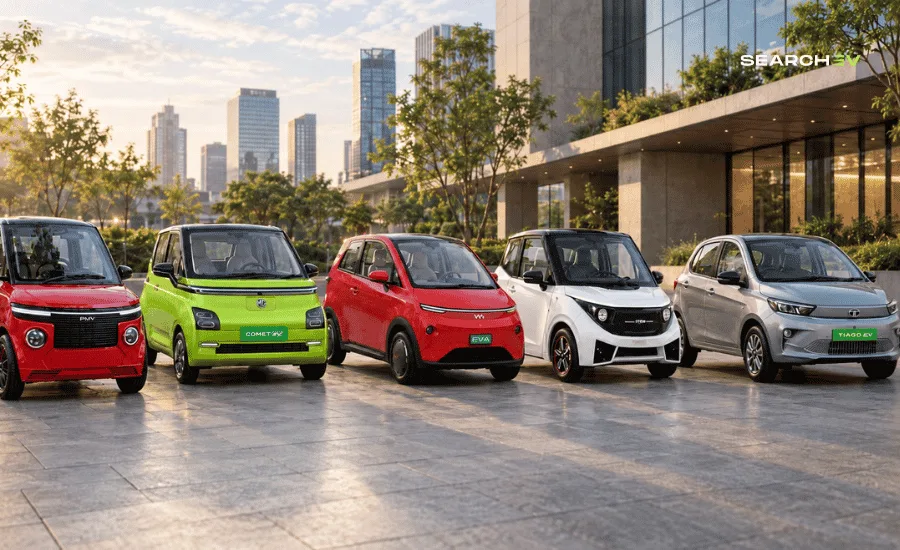
Prices are ex-showroom and indicative. Different pages quote slightly different figures, so confirm the final on-road price with a dealer.
| Model | Seats | Ex-showroom price | Battery | Claimed range | Notes |
| PMV EaS-E | 2 | ₹4.79 lakh | 10 kWh | 160 km (ARAI) | 30 L boot, 3-year / 50,000 km warranty |
| MG Comet EV | 4 (2 doors) | About ₹7.5 to 10.07 lakh, sources differ | 17.3 kWh | 230 km (ARAI) | Real-world 170 to 200 km in city use |
| Vayve Mobility Eva | 3 | ₹3.25 to 4.49 lakh | 9, 12.6 or 18 kWh | 125 to 250 km | Micro two-door EV, range varies by battery |
| Strom R3 | 2 | About ₹4.5 lakh | Not stated | 200 km | Three-wheeled; confirm availability before booking |
| Tata Tiago EV | 5 | ₹6.99 to 9.99 lakh | 24 kWh | 226 to 285 km | If you need real seating for a family |
| MG Cyberster | 2 | ₹82.5 lakh | 77 kWh | 580 km | Electric roadster, a different budget altogether |
Which one suits you? Model-by-model notes
PMV EaS-E: the true 2 seater. It’s the cheapest way into a proper enclosed electric car for two. Estimated real-world range is about 141 km in the city and 128 km combined, dropping to 112 km on the highway with the AC on. The catch is space: the boot is only 30 litres, so think handbags, not suitcases. Safety listings mention ABS and EBD, but the airbag count isn’t clear, so ask the dealer exactly what’s fitted.
MG Comet EV: the practical compact. It costs more, but you get a bigger battery, real-world range of roughly 170 to 200 km, and a safety kit that includes dual airbags, ABS with EBD, stability control, ISOFIX and a reverse camera. With all four seats up the boot is nearly nonexistent, though the rear seats fold down. At 2,974 mm long with a 4.2 m turning radius, it’s a dream in tight lanes.
Vayve Mobility Eva: the budget micro EV. Three seats and a starting price from ₹3.25 lakh. Worth a look if you want the smallest, cheapest footprint, but check service coverage in your city first.
Strom R3: handle with care. It looks interesting on paper, with a claimed 200 km of range and a price of about ₹4.5 lakh. But the pages I read disagree on its seats and its availability, so I wouldn’t book one without seeing it and the paperwork in person.
The specs that actually matter
Small EVs are bought on a few numbers, so here’s what I’d check before anything else.
- Real range, not ARAI range. The claimed figure is a lab number. The MG Comet claims 230 km but is quoted at about 170 to 200 km in city use with the AC on. The PMV EaS-E claims 160 km, with estimates of 128 km combined and 112 km on the highway. Budget for the lower number.
- Charging speed and where you’ll charge. The Comet takes about 7 hours on a 3.3 kW AC charger, or about 3.5 hours on the 7.4 kW AC charger of the FC variants, and it has no DC fast charging. The PMV EaS-E is listed at about 4 hours. Either way, these are overnight cars, so a home or society charging point matters more than public chargers.
- Safety kit. Look at airbags, ABS with EBD, stability control and ISOFIX. The Comet lists all of these, while the PMV EaS-E shows ABS and EBD with an unclear airbag count. I didn’t see a crash-test (NCAP) rating for either, so ask the dealer rather than assume.
- Boot and seating. The PMV EaS-E has 30 litres. The Comet has almost no boot with four seats up. If you shop for a family of four, a small car like this isn’t it.
- Warranty and service. The PMV EaS-E lists 3 years or 50,000 km. A newer brand means fewer service centres, so check there’s one near you before you buy.
Running costs: what charging really costs per km
Electricity is where these cars win. With home tariffs around ₹7 to 9 per unit, one source puts a full charge of the MG Comet at about ₹120 to 155, which it says works out to under ₹1 per km.
Here’s my own back-of-envelope maths, using the same tariff range and the real-world ranges above:
| Car | Full charge cost | Real-world range | Approx. cost per km |
| PMV EaS-E (10 kWh) | ₹70 to 90 | About 128 km combined | ₹0.55 to 0.70 |
| MG Comet EV (17.3 kWh) | ₹120 to 155 | 170 to 200 km | ₹0.60 to 0.90 |
There’s one more option on the Comet: battery rental. MG’s plan brings the car down to about ₹4.99 lakh, with a battery rental of ₹3.2 per km. At the Comet’s outright price of about ₹7.8 lakh, that’s roughly ₹2.8 lakh less upfront. Divide that by ₹3.2 and you get about 87,000 km before renting costs more than buying. If you drive 5,000 km a year, that’s well over a decade, so for low-mileage city use it can make sense. For heavy use, buying is cheaper.
Compare these numbers with what your current petrol car costs per km, which is the number that really decides this.
Licence, registration and incentives in India
These are four-wheelers, so the usual car rules apply: you need a driving licence valid for light motor vehicles, the car must be registered, and it needs insurance. A three-wheeler like the Strom R3 may be classified differently, so ask the dealer how it’s registered and which licence it needs.
Incentives are the tricky part. EV road tax and registration relief differs from state to state and changes often. One listing mentions a subsidy policy updated in October 2026 but gives no details, so I can’t quote figures. Ask your dealer or state transport department what applies today.
Also expect the on-road price to be higher than the sticker. For the PMV EaS-E, the Mumbai on-road estimate on its listing is about ₹5.60 lakh against ₹4.79 lakh ex-showroom, though the page’s own breakdown shows differing figures, so get a written quote.
How to choose by use case
Start with how you’ll actually use it, then pick the car.
- Solo or couple, short city trips, lowest budget: the PMV EaS-E. It’s the only confirmed two-seater, at ₹4.79 lakh ex-showroom.
- City car with occasional rear seats and more safety kit: the MG Comet EV, if you can stretch the budget.
- Smallest, cheapest footprint: the Vayve Eva, after checking service support.
- Family or regular four-five passengers: skip the micro cars and look at the Tata Tiago EV.
- Frequent highway driving: none of these small EVs is built for it. Check the range figures above and go bigger.
And a final test: can you charge it at home or work? If not, a small EV will stress you out, however cheap it is to run.
FAQ: 2 seater small electric cars in India
1. Is there a 2 seater electric car in India?
Yes. The PMV EaS-E is the one I could confirm as on sale, at ₹4.79 lakh ex-showroom with a 10 kWh battery and a claimed 160 km range.
2. Is the MG Comet EV a 2 seater?
No. It’s a two-door car with four seats, though many owners treat it as a 2+2 city car.
3. What is the cheapest small electric car in India?
On the pages I checked, the Vayve Mobility Eva starts around ₹3.25 lakh, with the PMV EaS-E at ₹4.79 lakh and the MG Comet from roughly ₹7.5 lakh.
4. How much does it cost to charge a small electric car at home?
At ₹7 to 9 per unit, a full charge costs about ₹70 to 90 for a 10 kWh car and about ₹120 to 155 for the MG Comet’s 17.3 kWh battery.
5. What is the real range of the MG Comet EV?
It claims 230 km, but expect about 170 to 200 km in city use with the AC on.
6. Can I use a 2 seater EV on the highway?
These cars are designed for the city. The PMV EaS-E’s estimated range drops to about 112 km on the highway with the AC on, so check top speed and highway suitability with the dealer first.
7. Do I need a special licence?
Four-wheeled models need a licence valid for light motor vehicles. Ask how a three-wheeler such as the Strom R3 is classified before you buy.