Quick reads
- Ather recently launched the Konarc S line with variants spanning from 100 km to 200 km of claimed range.
- Simple Energy will launch its first family scooter named the Simple Wave on September 2, 2026.
- The Simple Wave is expected to carry an estimated price tag around Rs 1.1 to 1.6 lakh.
- The Konarc focuses heavily on chassis stability with a 14-inch front alloy wheel and a long wheelbase.
- Rumours suggest the Simple Wave could feature a long riding range of up to around 200 km, claimed range, potentially utilising a large battery tech.
- Both scooters target the premium family commuter segment, stepping away from their brands’ traditional sporty roots.
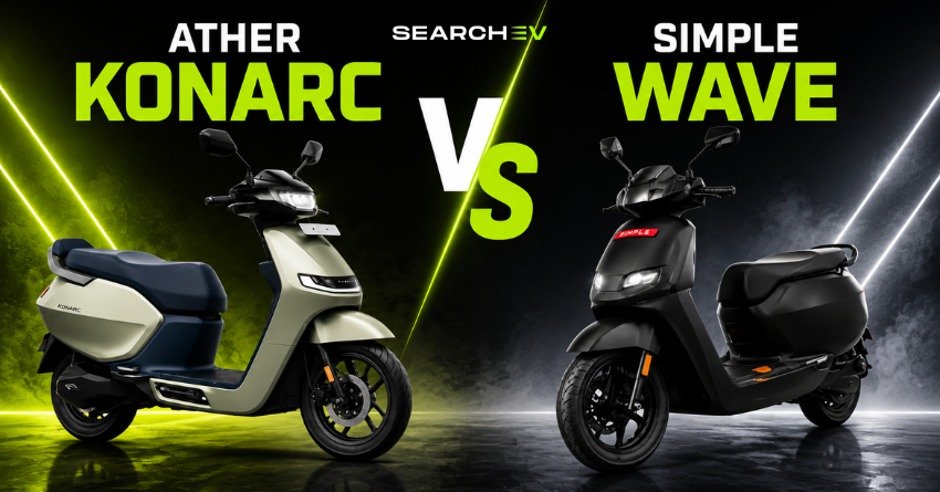
Three days. That’s the gap between Ather launching the Konarc on August 29, 2026, and Simple Energy set to reveal the Wave on September 2. Both scooters are aimed at the same buyer, someone who wants a practical, family-friendly electric scooter somewhere between one lakh and one and a half lakh rupees, and both companies are betting that this is where the next wave of EV adoption in India actually happens.
The Wave is Simple Energy’s first attempt at a scooter built around family use rather than outright range or speed, since everything the company has sold so far, the Simple One, the OneS, and the recent Ultra, has been built to win a spec sheet argument on range and acceleration. The Konarc, though, isn’t quite Ather’s first family scooter. That title belongs to the Rizta, which has been on sale since 2024 and has reportedly sold more than 2.8 lakh units. What the Konarc actually represents is Ather pushing that same family-scooter idea down to a sharper price point using an entirely new platform.
Pricing
Ather structured the Konarc lineup with multiple battery choices. Simple Energy is expected to position the Wave just below its flagship Simple One, targeting a similar premium commuter bracket.
| Model | Ex Showroom Price | Status | Target Audience |
| Ather Konarc S Line | Rs 99,000 to Rs 1.45 lakh (except 200 km range variant) | Launched | Tech-focused family buyers |
| Simple Wave | Rs 1.1 – 1.6 lakh (Estimated) | Launching September 2, 2026 | Range-focused urban commuters |
Design and first impressions
Both scooters lean into a similar visual language for this segment: a wide, single-piece seat, a flat floorboard, and a dual-tone paint theme meant to look premium. The Konarc, as the launched product, we know in detail: it uses a steel unibody chassis with metal body panels, the first for any Ather scooter, riding on a 1,352mm wheelbase, the longest in the company’s lineup, with 14-inch front and 12-inch rear wheels chosen specifically for stability on rough roads.
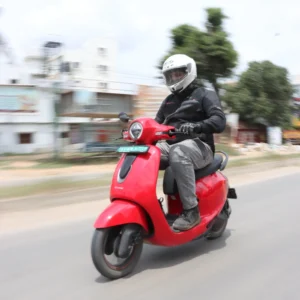
The Wave, still ahead of its reveal, is known mostly through spy shots and reported details. It reportedly gets a floating, spoiler-like pillion grab rail blended into the seat design and a dual-tone theme of its own. It features an apron-mounted LED headlamp, LED indicators positioned on the handlebar, and uniquely styled side mirrors.
Powertrain and performance
The Konarc uses a hub-mounted PMSM motor across its S line, producing 4 kW on the base S 100 and 4.7 kW on the S 125 and S 161, with 16 Nm of torque and a claimed top speed of 70 km/h. Zero to 40 km/h takes 5.0 seconds on the base variant and 4.7 seconds on the two higher ones.
The Wave, according to pre-launch reports, is expected to use a mid-drive, belt-driven motor rated at 4.5 kW with 35 Nm of torque, more than double what the Konarc offers on paper, and a claimed top speed of 80 km/h. Zero to 40 km/h is reportedly targeted at 3.5 to 4.0 seconds. If those numbers hold through to the actual launch, the Wave would be the quicker, torquier scooter of the two, and the belt-driven mid-drive layout is also a meaningfully different engineering choice from Ather’s hub motor.
Range and charging
Ather’s Konarc range figures, 100 km, 125 km, and 161 km depending on variant, are IDC certified, with a 200 km IDC variant confirmed but not yet priced.
Simple Energy is well known for the 265 km range of its Simple One flagship. Speculative reports suggest the Wave could boast a highly ambitious triple-digit range, potentially adapting a large battery architecture to offer class-leading endurance.
The Konarc ships with a 450 W charger built into the scooter, expandable with an additional off-board charger that Ather says pushes total charging capacity to 1.35 kW, cutting a 0 to 80 percent charge to around 2 hours on the base variant. Simple’s reported charging window for the Wave is a flat 4 to 5 hours for 0 to 80 per cent, with no combined or boosted charging option mentioned in early reports.
Simple’s existing scooters have also historically relied on owners charging at home rather than a public fast-charging network of the brand’s own, unlike Ather, which has spent years building out Ather Grid. Unless Simple reveals something new for the Wave specifically, this is likely to remain a point in Konarc’s favour.
Braking and safety hardware
The Konarc’s braking setup varies by variant. The base S 100 uses drum brakes front and rear, the S 125 and S 161 step up to a 220mm front disc with a rear drum, and the Z line adds Ather’s Advanced Electronic Braking System, described as reducing stopping distances and minimising rear-wheel lock-up during hard braking.
The Wave is reported to get a front disc brake paired with a Combined Braking System, a more basic setup that mechanically links front and rear braking rather than using electronic control.
Features, display, and software
The Konarc sets an incredibly high bar for onboard technology.
- Ather Konarc: The S line features a 7-inch DeepView display and an Advanced Electronic Braking System. It also includes active safety alerts like FallSafe and low-speed manoeuvring aids like AirWalk.
- Simple Wave: The upcoming scooter is expected to feature a full TFT instrument console with smartphone connectivity and dedicated navigation. It will utilise a front disc brake setup and full LED lighting.
What this comparison actually comes down to
On paper, Simple’s expected numbers for the Wave look competitive, in some cases better than the Konarc’s, particularly around torque and top speed. But paper specs are the easy part. The harder part, and the part where Ather currently has a clear lead, is everything that happens after the sale: service reach, charging infrastructure, and a track record of actually delivering scooters on the timeline promised. Simple’s own history with the Simple One suggests that the gap between announcement and delivery is something the company has struggled with before, though it’s also fair to note the company has grown its retail footprint meaningfully since then and has learned some hard lessons along the way.