
Tata Motors has established itself as a unique EV brand, pioneering sophisticated Tata electric cars in India based on modular electric vehicle architectures built with excellent quality standards. The automaker has also evolved from retrofitting existing internal combustion engine (ICE) platforms to building dedicated and bespoke electric car platforms, which have proved to be quite popular, for example, the launch of the Tata Sierra EV, a few months earlier. With a multi-tiered EV strategy, Tata EV cars are proving to be beneficial in extracting the best EV experience for their customers.
In fact, through the years, Tata has established a three-tiered EV strategy poised as the company’s architectural pillars, helping customers find a Tata EV car that meets requirements: Initially, Tata Motors introduced EV cars based on existing ICE platforms (resulting in the Nexon EV and Tiago EV). This transitioned into a tech-intelligent platform that can adapt to large battery packs. The next-generation platforms thereafter featured dedicated EV platforms with autonomous readiness.
Moreover, with its new-generation platform proving to be successful, with a positive sales trajectory, and based on the current launch trends and industry insights, Tata Motors may be preparing to make way for new EV additions to the lineup; we expect the following car launches:
Tata Safari EV | A Bold 3-Row EV SUV For India
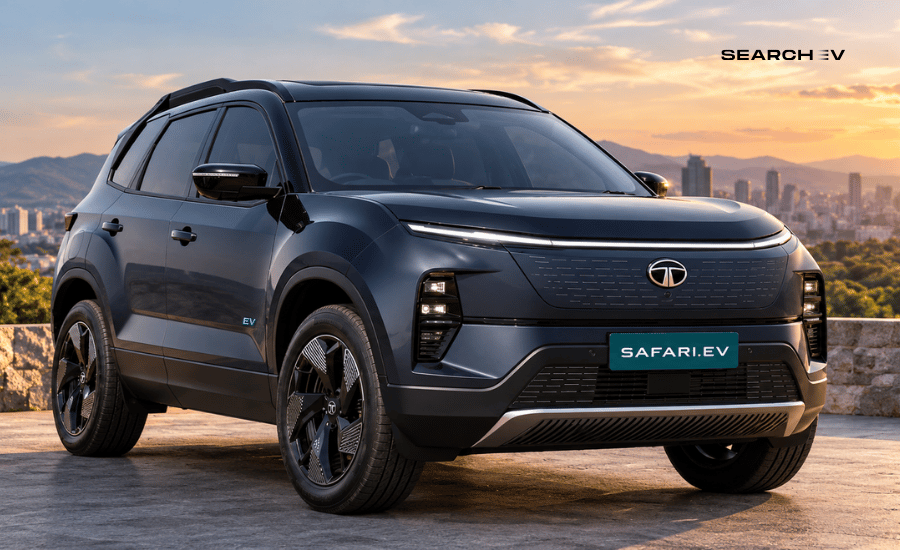
| Tata Safari EV Expected Prices | Base Model Price Can Start From | Rs 24 Lakh (Ex-showroom) |
| Top-End Trim Price Can Start From | Rs 30 Lakh (Ex-showroom) |
The upcoming Tata Safari EV has been spotted testing on Indian roads and is expected to be Tata Motors’ next big slated launch, designed around its Safari ICE counterpart, which carries forward the legendary SUV lineage; it resonates well with customers who prefer vehicular legacy. The upcoming Tata Safari EV will also serve as the flagship multi-seater model in Tata Motors’ portfolio; the vehicle will be a premium, family-orientated Tata EV SUV designed as an all-rounder, featuring front and rear axle motor configurations.
By leveraging the Land Rover D8-derived OMEGARC platform and making space for larger battery integration underneath the vehicle platform, the Safari EV will be designed with no compromise made to structural integrity and in-cabin space. In terms of performance too, the Safari EV from Tata Motors will be ahead of other vehicles in the lineup. Nevertheless, the following are the key specifications expected to feature in the upcoming Tata Safari EV in India:
Key Specifications And Expectations
| Tata Safari EV | Motor Configurations | All-Wheel Drive (AWD) With Optional Single Motor Front-Wheel Drive (FWD) |
| Battery Capacities | 65 kWh To 75 kWh | |
| Range | 500-550 km | |
| Charging Tech | 150 kW DC Fast Charging Capacity | |
| Features | Level 2 ADAS, ventilated 1st and 2nd row seats, multi-mode regenerative braking, triple-screen dashboard layout |
The Tata Safari EV’s recently spied mules also suggest that it can be designed to be similar in dimensions to that of the ICE counterpart; it is expected to measure 4668 mm in overall length, 1922 mm in overall width, and 1795 mm in overall height. With a wheelbase measuring 2741 mm, the cabin can be designed to accommodate occupants with utmost comfort, providing sufficient legroom, headroom, and shoulder room. The Safari EV will come as a 3-row electric SUV.
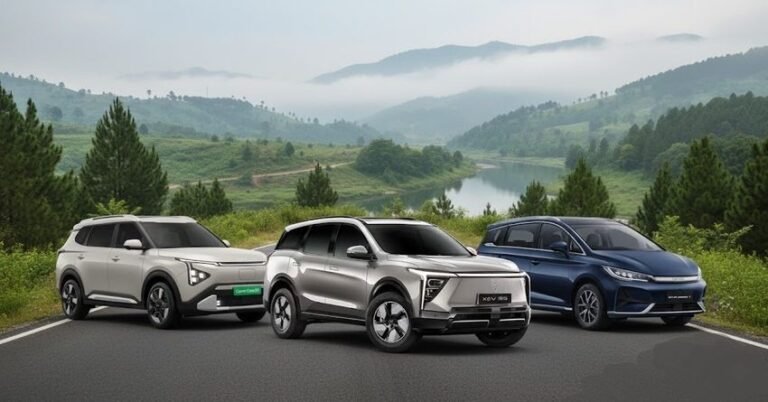
With all these attributes, the Tata Safari EV is expected to make a grand entry into the 3-row electric SUV market during the festive season of 2026. The Safari EV will feature range efficiency to reduce running costs while improving operating dynamics suitable for highway conditions. The cabin will also be designed to be roomy to seat occupants with adequate comfort. The use of dual-tone cabin colour themes is also expected to enhance the ambience and user experience. It will also have a triple-screen dashboard layout, which is also available in its direct rival – the Mahindra XEV 9S.
Tata Aeris EV | A Next-Gen Compact Electric Sedan
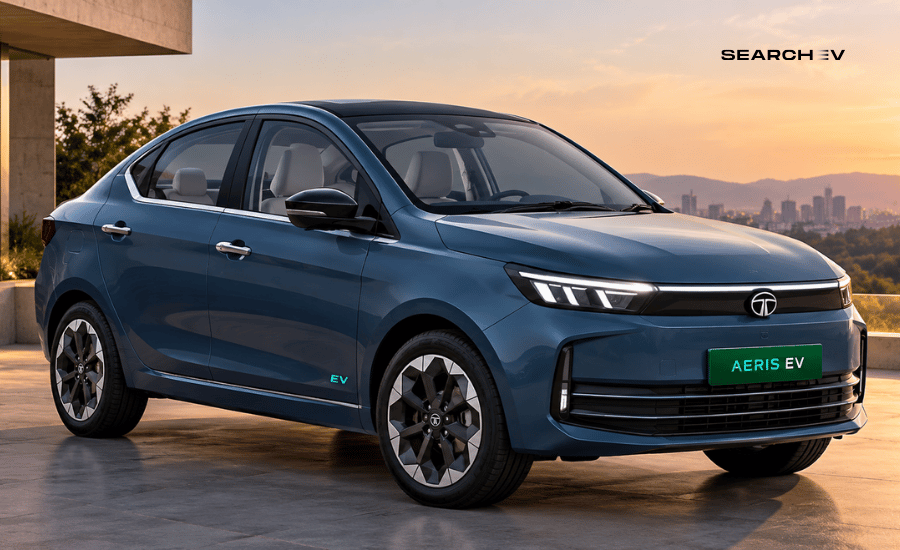
| Tata Aeris EV Expected Prices | Base Model Price Can Start From | Rs 10 Lakh (Ex-showroom) |
| Top-End Trim Price Can Start From | Rs 13 Lakh (Ex-showroom) |
The Tata Aeris EV is expected to be a spectacular technical successor of the Tata Tigor EV. Tata has already launched the updated Tiago EV in India and subsequently the ICE Aeris. So, it is quite natural that the all-electric Tata Aeris will follow.
It will feature sleeker body construction, with distinct elements that will be unique to the new EV iteration rather than being borrowed from the ICE Aeris counterpart. With an aerodynamic architecture, the Aeris EV will be designed to be more efficient than the Tigor EV for low running costs, all while being feature-rich to ensure the premium factor is associated with it.
The upcoming Tata Aeris EV will be meant for city commuters, eco-conscious and range-efficiency-focused fleet operators seeking premium urban transit vehicles, and for budget-conscious families in India. In terms of the design approach, the Aeris EV will still retain the notchback roofline and prominent glass area; however, the alloy wheels and fascia elements are expected to be different from the ICE counterpart for distinctiveness and to be much more aerodynamic for EV efficiency. Moreover, the following are the Tata Aeris EV’s expected specifications for a powerful experience:
Key Specifications And Expectations
| Tata Aeris EV | Motor Configurations | All-Wheel Drive (AWD) With Optional Single Motor Front-Wheel Drive (FWD) |
| Battery Capacities | 19.2 kWh To 26 kWh | |
| Range | 170-215 km | |
| Charging Tech | Supports 7.2 kW Home Wallbox Charger | |
| Features | Two-Spoke Tata Illuminated Steering Wheel, 360-degree Surround View Camera, Auto Climate Control System, 6 Airbags |
While the expectations are clear, the Tata Aeris EV will feature similar dimensions to those of the ICE counterpart: the in-production Aeris from Tata Motors. As an upcoming EV counterpart to the currently sold Tata Aeris, it is expected to come in dimensions measuring 3995 mm in overall length, 1684 mm in overall width, and 1532 mm in overall height. The wheelbase will be 2450 mm: this means the cabin is designed for sufficient legroom for rear-row passengers; the section will not feature the transmission tunnel. Hence, it is expected to feature a flatter floorboard for the foot room.
Overall, with a unique design approach that makes it stand out in the segment, well contrasted by featuring a unique blend of interior colour upholstery themes and exterior design elements, the upcoming Tata Aeris EV can truly resonate as a next-generation compact electric sedan in the EV segment and ecosystem.
Tata Avinya EV | A Pure ‘Born EV’ Gen SUV Evolution
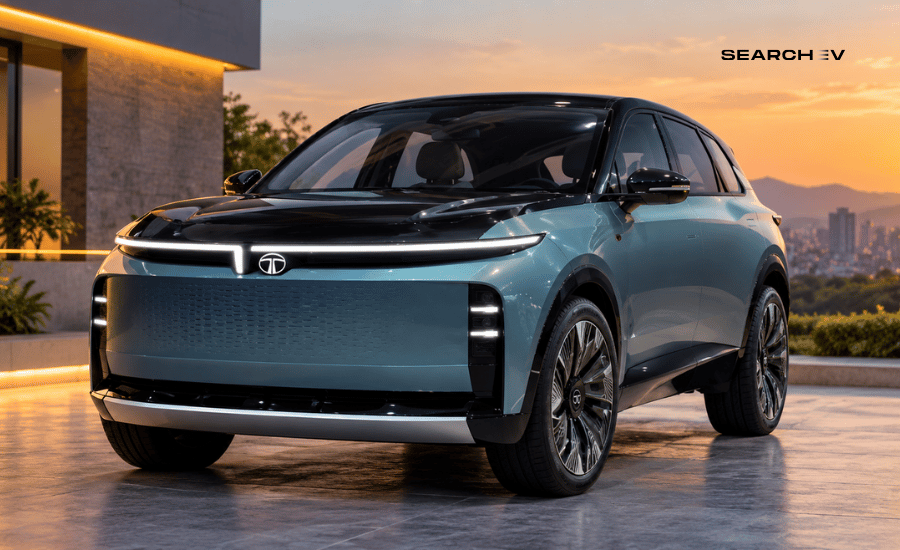
| Tata Avinya EV Expected Prices | Sportback Prices Can Start From | Rs 35 Lakh (Ex-showroom) |
| X SUV Concept Prices Can Start From | Rs 35-40 Lakh (Ex-showroom) |
The Tata Avinya EV represents the company’s foray into the luxury electric vehicle segment; the term “Avinya” is derived from the Sanskrit word for innovation, called ‘Navīna’, which this luxury car truly represents. In fact, the upcoming Tata Avinya EV moves away from the traditional silhouette with a much more aerodynamically poised architecture to ensure high-performance capabilities and an innovative appeal.
A few months earlier, Tata also announced that the Avinya will be built on the Chery-JLR (CJLR) Freelander platform, instead of the EMA architecture. It is designed to be a pure EV from the ground up, rather than borrowing an ICE architecture or platform to construct an EV iteration. The design is meant to feature a wider body construction with the aerodynamic wheel pushed out to corners to ensure sufficient cabin space. Devoid of an ICE construction, the car does not feature a transmission tunnel; hence, it should offer a flatter platform and an adequate footwell area.
That is not just what’s under its sleeves; the Tata Avinya EV is claimed by the company to be a high-power and torque-orientated luxury vehicle for India. The following are the key specifications:
Key Specifications And Expectations
| Tata Avinya EV | Motor Configurations | All-Wheel Drive (AWD) |
| Battery Capacities | 80 kWh To 85 kWh | |
| Range | 500-600 km | |
| Charging | 30 Minutes DC Fast Charging (For 500 km Range) | |
| Features | Wider Dashboard Construction, 360-degree Surround View Camera, Auto Climate Control System, Swivel Front Seats, Butterfly Doors |
While the Tata Avinya EV does the job well in the performance department, the Avinya EV will also be designed with a simple but effective dashboard, followed by premium interior integrations to enhance the luxury-sport coupe appeal. While the production-spec iteration is yet to be launched, the Avinya EV coupe concept reveals that the model can be designed with advanced driver assistance systems (Level-2 ADAS) and multiple airbags, stability control systems, and digital safety tech. With all these attributes, the Avinya EV is slated for launch in the latter half of 2027.
Tata Altroz EV | A Premium Electric Hatchback
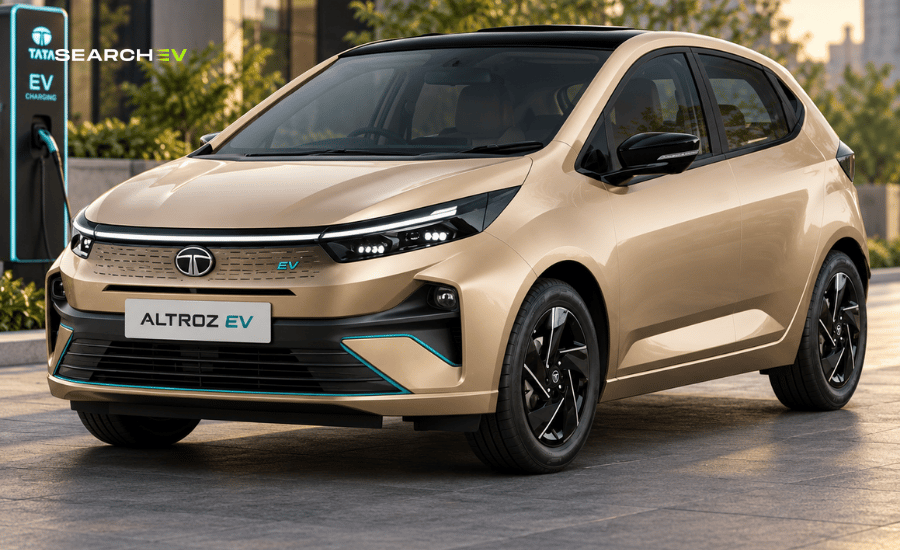
| Tata Altroz EV Expected Prices | Base Model Price Can Start From | Rs 24 Lakh (Ex-showroom) |
| Top-End Trim Price Can Start From | Rs 30 Lakh (Ex-showroom) |
The Tata Altroz EV was first showcased at the Auto Expo 2020 as a premium urban hatchback based on the ICE Altroz, which closes the gap between the Tata Tiago EV and the mid-size Nexon EV. Designed around the ALFA-ARC platform, the Altroz EV provides a high-strength construction to ensure occupant protection; in fact, the Altroz ICE counterpart has scored a 5-star in the GNCAP crash tests. The facelifted Altroz ICE scored a 5-star in BNCAP crash tests as well. This should mean that the Tata Altroz EV should also score a 5-star in crash tests when conducted in India.
In terms of design approach, the Tata Altroz EV is expected to retain the 90-degree openable doors and standard handling dynamics of the Altroz ICE currently sold in India. Swapping the ICE powertrain with an electric powertrain, the Altroz EV can offer higher torque performance. The floor-mounted battery pack should mean a flatter platform construction for better footwell area. On the subject of performance, the Altroz EV should feature the following aspects for better output:
Key Specifications And Expectations
| Tata Altroz EV | Motor Configurations | All-Wheel Drive (AWD) |
| Battery Capacities | 30 kWh to 45 kWh | |
| Range | 300-400 km | |
| Charging Tech | 50 kW DC Fast Charger (For 500 km Range) | |
| Features | 10.2-inch Infotainment System, Wireless Smartphone Charging Pad, 360-degree Surround View Camera, Auto Climate Control System, Electronic Parking Brake |
While the Tata Altroz EV is expected to roll out as a high-torque urban passenger car in India, the vehicle, with dimensions similar to those of the ICE counterpart, is engineered for similar drive dynamics – a standout aspect of the Altroz range, popularly spoken about by its customers. With solid highway composure, chassis stiffness, and reassuring power steering offering good feedback, these qualities of the ICE Altroz are expected from the upcoming Tata Altroz EV in India.
As for the launch timeline, industry insights suggest that the Tata Altroz EV is slated for launch in the early or later part of 2027. However, the company has not officially announced a timeline.
Conclusion | Upcoming Tata EV Cars Comparative Summary
| Vehicle Model | Target Range | Battery Capacity | Highlights |
| Tata Safari EV | 500-550 km | 65 kWh – 75 kWh | Premium 3-row EV SUV with AWD configurations |
| Tata Aeris EV | 170-215 km | 19.2 kWh – 26 kWh | Compact urban sedan with affordable price point |
| Tata Avinya EV | 500-600 km | 80 kWh – 85 kWh | Ultra-luxury and powerful born-EV design architecture |
| Tata Altroz EV | 300-400 km | 30 kWh – 45 kWh | Five-star safety hatchback with good driving dynamics |
All in all, it is evident that Tata Motors’ upcoming EV car lineup demonstrates a structured progression across segments, prioritising accessibility with lower pricing, high-performance capabilities and displaying future automotive tech. Supported by growing EV infrastructure ecosystem, tech suits and localised component manufacturing, Tata Motors is heading in the right direction for India and its EV space as of 2026-2027.