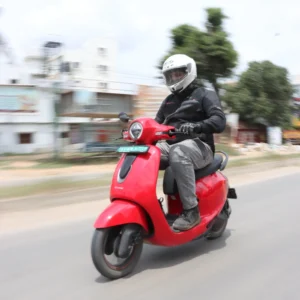
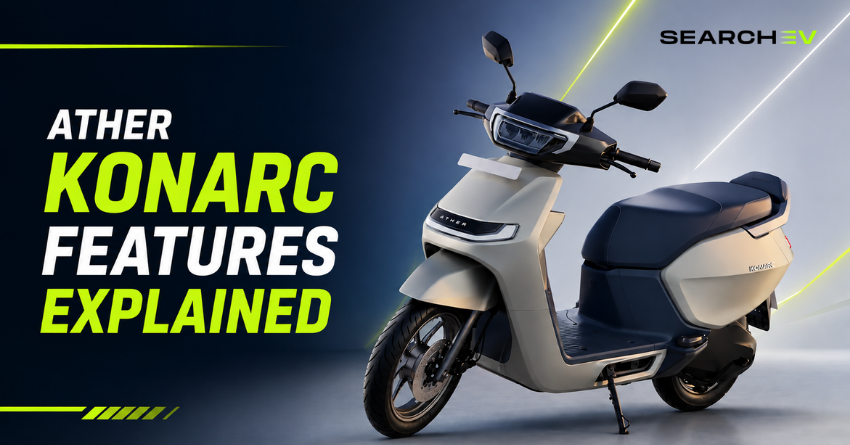
Ather Energy picked its fourth Community Day, held in Bengaluru on August 29, 2026, to introduce the Konarc. It had to be cheap. Not cheap in the way a company says “affordable”, but genuinely close to the one lakh mark that most buyers in this segment actually shop around. The base variant, called the S 100, is priced at Rs 99,999 ex-showroom.
The Ather Konarc rides on a new platform, called EL, and Ather says the underlying architecture was shaped using data pulled from 26 lakh kilometres of real-world riding by existing owners. Whether that number holds up over years of Konarc ownership is something only time will tell, but it does explain a lot of the design and features decisions here, from the metal body panels to the longer service intervals. Let’s go through what Ather has actually built into this scooter.
First Ather With Metal Body and Longest Wheelbase
The Konarc uses a steel unibody chassis with metal body panels, a first for any Ather scooter. Ather’s argument is that metal panels hold up better against dents and daily wear, and also something that the consumers wanted more than the team at Ather believed, though it carries roughly the same sub-130 kg kerb weight as the Ather Rizta.
The wheelbase is 1,352mm, the longest of any Ather scooter so far, aimed squarely at stability on the kind of broken, pothole-riddled roads that make up most Indian streets. And the front wheel is a 14-inch unit paired with a 12-inch rear, a combination chosen specifically for its ability to absorb road irregularities better than the smaller wheels typically used on scooters in this price band. Suspension travel sits at 90mm up front and 100mm at the rear.
The Tech Stack: DeepView displays and the Ather Software Suite
Ather has always leaned on software as a differentiator, and the Konarc doesn’t change that approach even at a lower price point. The base S 100 gets a 4.2-inch DeepView display, while the S 125 and S 161 step up to a larger 7-inch DeepView unit. Both run on AtherStack, the company’s in-house software layer that has, over successive updates, added things like turn-by-turn navigation, voice commands, call and music alerts, and OTA update support so the scooter’s feature set can grow even after purchase.
Connectivity runs through Bluetooth and SIM-based data, tied into the Ather App on the owner’s phone. Depending on the variant, that unlocks Find My Scooter, ride stories, remote charging status checks, and theft and tow alerts. On the Z line specifically, the dashboard goes a step further with Google Maps and WhatsApp shown directly on the display, along with live cricket scores while the scooter is parked.
Standout Features: AirWalk and the Magic Key
Two features got most of the attention at the launch.
AirWalk is a sensor-assisted system that uses the motor to gently help a rider push or pull the scooter around at walking pace, useful for tight parking spots, reversing out of a crowded lane, or manoeuvring on a slope without straining against the scooter’s weight. It’s offered on the S 125, S 161, and the Z variants, but not on the entry-level S 100.
The smart key system, which Ather calls MagicKey, is a bigger jump, and it is exclusive to the Konarc Z line. MagicKey brings SmartWake, which arms the scooter as the rider approaches with the key still in their pocket, and an auto-lock function that engages once the rider walks away. It can also open the boot, help locate the scooter through a ping command that triggers lights and sound from roughly 30 metres away, and, in a nice touch for anyone who’s ever forgotten their key at home, allows the scooter to be started offline using a code generated through the app.
Other convenience features that run across the higher variants include AutoHold, which keeps the scooter stationary at a stop without the rider having to hold the brake, and a reverse Park Assist that uses the motor to help back the scooter out of a spot.
Ather Electric Scooter With the Highest Range: Up to 200km
Ather has confirmed six variants in total, split across an S line and a Z line. The S line currently spans S 100, S 125, S 161, and a fourth S variant claiming up to 200km on the IDC test cycle. Of these, only three have confirmed pricing today: the S 100 at Rs 99,999, the S 125 at Rs 1,21,999, and the S 161 at Rs 1,44,999, all ex-showroom.
The 200km S variant, along with both Z-line options at the 125km and 161km IDC ranges, has been announced in name only. Ather has not released pricing for any of these three, and reports around the launch suggest the 200km version may not reach customers until sometime in 2027, well after the initial S 125 and S 161 units start reaching buyers.
The S 100 runs a 2.1 kWh battery for a claimed IDC range of 100km, with an 80km TrueRange figure that’s meant to reflect more realistic riding. The S 125 and S 161 use 2.7 kWh and 3.5 kWh packs, respectively, with TrueRange figures of 100km and 130km. All three share a 4kW to 4.7kW PMSM hub motor, 16Nm of torque, a claimed top speed of 70km/h, and a 16 degree gradeability rating.
| Line | Variant | Claimed Range (IDC) | Ex Showroom Price | Delivery Timeline |
| S Line | S 100 | 100 km | Rs 99,999 | Q1 2027 |
| S Line | S 125 | 125 km | Rs 1,21,999 | Sep 2026 |
| S Line | S 161 | 161 km | Rs 1,44,999 | Sep 2026 |
| S Line | S 200 | 200 km | Price TBA | Q3 2027 |
| Z Line | Z 125 | 125 km | Price TBA | Q2 2027 |
| Z Line | Z 161 | 161 km | Price TBA | Q2 2027 |
Combined Charging Capability: 0-80% Charge in 2 hours
Charging has also been simplified. Every Konarc ships with a 450W charger built into the scooter itself, using the same drive controller that also runs the motor, so there’s no separate charging brick to carry around. Ather says this can be paired with up to a 900W portable charger to push total charging capacity to 1.35kW, cutting a 0 to 80 per cent charge from roughly 4 hours down to about 2 hours on the S 100, with similar reductions on the S 125 and S 161 (2 hours 25 minutes). Ather also quotes a fast-charging figure of 13km added in 10 minutes for the S 100, rising to 15km in 10 minutes for the S 125 and S 161.
Safety Tech: AEBS, Pothole Alerts, and the Rest of the Suite
Ather’s braking headline for the Konarc is AEBS, its Advanced Electronic Braking System. Worth clarifying here, this isn’t the same thing as the automatic collision-braking systems seen on some cars. It’s an electronically controlled brake system meant to reduce stopping distances and cut down on rear-wheel lock-ups under hard braking, and like MagicKey, it’s exclusive to the Konarc Z line. The S line variants make do with a more conventional setup: drum brakes front and rear on the S 100, and a 220mm front disc paired with a 130mm rear drum on the S 125 and S 161.
Beyond the mechanical side, the AtherStack software brings pothole alerts, crash alerts, and tow alerts across the connected variants, warning riders or owners when something out of the ordinary happens to the scooter, whether that’s a rough patch of road ahead flagged through crowd-sourced data, a fall detected by onboard sensors, or the scooter being moved without authorisation.
The motor and the Bedrock battery pack are both rated IP67 for dust and water resistance, and Ather says the battery pack includes faster active cell balancing along with a damage-detection system it calls BreachSense, designed to flag internal battery issues within 24 hours rather than letting them go unnoticed.
Another safety feature is FallSafe, which cuts power to the motor if the scooter tips over, a small but sensible safeguard against the throttle being accidentally twisted while picking the scooter back up
Vehicle Health Monitoring and Why it Matters for Resale
One of the more understated additions on the Konarc is a feature Ather is calling True Health. It works as a scorecard, generated within the Ather App, that scans the scooter’s key components, the battery, the motor, and other wear-prone parts, and produces both an overall health score and individual scores per component.
The idea is to give an owner (and eventually a prospective used buyer) a transparent, data-backed picture of how much life is left in the vehicle rather than relying on a service centre’s word or a seller’s assurance. Ather frames this partly as a resale tool, since a documented health history could support a fairer asking price when the scooter changes hands, and partly as a maintenance aid, flagging which components are approaching the end of their useful life before they actually fail.
10,000 km Service Interval
Ather has doubled the periodic service interval on the Konarc to 10,000km or once a year, whichever comes first. The company says this was made possible partly by a reduced parts count on the EL platform, which it claims makes assembly around 15 per cent faster and routine servicing up to twice as quick, and partly by repositioning components that do need regular attention so they’re easier to reach.
At the Community Day event, Ather had technicians strip down and reassemble a Konarc’s battery and motor in around three minutes on stage, a demonstration meant to underline how serviceable the platform is meant to be.
The standard vehicle and battery warranty runs for 3 years or 30,000km. With AtherStack Pro, the battery warranty extends to 5 years or 60,000km, and buyers can also opt for an extended battery warranty of 10 years or 1,00,000 km, whichever comes first, with Ather guaranteeing a minimum 70 per cent state of health at the end of that period.
Where this Leaves the Konarc
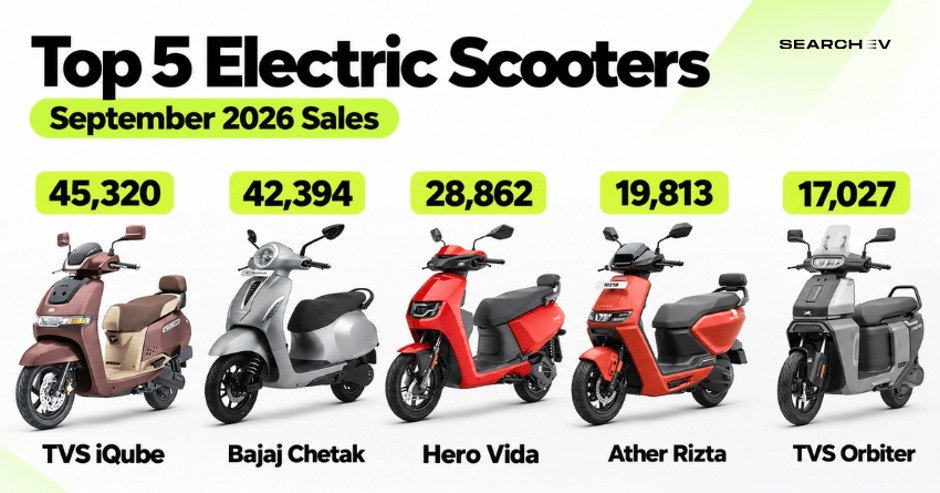
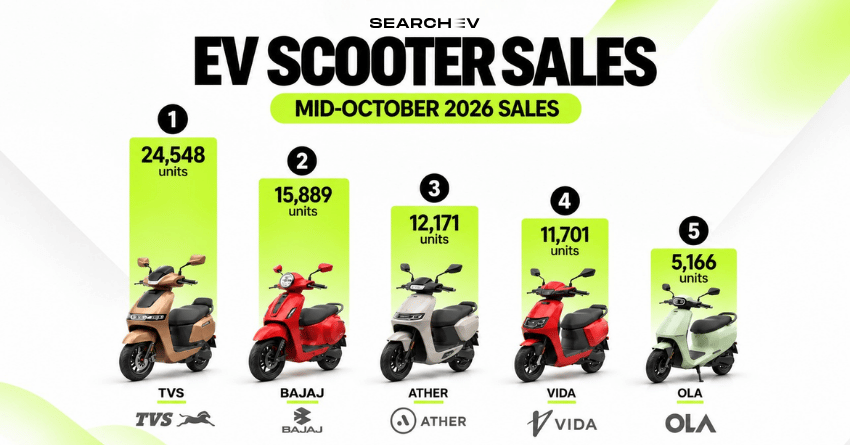
Ather has been fairly upfront that the Konarc exists to compete in the part of the market it has never really touched before, the Rs 1 lakh to Rs 1.25 lakh band where, by the company’s own estimate, close to half of all electric scooter sales in India happen. That pits the Konarc directly against the Bajaj Chetak, the TVS iQube, Ola’s S1 range, and Hero’s Vida VX2. Whether the Konarc’s feature set is enough to pull buyers away from more established or cheaper rivals will depend on how these numbers hold up once the scooter is actually out on Indian roads in meaningful volumes, rather than on a stage in Bengaluru.