Key Takeaways
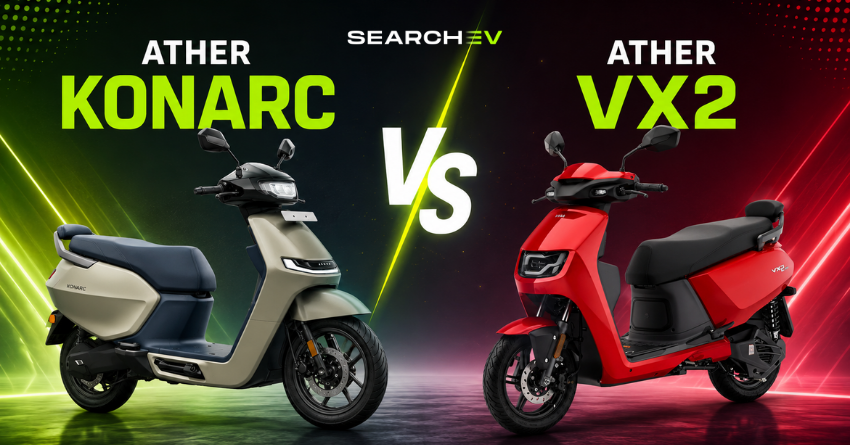
- The Ather Konarc S line starts at Rs 99,000 and offers four battery range options spanning from 100 km to a massive 200 km.
- The Chetak 3001, at Rs 1,19,270 ex-showroom before the PM E-Drive subsidy, lines up closely with the Konarc S 125 on both price and range.
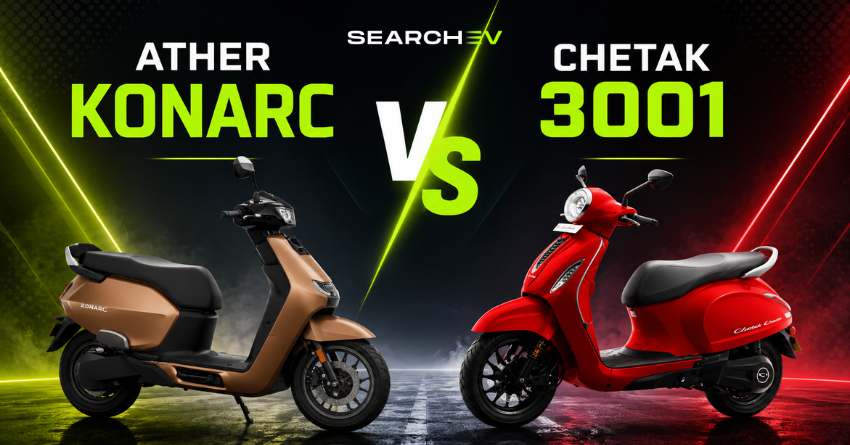
- The Chetak 3001 features a 3.0 kWh battery pack delivering an IDC-certified range of 127 km, while the Konarc S (125 km) variant packs a 2.7 kWh one.
- Both models rely on a metal body, and while Konarc has 31 litres of underseat storage, the Chetak packs 35 litres of space.
- Ather equips the Konarc S with a 220 mm front disc brake, a 7-inch TFT display, FallSafe alerts, and AirWalk low-speed motor assist.
- The Chetak 3001 has a 63 km/h top speed, while the Konarc delivers a 70 km/h top speed through a 4.7 kW peak motor.
Ather Konarc vs Chetak 3001: Price and Value Comparison
Ather has built the Konarc on what it calls the EL platform, a chassis designed from the ground up to be shared across several future products rather than a one-off scooter. The pitch behind it is cost efficiency, and that shows up directly in the price list, which starts nearly Rs 20,000 below anything else Ather currently sells.
The Chetak, on the other hand, is a nearly six-year-old product line that Bajaj has kept refreshing with new battery tiers rather than replacing outright. The Chetak lineup covers a broad price spectrum, spanning from entry-level variants to top-tier models equipped with high-capacity battery packs. The Chetak 3001 variant occupies a crucial middle spot in the Bajaj electric scooter lineup, priced at Rs 1,19,270 before any PM E-DRIVE government incentives.
Ather structured the new Konarc lineup across two branches called the S line and Z line. The entry-level Konarc S line offers four range configurations. When looking for the most direct competitor to the Chetak 3001 in terms of pricing and battery endurance, the Ather Konarc S line 125 km variant (priced at Rs 1,21,999) matches it closely. Buyers looking to spend less can also consider the base Konarc S line 100 km variant at Rs 99,000.
| Variant | Ex Showroom Price | Battery Size | Claimed Range | Top Speed |
| Bajaj Chetak 3001 | Rs 1,19,270 | 3.0 kWh | 127 km | 63 km/h |
| Ather Konarc S line (100 km) | Rs 99,000 | 2.1 kWh | 100 km | 70 km/h |
| Ather Konarc S line (125 km) | Rs 1,21,999 | 2.7 kWh | 125 km | 70 km/h |
| Ather Konarc S line (161 km) | Rs 1,44,999 | 3.5 kWh | 161 km | 70 km/h |
Design, Dimensions, and Practicality Comparison
| Specification | Ather Konarc S125 | Chetak 3001 |
| Wheelbase | 1,352 mm (longest in Ather’s own lineup) | 1,355 mm |
| Front Wheel | 14-inch alloy | 12-inch alloy |
| Rear Wheel | 12-inch alloy | 12-inch alloy |
| Rear Suspension Travel | 100 mm | 84 mm |
| Underseat Storage | 31 litres | 35 litres |
| Body Construction | Metal body panels | Metal body panels |
Both scooters lean on metal body panels. The Ather Konarc adopts angular bodywork supported by a steel unibody chassis. It features dual LED headlamps, a wide apron light bar, and a cushioned adjustable pillion grab rail.
The Chetak actually edges out the Konarc on wheelbase, if only by 3 mm, despite Ather specifically calling out the 1,352 mm figure as the longest in its own scooter range. Where the Konarc does pull ahead is at the front wheel. A 14-inch alloy up front, compared to the Chetak’s 12-inch unit, should theoretically help it roll over potholes and broken tarmac with less drama, and Ather has paired it with a fairly generous 100 mm of rear suspension travel for comfort over rough patches.
The Chetak’s advantage lies in practicality. Its 35 litres of underseat storage is enough to swallow a full-face helmet along with a bag or two, something plenty of scooters in this price bracket still struggle with, though Ather goes one up with an auto pop boot release feature along with a knee-operated catch tucked under the backrest, useful when your hands are full and the key is buried in a pocket.
Ather Konarc vs Chetak 3001: Which EV Offers More Features?
| Feature Category | Ather Konarc S 125 km | Bajaj Chetak 3001 |
| Instrument Cluster | 7-inch DeepView display | Digital Colour LCD |
| Riding Modes | SmartEco, Eco, Power | Eco, Sport |
| Navigation | Live navigation with built-in Google Maps | Turn-by-turn navigation |
| Front Braking Hardware | 220 mm Disc Brake | Drum Brake |
| Rear Braking Hardware | Drum Brake | Drum Brake |
| Reverse Assist | Park Assist Reverse | Standard Reverse Throttle |
| Hill Hold Control | Yes | Yes |
| Active Safety Telematics | FallSafe, Theft and Tow Alerts | Not Available |
| Low-Speed Manoeuvring | AirWalk Motor Assist | Standard Reverse |
| Smartphone Alerts | Call and Music Notifications | Call and SMS Notifications |
Unique Features of the Ather Konarc
- Airwalk: a low-speed motor assist that gently nudges the scooter alongside you while walking it by hand, meant to make parking and manoeuvring in tight spaces feel less like wrestling with the scooter’s actual weight.
- AEBS (Advanced Electronic Braking System): an electronically managed braking setup that Ather says raises peak braking force by up to 20 per cent compared to a standard setup, while still working to prevent the wheels from locking up.
- Smart key convenience suite: covers keyless start, a find-my-scooter function, an auto pop boot release, and more.
- Charging capability: Ather Grid network access with more than 6,000 fast chargers across the country, paired with a 450W onboard charger on the scooter itself and support for an additional portable charger to push total charging capacity higher.
- FallSafe System: An active sensor suite that cuts motor power and sends immediate alerts if the vehicle tips over.
Performance, Range, and Charging Speed Comparison
| Specification | Ather Konarc S 125 km | Bajaj Chetak 3001 |
| Acceleration (0 to 40 km/h) | 4.7 seconds | NA |
| Battery Capacity | 2.7 kWh | 3.0 kWh |
| Official Range (IDC) | 125 km | 127 km |
| Top Speed | 70 km/h | 62 km/h |
| Peak Motor Output | 4.7 kW | 3.1 kW |
| Standard Home Charging (0 to 80%) | 4 hours 30 minutes (450W Onboard); 2 hours 25 minutes (with combined charging) | 3 hours 30 minutes |
| Fast Charging Capability | Ather Grid (15 km in 10 minutes) | Standard AC Home Charging Only |
| Standard Vehicle and Battery Warranty | 3 Years / 30,000 km (Extendable to 10 Years / 100,000 km) | 3 Years / 50,000 km |
The Ather Konarc S 125’s 70 kph top speed beats the Chetak 3001’s 62 kmph, which should translate to a bit more confidence on faster stretches of road, even if neither scooter is really built with highway riding in mind. The two are almost very closely matched even on range, 125 km against 127 km, so this really comes down to top speed and features rather than how far either can travel on a full charge.
Charging is where the Konarc’s onboard hardware looks like a genuine step up. The Chetak’s 3.5-hour charge time for a similar 0 to 80 per cent top-up isn’t unusual for this class of scooter, but it does mean planning your charging around a longer window if you’re topping up between rides.
Ather Konarc vs Chetak 3001: Which Electric Scooter is the Better Buy?
Ather Konarc S125 Pros and Cons
Pros:
- A software and connectivity package, including standalone navigation, voice commands and a fully connected safety suite, that nothing at this price point currently matches
- Genuinely useful touches like Airwalk and the multi-point smart key system
- Access to one of India’s largest EV-specific fast charging networks through Ather Grid
- The 4.7 kW PMSM motor delivers a brisk 4.7-second sprint to 40 km/h and a usable 70 km/h top speed.
Cons:
- Underseat storage at 31 litres is slightly smaller than the Chetak.
- Deliveries for some variants start only in 2027.
Chetak 3001 Pros and Cons
Pros:
- The class-leading 35-litre boot space swallows large gear easily.
- Clean metal retro styling that carries timeless visual appeal.
- Established service presence across regular Bajaj two-wheeler dealerships.
Cons:
- A basic, non-touch instrument display that looks dated next to the Konarc’s touchscreen
- Lacks a front disc brake option and misses public fast charging compatibility.
Expert Take on the Best Electric Scooter for You
If you want a dependable runabout with classic retro styling, straightforward mechanicals, and maximum underseat luggage space for daily shopping, the Bajaj Chetak 3001 remains a very sensible pick.
But once you compare the two on a genuine like-for-like basis, the Chetak 3001 against the Konarc S125, the Konarc brings a touchscreen, more advanced safety and ride features, and a higher top speed, all for marginally more money. If you can wait a few weeks and want the newer platform with noticeably more tech for a small price premium, the Konarc S125 looks like the better long-term bet.