Walk into any EV showroom today and ask the salesperson what kind of battery the car uses. Here is a good chance they will say LFP. Ask them to explain what that means, and half the time you will get a blank stare or a rehearsed answer that leaves you more confused than before.
Here is the honest explanation for it.
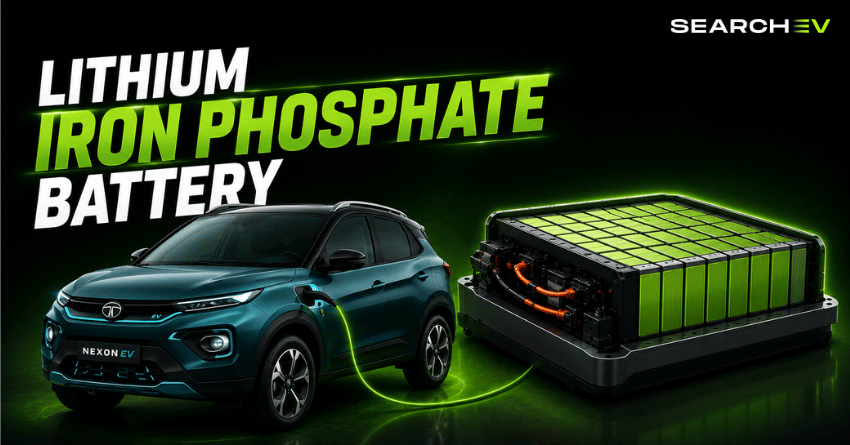
LFP means Lithium Iron Phosphate. It is a type of battery chemistry that has become the go-to choice for a growing number of electric vehicles worldwide. Tesla uses it. BYD swears by it. CATL, the world’s largest battery manufacturer, produces millions of them every year. And the reason all these big names trust it comes down to something very simple—it works, it lasts, and it does not cost a fortune to make.
Why Does Battery Chemistry Even Matter to a Regular Driver?
Most people buying a car do not think about chemistry. They think about range, price, charging time, and reliability. Fair enough.
But here is the thing — the chemistry inside your battery pack directly affects all four of those things. It decides how long your battery stays healthy. It decides whether you can charge to 100 percent every night without slowly killing it. It decides how the car handles summer heat and winter cold. And it plays a big role in what you eventually pay for the vehicle.
So understanding what is sitting under your floor actually helps you make smarter decisions about how you charge, how you drive, and what to expect over the years.
The Simple Version of How It Works
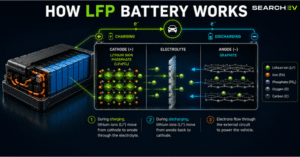
Every battery—your phone, your laptop, your electric car—works by moving tiny particles called lithium ions back and forth between two sides.
One side is the positive end, called the cathode. The other is the negative end, called the anode. Between them is a liquid that lets those ions travel freely.
Charging pushes the ions one way. Driving pulls them back. That movement is what creates electricity and keeps your wheels turning.
Now, what makes LFP different from other lithium batteries is the material used on the positive side — the cathode. Instead of cobalt or nickel, which most older EV batteries relied on, LFP uses iron and phosphate.
That switch might sound minor. The consequences are anything but.
Iron and Phosphate — Why This Combination Works So Well
Cobalt makes batteries energy-dense. You can pack a lot of power into a relatively small space. But cobalt is expensive, difficult to source cleanly, and—most importantly—it becomes chemically unstable when things heat up. That instability is what causes some batteries to catch fire or degrade rapidly in hot weather.
Iron and phosphate bond differently. The connection between them is tight and chemically very stable. You can heat an LFP battery well beyond normal operating temperatures, and it still holds together without breaking down or releasing dangerous gases.
This is why LFP batteries do not catch fire the same way as cobalt batteries can. The risk of what engineers call thermal runaway — where heat causes a chain reaction that keeps getting worse — is dramatically lower with LFP.
For a regular driver, this means you are sitting on top of a battery that is significantly safer, runs cooler, and handles stress far better than what was standard five years ago.
What Actually Happens When You Charge and Drive
When you plug your car in overnight, electricity flows into the battery and pushes lithium ions from the iron phosphate cathode across to the graphite anode on the other side. The battery holds them there, like water stored behind a dam.
When you start driving, those ions flow back toward the cathode. As they move, they release electrons — and those electrons travel through the circuit that powers your motor.
Your car’s battery management system watches over this entire process constantly. It checks temperature, voltage, and remaining charge hundreds of times per second. For LFP batteries, one of their key jobs is making sure the battery does not sit at very low charge for extended periods, which is one of the few things that genuinely causes wear over time.
One quirk worth knowing—LFP batteries have what is called a flat voltage curve. Unlike other batteries that show a gradual, predictable voltage drop as they discharge, LFP batteries hold a nearly steady voltage for most of their discharge range and then drop quickly near the end. Your car uses voltage to estimate how much range you have left. When that voltage barely changes for a long stretch, the range estimate can feel slightly off, particularly in the last 15 to 20 percent. This is not a fault. It is just how the chemistry behaves.
The Charging Habit That Changes Everything
Here is something that surprises a lot of new EV owners with LFP batteries.
With most cobalt-based batteries, manufacturers tell you not to charge above 80 percent in daily use. Sitting at full charge for hours puts stress on those cells and speeds up degradation over time.
LFP chemistry does not have the same problem. The cells are stable enough at full charge that most manufacturers actually tell you to charge to 100 percent regularly. Not just occasionally — regularly. Some systems even need that full charge periodically to keep the battery management system calibrated correctly.
This is genuinely freeing for daily drivers. Plug in every night, wake up to a full battery, and go. No mental math around keeping it between 20 and 80.
How Long Does an LFP Battery Actually Last?
This is the question most people really want answered.
LFP batteries are rated for somewhere between 2,000 and 4,000 full charge cycles before significant capacity loss appears. To put that in real terms, if you charge your car once a day, 2,000 cycles is roughly five and a half years of daily charging. 4,000 cycles is nearly eleven years.
Most drivers do not do a full charge cycle every single day. Partial charging cycles are gentler on the battery. The realistic lifespan for most LFP-equipped EVs under normal ownership is well over a decade of healthy capacity.
Cobalt-based batteries typically manage between 1,000 and 2,000 cycles under similar conditions. The difference is not small.
The Two Things LFP Does Not Do As Well
Cold weather hits LFP harder than it hits some other chemistries. When temperatures fall below freezing, lithium ions slow down inside the electrolyte. The battery delivers less power and charges more slowly. You will notice a real range drop on cold mornings.
The fix is preconditioning — warming the battery before you drive or charge using your car’s app or built-in timer. It works well, but it requires you to be proactive rather than just jumping in and going.
Energy density is the other limitation. A lithium iron phosphate battery is heavier and physically larger than a cobalt-based battery storing the same amount of energy. For manufacturers trying to squeeze maximum range out of a lightweight car, that matters. For most drivers doing under 200 miles a day, it rarely causes a real problem.
Cars Running on LFP Right Now
The Tesla Model 3 and Model Y standard range both run on LFP cells. Every BYD model — the Atto 3, Seal, Dolphin, and their newer releases — uses LFP. The MG4, entry-level Volkswagen ID.3, and several other mainstream EVs have made the same choice.
The next step beyond standard LFP is LMFP—Lithium Manganese Iron Phosphate—which adds manganese to push energy density higher while keeping the safety and longevity advantages. Several manufacturers are already moving in that direction.
The Honest Takeaway
If your EV has an LFP battery, you got a good deal—whether the showroom made that clear or not.
Charge it fully. Drive it normally. Do not lose sleep over degradation. This chemistry was built for exactly the kind of daily use most people put their cars through, and it holds up far better over time than the alternatives that came before it.
The most impressive battery is not always the one with the biggest numbers. Sometimes it is the one that just keeps working, year after year, without asking for much in return.
LFP is that battery.