So you’ve decided to make the switch from petrol. Good timing, honestly. First-gen Nexon EVs, Tiago EVs, and MG ZS EVs are sitting between ₹7 and ₹17 lakh in the used market — and the running cost difference kicks in from day one.
But buying a used EV is completely different from buying a used petrol car. With petrol, the odometer and a service book tell you most of what you need. With a used EV, the most critical component — the battery — has no mandatory health disclosure in India. No standardised certification. The seller isn’t legally required to hand you a battery report. That one number can flip a smart deal into an expensive mistake.
Here’s what to check before you commit.
Step 1 — Battery State of Health Comes First
Not the price. Not the colour. The battery.
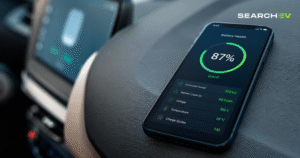
Battery State of Health — SoH — tells you how much capacity is left versus when it was new. A car rated for 300 km at 75% SoH now does roughly 225 km in real conditions. In Indian cities where public charging isn’t always nearby, that gap is a daily problem.
India’s heat and stop-go traffic are harder on batteries than almost anywhere else. A well-maintained five-year-old battery should still read above 85%.
What the numbers mean:
- Above 85% — Buy with confidence
- 80–85% — Fine, slight negotiation
- 75–80% — Negotiate hard, check warranty carefully
- Below 75% — Walk away or demand a serious discount
Ask the seller to show the battery health screen in settings. Better yet, request an official diagnostic from an authorised service centre — Tata, MG, and Hyundai can generate these in minutes. Hesitation to show this is its own answer.
Step 2 — How Much Battery Life Is Left?
Most EV batteries in India are covered for 8 years or 1,60,000 km. Within that window, if the battery drops below 70% SoH, the manufacturer must repair or replace it.
Four years of warranty remaining is real financial protection. Three months is nearly nothing. Confirm it transfers to your name in writing — and factor the remaining coverage into your price negotiation. Warranty left is money.
Step 3 — Drive It Properly, Not Just Around the Block
A 5-minute loop tells you nothing about battery health. Take it for at least 15–20 km in real conditions — city traffic, AC running, the way you’d actually use it.
Watch how fast the range drops versus distance covered. A healthy battery tracks close to the official spec. If you’re losing 30 km of range for every 20 km driven, the battery is working harder than the SoH suggests. Understanding how fast charging and slow charging affect the battery differently is useful context here — ask how the vehicle was primarily charged day-to-day.
Step 4 — Ask About the Charging History
Three years of charging habits can affect battery health as much as mileage itself.
Did they charge at home overnight on a slow charger or rely heavily on DC fast chargers? Did they regularly charge to 100% or stay in the 20–80% range? Did they plug in right after long drives without letting the battery cool — especially important in Indian summer heat?
Heavy fast charging, constant full charges, and charging on a hot battery all wear cells faster. If the EV has app connectivity, ask to see the charging history directly. Reluctance here is a signal.
Step 5 — Inspect the Charging Port
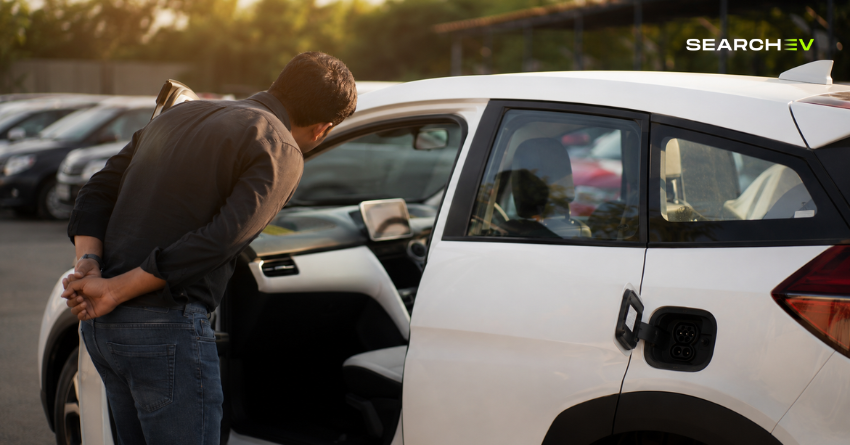
This gets skipped almost every time. A daily-use EV has had its charging port plugged and unplugged hundreds of times. Look for bent pins, corrosion, or discolouration inside the port. Check the flap closes and seals cleanly.
A damaged port causes slow charging and intermittent failures — the kind of post-purchase surprise you don’t want in week two of ownership.
Step 6 — Check the Software Version
Takes 30 seconds. Check which software version it’s running and when it last got an OTA update. An EV that hasn’t updated in over a year has likely been offline or sitting unused — missing battery management improvements, safety patches, and feature fixes that come through regular updates.
Step 7 — Sort the Documents
Before any money moves:
- RC — correct details, listed as a battery electric vehicle
- Insurance — active, no prior fire or accident claims
- Service history — from authorised centres, no unexplained gaps
- NOC — mandatory if registered in another state
- Battery warranty transfer — confirmed in writing from the brand
Documentation gaps after the keys are in your hand take weeks to sort. Don’t skip this even if the vehicle itself checks out.
One More Thing — Service Network
A used Nexon EV with good battery health and three Tata service centres in your city is a completely different buy from a lesser-known brand whose nearest authorised service is 200 km away. Check this before you commit.
Bottom Line
Used EVs in 2026 make real financial sense for anyone switching from petrol. But nobody is automatically protecting you from a bad battery.
Check the SoH, push for diagnostics, verify warranty transfer, watch the real-world range, sort the paperwork. Get those right and this is one of the smartest vehicle purchases available in India right now.
Stay on top of every EV ownership tip and buying guide — SearchEV covers what actually matters for Indian EV owners.