Key Takeaways
- The petrol and diesel versions of the Syros are comparatively cheaper to buy upfront, but the EV returns lower running costs
- The ICE Syros comes with 1.0-litre turbo-petrol and 1.5-litre diesel options, while the Syros EV offers 42 kWh and 51.4 kWh battery packs.
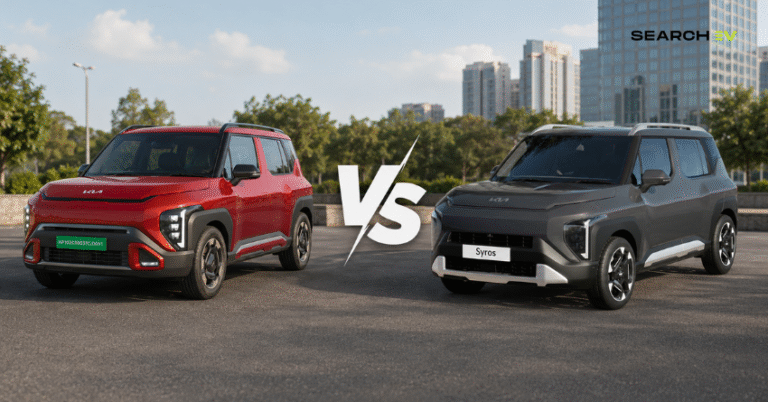
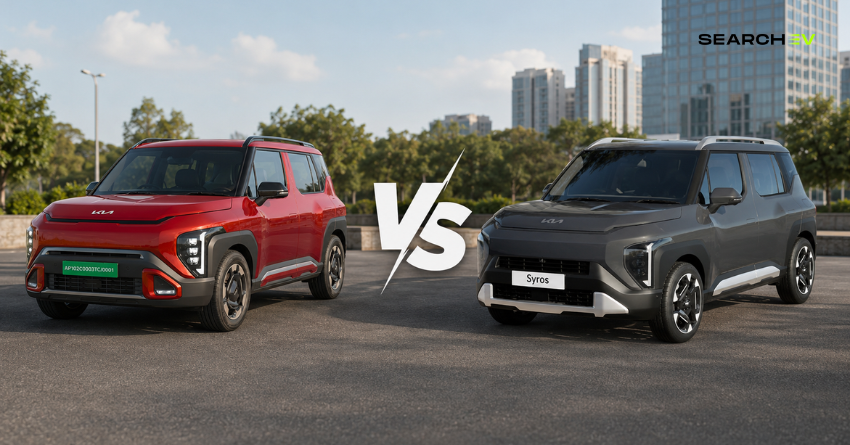
- Both versions share a boxy, tall-boy silhouette, but the EV gets a closed-off front end and redesigned wheels.
- The Syros EV gets features like Level 2 ADAS and 360-degree camera, which has been removed from the petrol and diesel models
Kia Syros ICE vs EV: Price
The standard ICE version starts at around Rs 8.5 lakh, making it much more accessible upfront. Because electric vehicle batteries are expensive to manufacture, the Syros EV starts at a notably higher price tag.
| Variant Category | Syros ICE Price | Syros EV Price |
| Base Trim | Rs 8.42 Lakh | Rs 13.49 Lakh (42 kWh) |
| Mid Trim (Automatic) | Rs 11.95 Lakh | Rs 15.99 Lakh (42 kWh) |
| Top Trim (Fully Loaded) | Rs 15.82 Lakh | Rs 19.99 Lakh (51.4 kWh) |
When comparing equivalent top-end trims, the EV version requires a larger upfront investment. However, buyers looking at daily city commutes may find that the EV makes up for the price difference over time through lower charging and maintenance costs compared to petrol or diesel.
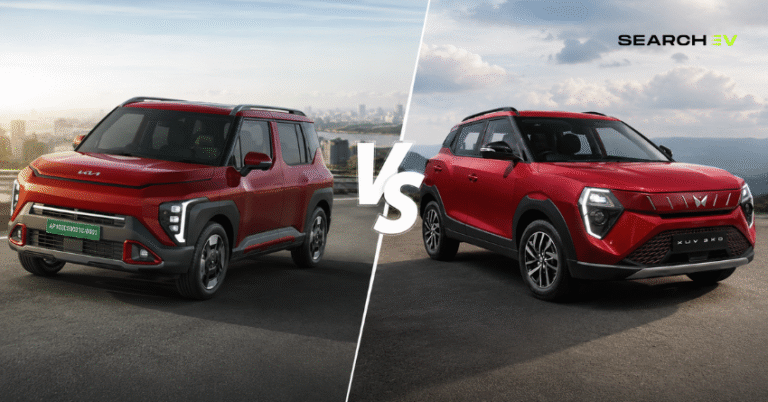
Kia Syros EV vs ICE: How to Tell Them Apart
Both models share the exact same fundamental architecture, but Kia has integrated a few specific visual changes to separate the electric model from its petrol and diesel counterparts.
Both the ICE and EV versions feature vertical LED light bars, a boxy stance, and flush door handles. The rear profiles are also largely identical, with vertical taillamp clusters.
The differences lie in very specific details
- Syros ICE: The petrol and diesel models come with the conventional front end including functional air intakes to cool the engine. Along the sides, the top-spec ICE variants ride on 17-inch diamond-cut alloy wheels and feature a visible exhaust outlet at the rear.
- Syros EV: The electric variant adopts a sealed body-coloured front fascia, improving aerodynamics since there is no combustion engine to cool. To maximise range, the EV model rides on specially designed aero-pattern 16-inch or 17-inch alloy wheels. You will also find the charging port cleanly integrated into the front fender.
Kia Syros ICE vs EV: Interior and Safety Upgrades

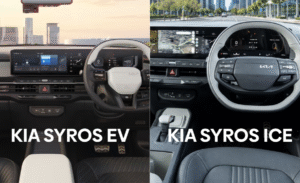
The Kia Syros introduces a tech-heavy cabin that remains largely identical across both fuel types. Both vehicles get a unique triple-screen dashboard layout, combining a 12.3-inch infotainment screen, a 12.3-inch digital driver display, and a dedicated 5-inch screen strictly for climate controls.
The Syros EV gets a Shift-by-Wire (SBW) column-type gear selector which frees up space in the centre console compared to the traditional manual or automatic gear knob on the ICE version.
Safety is a core focus for the Syros lineup. Kia has standardised six airbags, electronic stability control, and all-wheel disc brakes across both the ICE and EV models. However, when you move up the variant chain, you will find that the Syros EV offers Level-2 ADAS (Advanced Driver Assistance Systems) features and a 360-degree parking camera. These driver assistance features were recently axed out of the petrol and diesel Syros lineup.
The other main interior difference comes down to software graphics. The Syros EV gets specific menus to track battery charge, nearest charging stations, and energy flow, while the ICE model uses traditional tachometers and fuel range displays.
Kia Syros EV vs Petrol/Diesel: Feature Comparison
Because the Syros is positioned as a premium offering in the sub-four-metre segment, the feature list is heavily shared between the two powertrains.
Here is a breakdown of what the top-spec variants share and where they diverge:
Features Common to Both (Top Trims)
- Dual-pane panoramic sunroof
- Ventilated seats for front and rear passengers
- 8-speaker Harman Kardon sound system
- 12.3-inch infotainment with wireless smartphone connectivity
- Flush-fitting door handles
Features Unique to Syros EV
- V2L (Vehicle-to-Load): Allows the EV to act as a mobile power bank to run external electronic devices.
- Regenerative Braking: Uses steering-mounted paddle shifters to adjust the intensity of battery regeneration during deceleration.
- Front Frunk: A small 16-litre storage space under the hood
- Safety: Level-2 ADAS suite and 360-degree camera
Features Unique to Syros ICE
- Multi-Terrain Modes: Sand, Mud, and Snow driving modes to adjust engine and gearbox traction.
- Gearbox Variety: Choice between a manual, a 7-speed DCT (petrol), or a 6-speed torque converter automatic (diesel).
Powertrain and Performance Specifications
| Specification | Syros ICE (Turbo Petrol) | Syros ICE (Diesel) | Syros EV (Long Range) |
| Engine / Battery | 1.0L Turbocharged Petrol | 1.5L Turbocharged Diesel | 51.4 kWh Battery Pack |
| Power Output | 120 bhp | 116 bhp | 168 bhp |
| Peak Torque | 172 Nm | 250 Nm | 255 Nm |
| Transmission | 6-Speed MT / 7-Speed DCT | 6-Speed MT / 6-Speed AT | Single-Speed Automatic |
| Fuel Economy / Range | 17.68 – 18.2 kmpl (Claimed) | 17.65 – 20.75 kmpl (Claimed) | Up to 526 km (Claimed) |
Typical of electric cars, driving the Syros EV gives you access to instant torque right from a standstill, making it quicker off the line and very smooth in city traffic. On the other hand, the Syros ICE models give you the freedom to refuel in minutes on long road trips. Not to mention that the diesel option provides excellent highway fuel economy, making it very closely matched to the EV’s running costs when compared to public DC fast charging specifically.