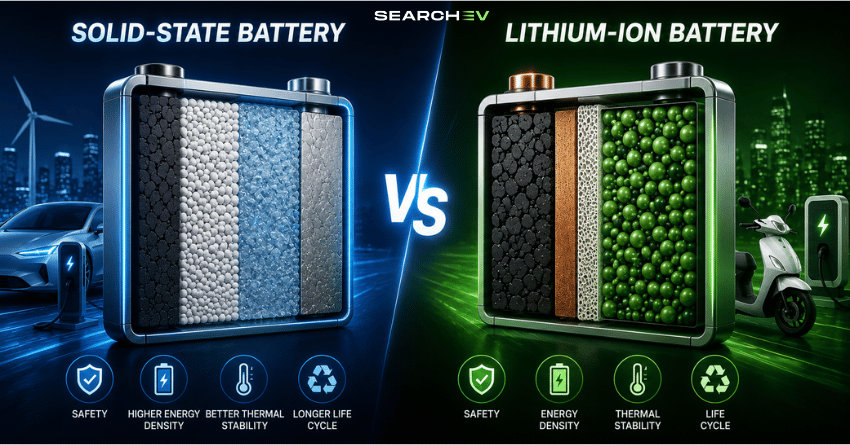
Everyone in the EV world is talking about solid-state batteries. Toyota says it will change everything. Startups are raising billions around it. And somewhere in the middle of all that noise, regular people are sitting there wondering—wait, what even is a solid-state battery, and is my current EV already outdated?
Short answer: no, your EV is not outdated. But the long answer is genuinely interesting, and once you understand what is actually different between these two technologies, you will have a much clearer picture of where electric vehicles are heading in the next five years.
Let us start from the beginning.
What Is Inside a Lithium-Ion Battery Right Now
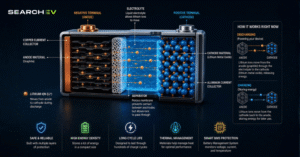
Your EV, your phone, your laptop — they all run on lithium-ion batteries. Inside every one of those cells is a liquid electrolyte. Think of it as the messenger fluid that carries lithium ions back and forth between two electrodes — the anode and the cathode — every time you charge or discharge.
This liquid does its job well. It has been doing it for decades. But it comes with some baggage.
Liquid electrolytes are flammable. When a battery overheats — whether from a bad cell, a crash, or too much fast charging — that liquid can ignite. This is why EV fires, while rare, burn so intensely and are so difficult to put out. The liquid is also the reason batteries degrade over time. Each charge cycle causes tiny chemical reactions at the electrodes, and the liquid electrolyte plays a role in that slow breakdown.
There is also a physical limitation. Liquid electrolytes put a ceiling on how much energy you can pack into a given space. Engineers have been pushing against that ceiling for years.
So What Does Solid-State Actually Mean
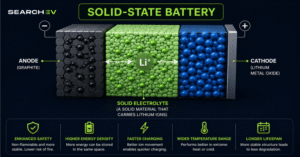
Exactly what it sounds like. In a solid-state battery, the liquid electrolyte is replaced with a solid material — usually a ceramic, glass, or polymer compound.
Same basic concept: lithium ions still need to move between two electrodes to store and release energy. But now, instead of swimming through a liquid, they travel through a solid layer.
That one change — liquid to solid — has a surprisingly large ripple effect on everything else.
Where Solid-State Batteries Win
Safety first. Removing the flammable liquid and you remove the biggest fire risk in current EV batteries. Solid electrolytes are not flammable. A solid-state battery that gets punctured, crushed, or overheated behaves very differently from a lithium-ion pack in the same situation. This alone is a massive deal for the automotive industry.
More energy in less space. Solid-state batteries can use a lithium metal anode instead of the graphite anode in today’s cells. Lithium metal stores significantly more energy per gram. The result is a battery that is either much smaller for the same range or delivers dramatically more range in the same-sized pack. Some estimates suggest solid-state packs could offer 50 to 100 percent more energy density than today’s best lithium-ion cells.
Faster charging. Liquid electrolytes get nervous under high current. Push too much charge in too quickly, and the liquid starts breaking down, which is why DC fast charging degrades lithium-ion batteries faster than slow overnight charging. Solid electrolytes handle high current better, which opens the door to genuinely fast charging—some projections suggest 10 to 15 minutes for an 80 percent charge—without the same degradation penalty.
Longer lifespan. One of the main reasons lithium-ion batteries degrade is a phenomenon called lithium plating, where lithium deposits build up unevenly on the anode over many charge cycles. Solid-state designs are expected to reduce this problem significantly, potentially lasting two to three times longer than today’s batteries.
Works better in the cold. Liquid electrolytes thicken and slow down in cold weather, which is why your EV loses range in winter. Certain solid electrolyte materials handle low temperatures more gracefully, which would be a meaningful upgrade for anyone driving in colder climates.
Where Solid-State Batteries Still Struggle
Here is the honest part — and this is why your EV showroom is not selling solid-state cars today.
Manufacturing is brutally difficult. Making a solid layer thin enough, uniform enough, and stable enough at a mass scale is an engineering problem that has not been fully solved yet. Any microscopic crack or imperfection in the solid electrolyte layer causes the battery to fail. Lithium-ion manufacturing has had 30 years of refinement. Solid-state is still climbing that curve.
They are expensive. Very expensive right now. The materials and processes involved push the cost per kWh far above what lithium-ion cells cost today. Until manufacturing scales up, solid-state batteries will be reserved for premium applications.
They expand and contract. Solid electrolytes do not flex like liquid ones. As lithium ions move in and out of the electrodes during charging and discharging, the materials expand and contract slightly. In a liquid system, this is not a problem. In a solid system, physical stress can cause the solid layers to crack over time. Managing this mechanical stress is one of the key engineering challenges researchers are still working through.
When Will Solid-State EVs Actually Arrive
Toyota has been the loudest voice here, promising solid-state EVs in production by 2027 to 2028. Samsung SDI, QuantumScape, and Solid Power are all working with major automakers on pilot production lines.
The honest industry consensus is that small-volume, premium solid-state EVs will arrive before 2030. Widespread, affordable solid-state batteries in everyday EVs—the kind that replace current lithium-ion entirely—are more likely a 2030 to 2035 story.
Should You Wait Before Buying an EV
No. And here is why.
Today’s lithium-ion EVs — especially those with LFP batteries — are genuinely excellent. They last, they perform, and the technology is mature. Waiting for solid-state is a bit like waiting for the next iPhone before buying a phone. By the time it arrives, there will be something newer to wait for.
Buy what works today. Solid-state will be a compelling upgrade when it gets here. But it is not worth sitting on the sidelines for five more years to find out.