Solid-state batteries have been promising to fix this. And in 2026, the claims have gotten bolder than ever — five minutes to a full charge. No heat. No degradation. But here’s the real question: is this actually happening, or is the EV industry doing what it does best — overpromising?
Let’s get into it.
Why Charging Speed Is a Battery Chemistry Problem
To understand why solid-state changes the charging equation, you need to understand why today’s lithium-ion batteries charge slowly in the first place.
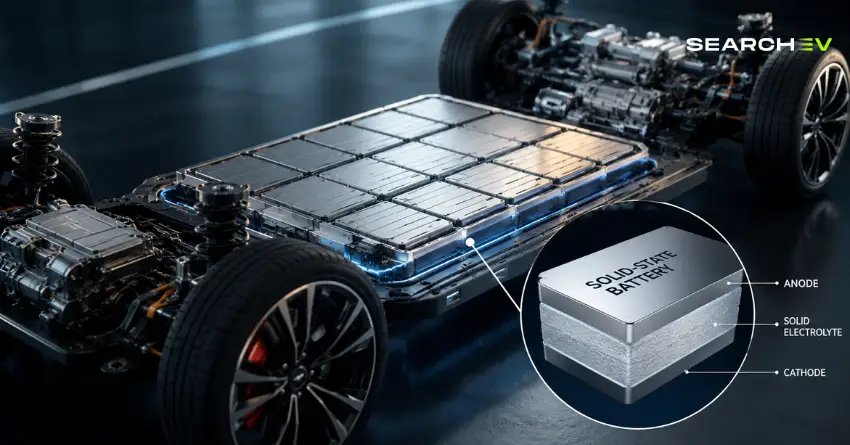
Inside every lithium-ion cell is a liquid electrolyte — the medium through which lithium ions travel between the anode and cathode during charging. Push too much current through that liquid too fast, and two things happen: heat builds up, and lithium metal starts depositing unevenly on the anode in a process called lithium plating. Both are bad. One can cause a fire. The other permanently degrades your battery.
So fast charging on lithium-ion is essentially a thermal management problem. Manufacturers throttle charging speeds specifically to protect the battery from itself. That’s why most EVs today slow down considerably after reaching 80% — they’re protecting the cells.
Solid-state batteries replace that liquid electrolyte with a solid material — typically ceramic or sulfide-based compounds. This changes the physics entirely. Solid electrolytes are more thermally stable and better at preventing lithium plating, which theoretically allows them to accept far higher charge rates without the same degradation risk.
That’s the science behind the five-minute claim. In theory, it’s sound.
What’s Actually Happening in 2026
Here’s where things get genuinely interesting.
At CES 2026 in Las Vegas, Finnish-Estonian startup Donut Lab unveiled what it calls the world’s first production-ready all-solid-state battery. The headline spec: full charge in five minutes. Energy density of 400 Wh/kg. A claimed lifespan of 100,000 charge cycles. That last number deserves a second read. Most lithium-ion EV batteries are rated for 1,000–2,000 cycles before meaningful degradation. Donut Lab is claiming 100 times that.
The battery wasn’t just a slide deck. It launched in a real vehicle — the Verge TS Pro electric motorcycle — with customer deliveries beginning Q1 2026. And in April, Donut Lab published its first pack-level real-world test results. Its 18 kWh battery pack sustained over 100 kW of charging power continuously for five minutes at a 5C charge rate on the Verge TS Pro. That is, to our knowledge, the first independently observable charging test of any production solid-state battery in a consumer vehicle Charging 50% in five minutes on a motorcycle is not the same as charging an 80 kWh car battery in five minutes. But it is proof that the underlying chemistry works outside a laboratory — and that matters.
The Honest Caveats
Five-minute charging for your Model Y or Tata Nexon EV is not around the corner. There are real barriers that still need addressing.
Scale is the biggest one. Donut Lab’s battery works in an 18 kWh motorcycle pack. Scaling that same chemistry to a 75–100 kWh automotive pack, manufacturing it in the millions, and keeping the cost competitive with lithium-ion — that’s a fundamentally different engineering challenge.
Infrastructure has to keep pace. Even if a solid-state battery can accept a charge at 400–500 kW, charging stations capable of delivering that power barely exist at scale today. The charging network and the battery technology need to develop in parallel, and right now the network is behind.
The five-minute claim hasn’t been independently validated at full scale. Verge intentionally caps charging speed on the TS Pro below its theoretical maximum — partly so riders take a break. That’s responsible, but it also means the absolute ceiling hasn’t been stress-tested in real-world conditions yet.
Meanwhile, established players like Toyota, QuantumScape, and Factorial Energy are targeting solid-state production between 2027 and 2030 for passenger cars — and none of them are promising five-minute charging out of the gate for full-size EVs. Factorial’s cells, tested in a Mercedes prototype that drove over 745 miles on a single charge, focus first on energy density over charging speed.
So, Can Solid State Battery Actually Deliver?
Yes — with precision on what “deliver” means.
The chemistry is real. The physics supports fast charging at a level that lithium-ion structurally cannot match. And for the first time in 2026, there is a production vehicle on real roads demonstrating measurable results from a solid-state pack, not just a lab bench.
What’s not yet delivered: five-minute charging for a mainstream passenger EV at affordable cost, through a widely available charging network. That gap — between what solid-state can do and what it can do for you, today, at scale — is exactly the gap the industry is racing to close. Most credible timelines point to 2028–2032 before solid-state batteries reach mainstream car buyers in volume. The five-minute charge is coming. It’s just not taking five minutes to get here.
Stay on top of every solid-state battery development as it happens — SearchEV covers the technology that’s actually moving the needle.