Nobody talks about this when you are buying an EV. The salesperson shows you the range, the charging time, the fancy touchscreen. What they quietly skip is the fact that the battery powering all of that is slowly dying from the moment you first charge it.
That is not a scare tactic. It is just chemistry. Every rechargeable battery degrades over time — the question is how fast. And the honest truth is that most EV owners unknowingly speed up that process every single day without realising it.
Let us get into exactly what is killing your battery faster than it should die.
First, Understand What EV Battery Degradation Actually Means
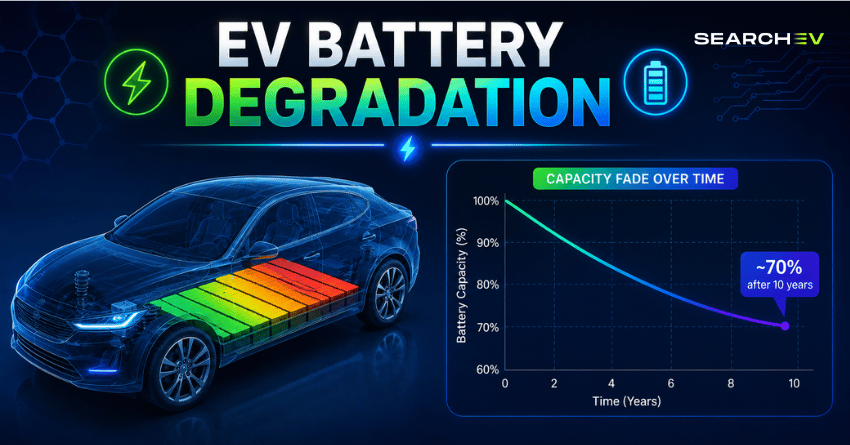
When people say an EV battery is degrading, they mean the battery is losing its ability to hold a full charge. A brand new battery pack might store 50 kWh. After a few years of hard use, that same pack might only hold 42 kWh — which means shorter range, more frequent charging stops, and eventually a costly replacement.
The cells inside your battery are made of layers of material that lithium ions pass through during every charge and discharge. Over time, those materials break down, crack, and lose their ability to hold ions efficiently. That is EV Battery degradation in simple terms.
Now here is what makes it happen faster than it needs to.
Keeping Your Battery at 100% All the Time
This is the most common mistake EV owners make — and it is completely understandable. You plug in overnight, wake up to a full battery, feel great about it. But here is what is actually happening inside the pack.
When a lithium-ion or NMC battery sits at a very high state of charge for hours on end — say 95% to 100% — the cells are under sustained chemical stress. The lithium ions are packed tightly into the electrode material, and that constant pressure slowly breaks down the structure of the cathode over time.
It is not something you will notice after one night. Or one month. But over two or three years of always sleeping at 100%, your battery will show measurably more degradation than one kept at 80%.
The fix is simple. Most EVs let you set a charge limit in the app. Set it to 80% for daily use and only go to 100% when you genuinely need the range for a long trip.
Frequent DC Fast Charging
Fast chargers are brilliant on road trips. Pulling 100 kW or more into your battery in 20 minutes is genuinely impressive technology. But there is a cost that nobody puts on the brochure.
High-speed charging generates heat inside the battery cells. It also pushes a large amount of current through the electrodes very quickly, which causes microscopic stress on the internal structure. Do this occasionally and your battery handles it fine. Make DC fast charging your daily habit — stopping at a public charger every morning instead of using a home charger overnight — and the degradation compounds noticeably faster.
Slow AC charging at home is always gentler on the battery. Think of fast charging as the emergency option, not the routine.
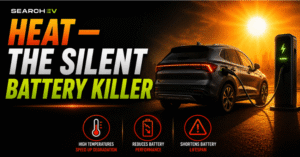
Heat — The Silent Battery Killer
The same logic that applies to keeping it too high also applies to letting it go too low. Deeply discharging a lithium-ion battery — running it down to 0% regularly — stresses the anode and causes a different but equally damaging set of chemical reactions.
Most EVs protect you from this by building a hidden buffer at the bottom. When your display shows 0%, the cells are not truly empty — there is a small reserve left to prevent full discharge. But consistently running your battery down to single digits before charging is still harder on the pack than keeping it above 20%.
Think of 20% as the floor and 80% as the ceiling for everyday driving. That window is where your battery is happiest.
Leaving the Battery Idle for Long Periods

Going on a two-week holiday and leaving your EV fully charged in the parking lot? That is a recipe for accelerated degradation. Lithium-ion batteries do not like sitting at high states of charge for extended periods—especially in heat.
If you are leaving your EV unused for a long time, charge it to around 50% before you park it. That is the sweet spot for long-term storage. Some EVs even have a storage mode in the app that does this automatically.
Software That Is Out of Date
This one surprises people. Your EV’s battery management system — the software that controls how the battery charges, discharges, and manages temperature — gets updated over time. Manufacturers push improvements that directly affect battery longevity.
Ignoring OTA updates is not just about missing new features. It sometimes means your battery is being managed by older, less efficient software that is not protecting it as well as it could be.
Keep your EV software updated. It genuinely matters.
The Bottom Line
EV battery degradation is inevitable. But there is a massive difference between a battery that loses 10% capacity in five years and one that loses 25% in the same period. That difference comes almost entirely down to how you treat it daily.
Charge to 80% for regular use. Use fast chargers when you need them, not as a habit. Park in the shade when you can. Do not let it sit at zero or one hundred percent for days on end.
Small habits, compounded over years, are the entire story with battery health. Start today, and your battery will still feel strong long after the loan is paid off.