Key Takeaways
- The Hector Tomahawk EV starts below the XEV 9S at every comparable level, and its base variant already carries a bigger battery than Mahindra’s cheapest trim.
- Only the Tomahawk offers a five-seat layout. The XEV 9S has been strictly a seven-seater since launch, though Mahindra recently added a six-seat option too.
- The XEV 9S charges quicker, and its priciest variant can travel further than the single-battery Tomahawk EV
- MG’s Battery-as-a-Service programme can pull the Tomahawk’s on-road price down by more than five lakh rupees
MG Hector Tomahawk EV vs Mahindra XEV 9S: Price and Value Comparison
The Tomahawk costs less at nearly every comparable trim, and its rental-battery option opens up an even cheaper way in.
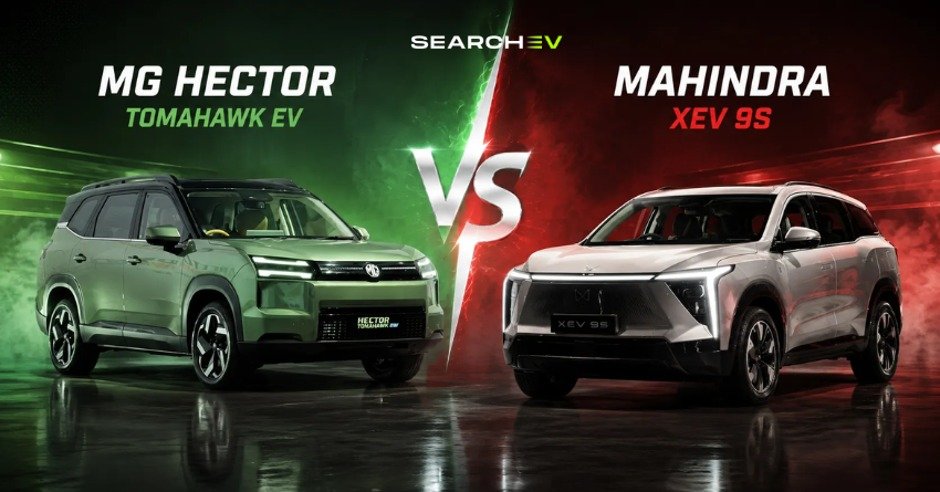
MG has priced the Hector Tomahawk EV aggressively, and it more or less had to. The XEV 9S already has brand recall on its side, a strong dealer network, and a head start most rivals would envy. The base Tomahawk, badged Excite, is a seven-seater priced at Rs 19.49 lakh, undercutting the XEV 9S’s entry-level Pack One Above (59 kWh) trim by close to a lakh rupees. What makes that gap more interesting is what you get for it: the Tomahawk’s cheapest variant already carries a 69.2 kWh battery, while Mahindra’s least expensive 9S makes do with just 59 kWh.
| MG Hector Tomahawk EV Variant | Price (Ex-showroom) | Mahindra XEV 9S Variant | Price (Ex-showroom) |
| Excite (7-seater) | Rs 19.49 Lakh | Pack One Above (59 kWh) | Rs 20.65 Lakh |
| Exclusive (7-seater) | Rs 21.99 Lakh | Pack One Above (79 kWh) | Rs 22.65 Lakh |
| Essence (5-seater) | Rs 22.99 Lakh | Pack Two Above (70 kWh) | Rs 25.05 Lakh |
| Essence (7-seater) | Rs 23.49 Lakh | Pack Two Above (79 kWh) | Rs 25.95 Lakh |
| – | – | Pack Three (79 kWh) | Rs 27.85 Lakh |
| – | – | Pack Three Above (79 kWh) | Rs 29.95 Lakh |
Buyers who can’t stretch to Rs 19.49 lakh upfront get another option with the Tomahawk. Under MG’s Battery-as-a-Service scheme, the SUV can be driven home for Rs 13.99 lakh, with the battery rented separately at Rs 4.90 per kilometre driven. The Mahindra XEV 9S offers no equivalent route; every buyer pays the full amount upfront. Worth flagging too, these Tomahawk prices are introductory and apply to a limited first batch of units, so a small upward revision later shouldn’t come as a surprise.
Road Presence, Dimensions, and Practicality Comparison
The Tomahawk is actually the larger car this time, and it’s the only one of the two that lets you drop down to a true five-seat layout.
MG’s SUV is 8mm longer overall, 23mm taller, and sits on a wheelbase that’s 48mm longer than the 9S’s. The XEV 9S only wins out on width by 50mm.
| Dimension / Capacity | MG Hector Tomahawk EV | Mahindra XEV 9S |
| Overall Length | 4,745 mm | 4,737 mm |
| Overall Width | 1,850 mm | 1,900 mm |
| Overall Height | 1,770 mm | 1,747 mm |
| Wheelbase | 2,810 mm | 2,762 mm |
| Ground Clearance | 230 mm | 205 mm |
| Seating Capacity | 5 or 7 seats | 7 seats (6-seat layout also offered) |
In its five-seat form, the Hector Tomahawk EV offers 610 litres of boot space, expanding to a claimed 1,053 litres with the second row folded flat. Nothing like that exists on the XEV 9S, which has stuck to a strict seven-seat layout since it launched. Mahindra did narrow the gap slightly recently by introducing a six-seat XEV 9S variant priced roughly Rs 25,000 above the equivalent seven-seat trim, likely aimed at buyers who want captain’s chairs in row two without committing to a full five-seat cabin.
MG Hector Tomahawk EV vs Mahindra XEV 9S: Which EV Offers More Features?
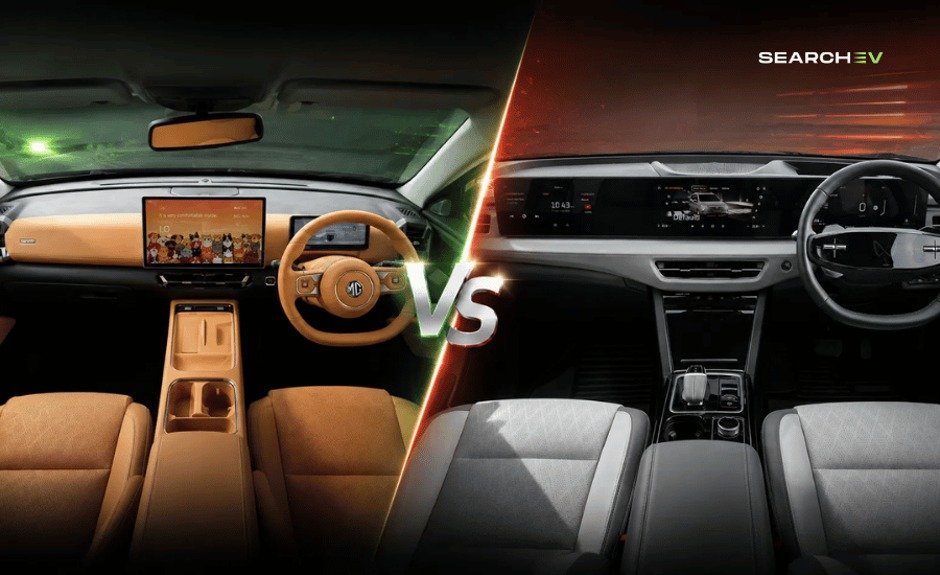
MG puts most of its tech budget into one large screen up front. Mahindra spreads it across three separate displays, including one just for whoever’s riding shotgun.
Step into either cabin and physical buttons will feel like an afterthought. Both get panoramic sunroofs, ventilated front seats, and a Level 2 ADAS suite.
| Feature Category | MG Hector Tomahawk EV | Mahindra XEV 9S |
| Infotainment Screen | 15.6-inch Touchscreen | 12.3-inch Touchscreen |
| Instrument Cluster | 8.8-inch Display | 12.3-inch Display |
| Co-Passenger Display | Not offered | 12.3-inch Screen |
| Panoramic Sunroof | Yes (dual-pane) | Yes |
| Audio System | 10-speaker Infinity | 16-speaker Harman Kardon |
| Driving Safety | ADAS Level 2 | ADAS Level 2 |
Unique features of the MG Hector Tomahawk EV:
- Vehicle-to-home charging, which MG says is a first for any car sold in India, letting the battery run select household appliances during a power cut, alongside standard vehicle-to-load support.
- Six selectable cabin modes, including one called Camp for overnight stops and another, Pro Pet, built around travelling with animals.
Unique features of the Mahindra XEV 9S:
- A triple 12.3-inch screen layout as standard equipment from the base variant, including a dedicated display for the front passenger.
- Faster DC charging hardware on higher trims, supporting up to 180 kW.
Performance, Range, and Charging Speed Comparison
Mahindra’s spread of three battery sizes gives the 9S the edge on range and charging speed. MG keeps things simple with a single battery across the whole lineup.
The Tomahawk’s lone 69.2 kWh pack pairs with a 150 kW motor rated at 204 PS and 310 Nm, good for a claimed 8.2-second run to 100 kmph and 517 km of range. Mahindra spreads its outputs across three battery sizes, and depending on which one you choose, power climbs from 231 PS to 286 PS, with torque holding steady at 380 Nm throughout the range. The top 79 kWh XEV 9S variants are claimed to reach 100 kmph in around 7 seconds and can stretch as far as 679 km on a full charge, comfortably ahead of what the Tomahawk offers today.
| Metric | MG Hector Tomahawk EV | Mahindra XEV 9S |
| Battery Size | 69.2 kWh (one option) | 59 kWh, 70 kWh, 79 kWh |
| Claimed Range | 517 km | 521 km to 679 km |
| Peak Power | 204 PS (150 kW) | 231 PS to 286 PS |
| Peak Torque | 310 Nm | 380 Nm |
| Acceleration (0-100 km/h) | 8.2 seconds | Around 7 seconds (higher-output variants) |
| Fast Charging (DC) | 30-80% in about 35 minutes at up to 90 kW | 20-80% in about 20 minutes at up to 180 kW |
Charging tells much the same story as range. The Tomahawk tops out at 90 kW on a DC charger, taking roughly 35 minutes to climb from 30 to 80 percent. The XEV 9S, on variants built for it, can pull as much as 180 kW and complete a 20 to 80 percent top-up in about 20 minutes.
MG Hector Tomahawk EV vs Mahindra XEV 9S: Which Electric SUV is the Better Buy?
MG Hector Tomahawk EV Pros and Cons
- Pros: Lower starting price paired with a bigger base battery; five-seat option with a large, flexible boot; Battery-as-a-Service route for a cheaper entry point; unique vehicle-to-home charging capability.
- Cons: Just one battery and range option; slower DC charging than its rival; less power and torque than the XEV 9S’s upper trims; no ownership track record to draw on yet.
Mahindra XEV 9S Pros and Cons
- Pros: Three battery sizes to pick from; quicker charging and a longer maximum range; more screens and a punchier standard audio system; nearly a year of sales and service experience behind it.
- Cons: Costs more at almost every comparable trim; no rental-battery scheme to soften the upfront price.
Expert Take on the Best Electric SUV for You
If your household genuinely fills all three rows on a regular basis and you’d rather buy a car with a track record behind it, the Mahindra XEV 9S still makes a strong case. It charges faster, travels further on its top trim, and Mahindra’s service network has had time to work through any early teething issues.
But if upfront cost is the thing standing between you and an electric SUV, the Hector Tomahawk argues its case well too. It’s the cheaper car at nearly every trim; its battery rental scheme brings that price down further still, and it remains the only one of these two you can buy with a proper five-seat cabin.