Key Takeaways
- Tata Sierra EV starts slightly cheaper at Rs 18.79 lakh against the Hector Tomahawk EV’s Rs 19.49 lakh, but MG throws in a seven-seater cabin from the base trim itself
- Tata’s larger 75 kWh battery pushes claimed range up to 665 km, well past the Hector Tomahawk EV’s single 69.2 kWh pack and its 517 km MIDC figure
- The Sierra EV counters with a dual motor QWD option that MG simply has no answer for, along with a bigger 622-litre boot in a five-seat guise.
- Both cars lean on bidirectional charging as a selling point, though MG’s Vehicle to Home function is something Tata has not matched yet.
MG Hector Tomahawk EV vs Tata Sierra EV: Price Comparison
Rs 70,000 is roughly the gap between where these two SUVs begin their price lists, and that number alone does not tell you much until you look at what each rupee buys. Tata is technically the cheaper car at the entry point, with the Sierra EV’s Pure trim priced at Rs 18.79 lakh against the Hector Tomahawk EV‘s Rs 19.49 lakh starting figure. What MG does offer for that slightly higher sum is a seven-seater cabin from the very first variant, while Tata’s entry trim remains a five-seater built around a smaller 63 kWh pack.
Ex-Showroom Variant Price Breakdown
| MG Hector Tomahawk EV Variant | LatestPrice | Tata Sierra EV Variant | Latest Price |
| Excite (7-Seater) | Rs 19.49 Lakh | Pure (63 kWh) | Rs 18.79 Lakh |
| Exclusive (7-Seater) | Rs 21.99 Lakh | Pure S (63 kWh) | Rs 19.99 Lakh |
| Essence (5-Seater) | Rs 22.99 Lakh | Adventure (63 kWh) | Rs 20.99 Lakh |
| Essence (7-Seater) | Rs 23.49 Lakh | Adventure (75 kWh) | Rs 22.19 Lakh |
| N/A | N/A | Empowered (63 kWh) | Rs 22.79 Lakh |
| N/A | N/A | Empowered (75 kWh) | Rs 23.79 Lakh |
| N/A | N/A | Empowered A (75 kWh) | Rs 24.79 Lakh |
| N/A | N/A | Empowered A with QWD (75 kWh) | Rs 25.99 Lakh |
MG has also rolled out a Battery as a Service scheme for the Hector Tomahawk EV, where the outright purchase price drops to Rs 13.99 lakh for a limited run of units. Choose this scheme, and you pay a separate rental of Rs 4.90 per kilometre driven, on top of the vehicle cost. Tata has no equivalent BaaS arrangement on the Sierra EV as things stand, so the entire on-road price has to be paid upfront regardless of which trim you pick.
Where the maths shifts in Tata’s favour is at the top end. Rs 25.99 lakh buys you a dual-motor, all-wheel-drive Sierra EV with the larger battery, a proposition MG cannot match since the Hector Tomahawk EV comes in only one motor and one battery configuration across its whole range.
MG Hector Tomahawk EV vs Tata Sierra EV Road Presence, Dimensions, and Practicality Comparison
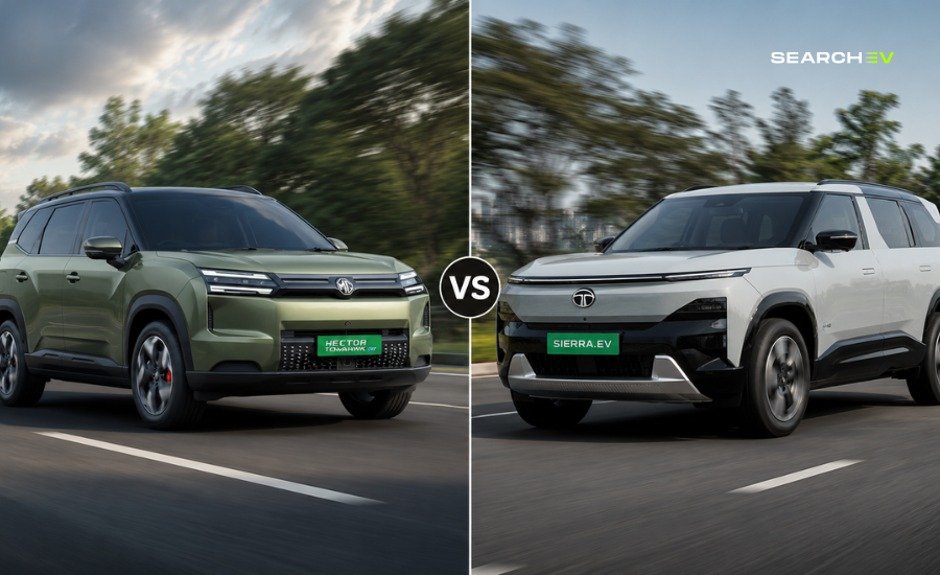
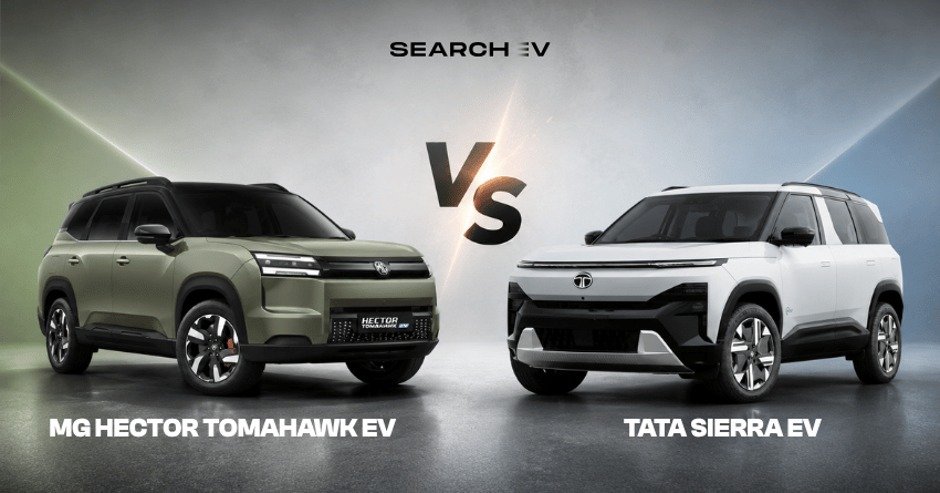
Park these two next to each other, and the size difference becomes obvious immediately. The Hector Tomahawk EV is the bigger vehicle by a comfortable margin, built on MG’s new ADAPT platform and clearly aimed at buyers who want a proper three-row family SUV. The Sierra EV, in contrast, revives Tata’s old nameplate with a boxy silhouette, flush door handles, and a glasshouse effect that harks back to the original from the 1990s, but it stays within mid-size boundaries.
MG Hector Tomahawk EV vs Tata Sierra EV Dimensions and Space
| Dimension / Capacity | MG Hector Tomahawk EV | Tata Sierra EV |
| Overall Length | 4,745 mm | 4,340 mm |
| Overall Width | 1,850 mm | 1,841 mm |
| Overall Height | 1,770 mm | 1,750 mm |
| Wheelbase | 2,810 mm | 2,730 mm |
| Ground Clearance | 230 mm | 205 mm |
| Alloy Wheel Size | 18-inch | 19-inch |
| Luggage Boot Space | 610 litres (5-seat) / 192 litres (7-seat, all rows up) | 622 litres |
Those numbers add up to a genuinely larger footprint for the MG. A 405mm longer body and an 80mm longer wheelbase mean the Hector Tomahawk EV can accommodate a proper third row. Fold down the last row on the seven-seat Tomahawk, and boot space climbs to 528 litres, while the five-seat version offers 610 litres that extends to 1,053 litres with the second row folded flat.
MG Hector Tomahawk EV vs Tata Sierra EV Features: Which One Is Better Equipped?
Both manufacturers have gone heavy on screens and connected technology, though they have taken slightly different routes to get there.
Comfort and Technology Summary
| Feature Category | MG Hector Tomahawk EV | Tata Sierra EV |
| Infotainment Screen | 15.6-inch Touchscreen | 12.3-inch Touchscreen |
| Instrument Cluster | 8.8-inch Display | 10.25-inch Cluster |
| Passenger Display | Not Offered | 12.3-inch Touchscreen |
| Panoramic Sunroof | Yes | Yes |
| Ventilated Seats | Front Only | Front Only |
| Audio System | 10-speaker Infinity | 12-speaker JBL with Dolby Atmos |
| Driving Safety | ADAS Level 2 | ADAS Level 2 |
Unique Highlights of the MG Hector Tomahawk EV:
- A 15.6-inch infotainment display that MG claims is the largest in its class, paired with wireless Apple CarPlay and Android Auto.
- Six selectable cabin modes named Nap, Camp, Energise, Pro Pet, Valet, and Quiet, along with gesture controls for climate and audio functions.
- Vehicle-to-home charging support, which MG is calling the first for any car sold in India.
Unique Highlights of the Tata Sierra EV:
- A triple-screen Horizon View dashboard that adds a dedicated 12.3-inch passenger touchscreen with wireless headphone support.
- A 540-degree surround view camera system and a summon mode that lets the car manoeuvre itself in tight spaces.
- Six terrain modes paired with Ultra Glide suspension using frequency-dependent damping, plus reclining 60:40 rear seats.
Performance, Range, and Charging Speed Comparison
This is where the two cars separate the most, largely because Tata offers two battery sizes and two drivetrain layouts against MG’s single, fixed configuration.
Power, Efficiency, and Charging Specifications
| Metric | MG Hector Tomahawk EV | Tata Sierra EV |
| Battery Size | 69.2 kWh (single option) | 63 kWh & 75 kWh |
| Official Claimed Range (MIDC) | 517 km | Up to 585 km (63 kWh) / 665 km (75 kWh) |
| Acceleration (0-100 km/h) | 8.2 seconds | 5.8 seconds (QWD Variant) |
| Peak Power Output | 150 kW | 177 kW (RWD) / 291 kW (QWD) |
| Peak Torque Output | 310 Nm | 315 Nm (RWD) / 504 Nm (QWD) |
| DC Fast Charging Speed | 30% to 80% in 35 minutes (90 kW) | 20% to 80% in 26 minutes (120 kW) |
The Hector Tomahawk EV runs a single front-mounted motor, good for 150 kW (204 hp) and 310 Nm, enough for a claimed 8.2-second sprint to 100 km/h. Its 69.2 kWh LFP battery returns an official MIDC range of 517 km, which comfortably covers most weekly driving needs without demanding frequent charging stops.
On the other hand, the Tata Sierra EV’s base 63 kWh already edges past the MG’s range claim, and stepping up to the 75 kWh pack pushes the number closer to 665 km on the two-wheel-drive version. The range topping Empowered A with QWD trades some of that range for outright pace, using a dual motor setup to generate 291 kW (390 bhp) and 504 Nm, enough to cut the 0-100 km/h dash down to 5.8 seconds.
Charging speed favours Tata too. A 120 kW DC charger takes the Sierra EV from 20 to 80 percent in 26 minutes, while MG’s 90 kW ceiling means a slightly longer 35-minute wait to go from 30 to 80 percent.
MG Hector Tomahawk EV vs Tata Sierra EV: Which Electric SUV is the Better Buy?
MG Hector Tomahawk EV Pros and Cons
- Pros: Genuine seven-seat option across most trims; larger cabin and longer wheelbase; Battery as a Service scheme lowers the entry cost; segment-first Vehicle to Home charging.
- Cons: Only one battery and motor combination available; no all-wheel drive option; slower DC charging than the Sierra EV.
Tata Sierra EV Pros and Cons
- Pros: Two battery sizes with a 665 km range claim; dual motor QWD variant for those who want speed and traction; faster DC charging; triple-screen cabin with a dedicated passenger display.
- Cons: No seven-seat variant for buyers who need one; top-spec pricing climbs close to Rs 26 lakh; no leasing or battery rental option to soften the upfront cost.
Expert Take on the Better Electric SUV for You
If your household regularly needs a third row, whether for kids, parents, or just the occasional airport run with more people than seats, the Hector Tomahawk EV is really the only option between these two right now. Its longer wheelbase and taller body translate into genuine third-row usability rather than an emergency seat nobody wants to sit in, and the Battery as a Service route gives you a way to bring the purchase price down if outright ownership feels steep.
The Sierra EV, on the other hand, makes more sense if range anxiety and outright performance matter more to you than seating count. The 75 kWh pack’s near 665 km claim, the option of a proper dual motor AWD system, and quicker charging all point toward a car built for buyers who drive longer distances or simply want more capability in reserve. It also happens to undercut the MG on starting price by a small margin, which is worth factoring in if seven seats are not a requirement for you.