Key Takeaways
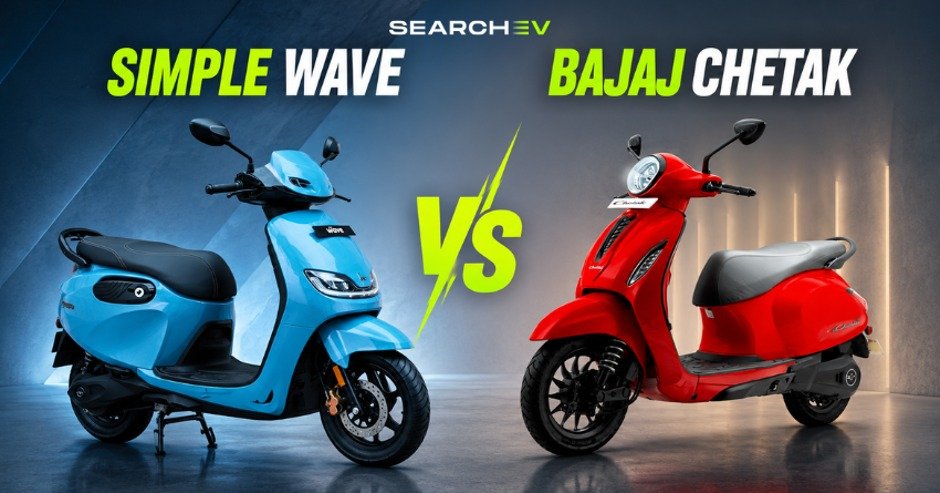
- Simple Energy has entered the family scooter segment with the Wave lineup, featuring models equipped with battery capacities ranging from 2.2 kWh to 5.0 kWh.
- The flagship Simple Wave + delivers an impressive 243 km certified IDC range and a 90 km/h top speed.
- Bajaj offers the Chetak in multiple variants, with the range-topping C3501 variant coming with a 3.5 kWh battery and 153 km of claimed range.
- Storage is where the Wave pulls furthest ahead. Its 70-litre total capacity is roughly double what the updated Chetak offers.
- The Chetak still wins on brand trust and service reach, with over 4,100 service touchpoints.
- Simple Energy offers an industry first lifetime warranty on both the electric motor and the battery pack
Simple Wave vs Bajaj Chetak: Price and Value Comparison
Simple has only confirmed pricing for its base variant so far, but even that one number tells you where this scooter is aimed.
The family electric scooter market is highly competitive, and both brands spread their portfolios across multiple battery choices to capture different buyer budgets. The Bajaj Chetak lineup starts near Rs 1.0 Lakh for the entry level C2501 and stretches over Rs 1.5 Lakh for the fully loaded C3501.
Simple Energy offers the Wave lineup across three main variants named the Wave S, Wave, and Wave +. The introductory pricing begins at Rs 1,09,999 for the 2.2 kWh Wave S EBN model.
| Simple Wave Variant | Battery | Range (IDC) | Price (Ex-showroom) | Comparable Bajaj Chetak Variant | Battery | Range (IDC) | Price (Ex-showroom) |
| Wave S EBN | 2.2 kWh | 110 km | Rs 1,09,999 | Chetak C2501 | 2.5 kWh | 113 km | Rs 1,04,802 |
| Wave S (TFT/EBN) | 2.7 kWh | 132 km | – | Chetak C3001 | 3.0 kWh | 127 km | Rs 1,19,270 |
| Wave (TFT/EBN) | 3.7 kWh | 171 km | – | Chetak C3503 / C3502 / 3501 | 3.5 kWh | 153 km | Rs 1,29,157 to Rs 1,57,140 |
| Wave+ | 5.0 kWh | 243 km | – | No comparable Chetak variant | – | – | – |
A few things stand out here. At the entry level, the Chetak C2501 is a bit cheaper than the Wave S EBN, despite offering a slightly bigger battery pack. But once you move up the range ladder, the picture flips. The Wave’s mid and upper variants promise considerably more distance per charge than anything Bajaj currently sells, and there’s simply no Chetak variant that competes with the Wave+’s 243 km claim.
Design, Dimensions, and Practicality Comparison
The Wave was built around one number: 70 litres of storage. The Chetak, in contrast, leans on its all-metal body and a design that hasn’t needed much reinventing.
Simple designed the Wave with a longer seat, a wider floorboard, and considerably more storage than its own One-series scooters, let alone its rivals. At 920 mm, the seat is claimed to be the longest fitted to any scooter sold in India. The underseat compartment alone holds 63 litres, enough for two full-face helmets, and there’s a further 4-litre “Pill” pocket accessible without getting off the scooter, plus a 3-litre glove box up front. Add it up and you get 70 litres total, which is close to double what the updated Chetak offers.
| Metric | Simple Wave | Bajaj Chetak |
| Seat Length | 920 mm (claimed longest in India) | Not disclosed |
| Seat Height | 775 mm | 775 mm |
| Ground Clearance | 175 mm | 168 mm |
| Wheelbase | 1,347 mm | 1,355 mm |
| Total Storage | 70 litres (63L underseat + 4L Pill + 3L glovebox) | 35 litres underseat |
| Suspension Setup | Telescopic Front, Twin Rear Shocks | Single Sided Leading Link, Rear Monoshock |
| Front Wheel | 12 inch Alloy | 12 inch Alloy |
| Rear Wheel | 12 inch Alloy | 12 inch Alloy |
Seat height is nearly identical on both scooters, which means neither should feel intimidating for shorter riders. Where they diverge is design philosophy. The Wave takes cues from dolphins, according to Simple, with rounded panels and a continuous DRL that forms what the company calls a smile signature. The Chetak, meanwhile, keeps its all-metal body and neo-retro silhouette largely unchanged since it first launched in 2021. If cargo space and pillion comfort top your list, the Wave has a real edge. If you’d rather have a scooter with a more classic design language and years of visible road presence, the Chetak still has that going for it.
Simple Wave vs Bajaj Chetak: Which EV Offers More Features?
Both scooters lean on TFT displays and companion apps, but the Wave adds a few rider aids the Chetak simply doesn’t have.
| Feature Category | Simple Wave | Bajaj Chetak |
| Instrument Cluster | 7-inch TFT (higher variants) or InfiniteBlack LCD (lower variants) | 5-inch colour TFT (C35 Series) or LCD (C3001/C2501) |
| Riding Modes | Ride, Eco, EcoX, plus Sport on Wave and Wave+ | Eco and Sport across the range |
| Navigation | Turn-by-turn on TFT variants, via Bluetooth phone pairing | Turn-by-turn only via the paid TecPac add-on on C35 Series |
| Braking System | Front disc, rear drum, with CBS on all variants | Front disc (higher variants) or drum (C2501), rear drum, with CBS |
| Reverse Assist | Yes, standard across the range | Yes, standard across the range |
| Traction Control | Yes, on higher variants (called GripSense) | Not offered |
| Hill Hold Assist | Yes, via a feature called Super Hold | Yes, standard on C3001 and C35-series variants |
| Connected App | Simple Connect: live location, geofencing, theft and tow alerts, remote diagnostics | Chetak app: geofencing, remote immobilisation, over-speed alerts |
| USB Charging | Yes, Type-A port | Yes |
| LED Lighting | Full LED setup, including exit lights that stay on after parking | Full LED setup |
| Crawl and Limp Home Modes | Yes, both included | Not offered |
| Warranty (Vehicle & Battery) | Lifetime warranty on motor and battery (company-wide policy) | 3 years or 50,000 km |
Unique features of the Simple Wave:
- Pill Storage, a 4-litre pocket on the side panel that stays reachable while you’re sitting on the scooter, meant for things like a wallet, sunglasses or a water bottle.
- HushDrive, a patented noise-reduction system using moulded rubber dampeners around the chain, aimed at quieting the usual clatter of a chain-drive transmission.
- DropSafe, which cuts power to the motor automatically if the scooter starts to tip over.
- A rare-earth-free motor design, which Simple says it engineered in-house and now manufactures without heavy rare-earth materials.
Unique features of the Bajaj Chetak:
- TecPac, a retrofittable software add-on that unlocks navigation, Sport mode and sequential indicators on select variants, and can be added up to a year after purchase.
- Self-cancelling indicators on the C3501, which switch off automatically once the handlebar straightens out.
- A service network built over five years and 4,100-plus touchpoints, plus collision detection that triggers an alert if the scooter is involved in an accident.
- 8 lakh-plus scooters already on Indian roads, giving buyers a genuine track record to look at.
Performance, Range, and Charging Speed Comparison
The Wave is quicker off the line and goes further on a single charge. The Chetak’s numbers are more modest, but Bajaj has never really positioned it as the performance option.
Simple claims the Wave can do 0 to 40 kmph in 3.3 seconds on the Wave and Wave+ variants, and 4 seconds flat on the entry-level Wave S, numbers the company says make it among the quickest family scooter sold in India today.
| Metric | Simple Wave | Bajaj Chetak |
| Acceleration (0-40 kmph) | 3.3 seconds (Wave/Wave+), 4.0 seconds (Wave S) | Not officially disclosed |
| Battery Sizes | 2.2 kWh, 2.7 kWh, 3.7 kWh, 5.0 kWh | 2.5 kWh, 3.0 kWh, 3.5 kWh |
| Official Claimed Range (IDC) | 110 km to 243 km | 113 km to 153 km |
| Top Speed | 75 kmph (S variants), 90 kmph (Wave/Wave+) | 60 kmph to 80 kmph, depending on variant |
| Peak Motor Power | 4.5 kW (base variant), 6.4 kW (rest of the range) | Around 3 kW to 4.8 kW, depending on variant |
| Peak Torque | 179 Nm (wheel torque, on 6.4 kW variants) | Up to 20 Nm |
| Warranty (Vehicle & Battery) | Lifetime on motor and battery | 3 years or 50,000 km |
Simple’s charging claims stand out. A 70-minute top-up to 80 percent on the base variant is quick for this segment, and even the range-topping Wave+, with more than double the battery capacity, gets there in a claimed 2 hours 15 minutes. The Chetak’s charging times, by comparison, run longer across the board, though its lower battery capacities mean it needs less energy to begin with.
Simple Wave vs Bajaj Chetak: Which Electric Scooter is the Better Buy?
Simple Wave Pros and Cons
- Pros: Best-in-class storage at 70 litres; quicker claimed acceleration; longer range across the board, especially on the Wave+; lifetime warranty on the motor and battery; faster charging times.
- Cons: Pricing for four of its six variants hasn’t been announced yet; no ownership track record since it just launched; Simple’s dealer and service network is still considerably smaller than Bajaj’s.
Bajaj Chetak Pros and Cons
- Pros: A proven metal-body build with over eight lakh units sold; a large, established service network; retrofittable TecPac features for buyers who want to add tech later.
- Cons: Meaningfully less underseat storage; no traction control on any variant; slower charging on most trims; navigation only comes bundled with a paid add-on rather than as standard.
Expert Take on the Best Electric Scooter for You
The Bajaj Chetak isn’t the most feature-packed scooter around, but Bajaj’s service network and the sheer number of Chetak e-scooters already on Indian roads count for something when something eventually needs fixing.
If storage space, range, and charging speed matter more to you than a proven track record, the Wave is worth waiting for. Its base variant is already on sale and undercuts nothing on the numbers, but it’s the unpriced higher variants, the Wave and Wave+, that make this scooter genuinely interesting. Once Simple reveals what those cost, this comparison could tilt further in the Wave’s favour. For now, buyers who need a scooter immediately might lean Chetak, while anyone willing to wait a few weeks for full Wave pricing should hold off and see the complete picture first.