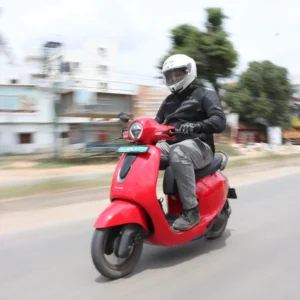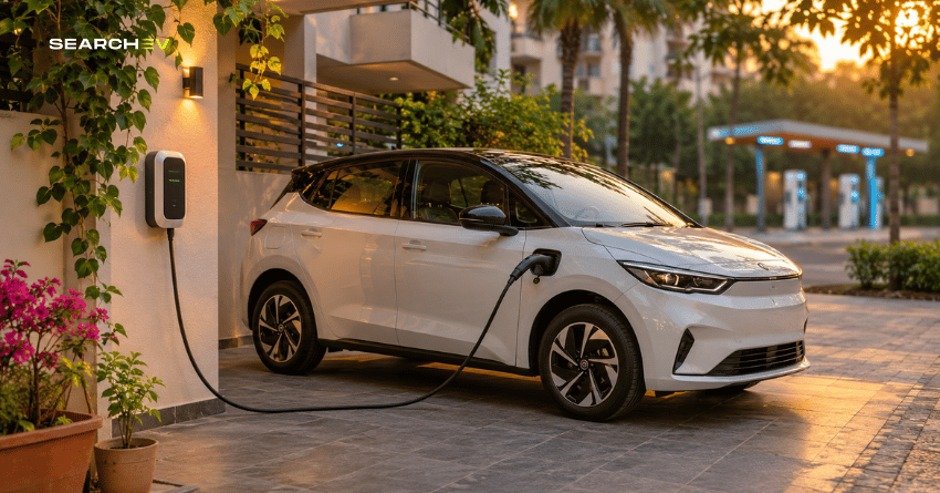
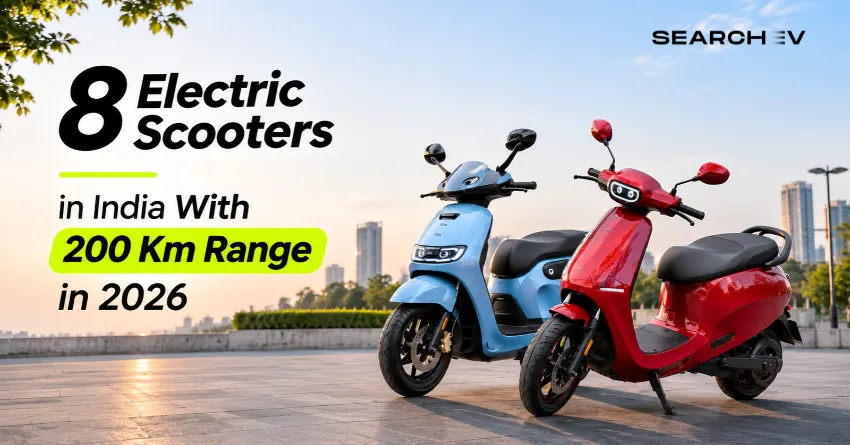
India registered about 2.24 lakh electric two-wheelers in October 2026. Driven by denser Lithium Iron Phosphate and Nickel Manganese Cobalt cells, alongside larger 4 kWh to 6.5 kWh floorboards and dual battery architectures, Indian two-wheeler buyers now have multiple high-speed electric scooters with 200 km range in India. This guide covers eight scooters whose makers claim 200 km or more.
| Model | Battery Size | Claimed Range | Ex-Showroom Price |
| TVS iQube ST | 5.3 kWh | 212 km | Rs 1.77 Lakh |
| Ola S1 Pro Plus (Gen 3) | 4 kWh / 5.2 kWh | 242 km / 320 km | Rs 1.49 Lakh to Rs 1.79 Lakh |
| Simple One | 5.0 kWh | 265 km | Rs 2.05 Lakh |
| Simple Wave | 5.0 kWh | 243 km | Rs 1.90 Lakh |
| Simple Ultra | 6.5 kWh | 400 km | Rs 2.45 Lakh |
| Ola S1 X and S1 X Plus (Gen 3) | 4 kWh / 5.2 kWh | 242 km / 320 km | Rs 1.22 Lakh to Rs 1.64 Lakh |
| Ultraviolette Tesseract | 5 kWh / 6 kWh | 220 km / 261 km | ~Rs 2.00 Lakh |
| Ather Konarc (S 200) | Expected ~4.7 kWh | 200 km | To Be Announced* |
Note: Before looking at the numbers, Indian riders need one important piece of context. Manufacturers advertise range based on the Indian Driving Cycle (IDC) or ARAI laboratory tests, which are conducted under controlled speeds without heavy pillion loads, steep flyovers, or 40-degree summer heat. In real-world Indian city traffic, a scooter with a claimed 200 to 260 kilometre IDC range typically delivers between 150 and 200 kilometres on the road. Choosing a model in the 200-kilometre claimed bracket is the smartest way to get a genuine 140-plus-kilometre real-world buffer, allowing daily office commuters to charge just once or twice a week.
1. TVS iQube ST (5.3 kWh)
| Specification | Details |
| Ex Showroom Price | Rs 1.77 Lakh |
| Battery Capacity & Type | 5.3 kWh Fixed Lithium Ion |
| Claimed IDC Range | 212 km per charge |
| Motor Power & Torque | 4.4 kW Peak BLDC Hub Motor (140 Nm Wheel Torque) |
| Top Speed | 82 kmph |
| Charging Time (0 to 80%) | 4 Hours 30 Minutes (950W Offboard Charger) |
| Key Features | 7-inch touchscreen (Android Auto ready), 32-litre boot, TPMS, Alexa & SmartXonnect, connected features |
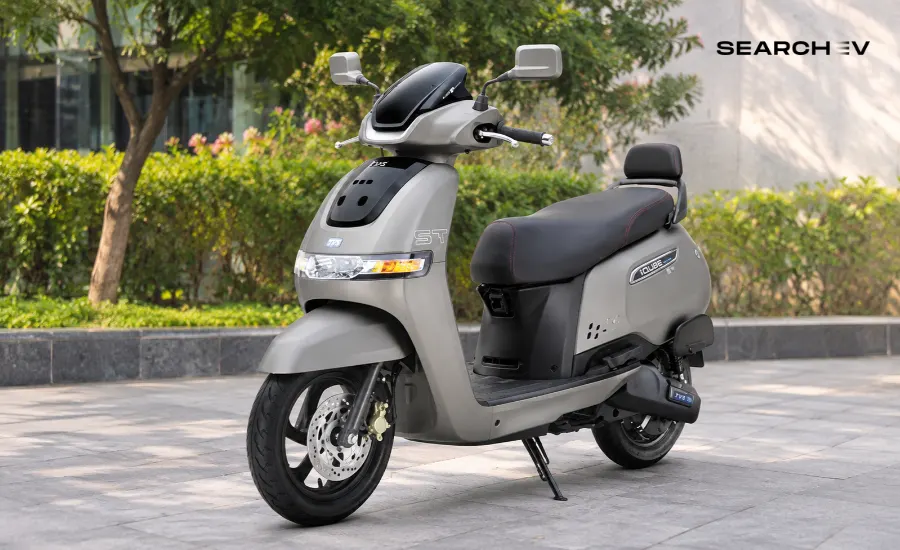
For family buyers who prioritise service reach and mechanical predictability over flashy gimmicks, the top spec TVS iQube ST 5.3 kWh remains the safest bet in the 200 km club. Packing the largest fixed battery in any mainstream legacy scooter, it delivers a claimed 212 km IDC range, which translates to a realistic 145 to 160 km in everyday city traffic. Because TVS uses a hub-mounted motor tuned for a modest 82 km/h top speed, the battery drains slowly even with a pillion on board. You still get a 32-litre boot that fits two half-face helmets, a 7-inch touchscreen that recently gained Android Auto support at EICMA 2026, and access to more than 4,000 TVS touchpoints across India. Its Rs 1.77 lakh price tag (ex-showroom before subsidies) feels steep, but that ownership peace of mind is hard for newer players to match.
2. Ola S1 Pro Plus (Gen 3)
| Specification | Details |
| Ex Showroom Price | Rs 1.49 Lakh (4 kWh) to Rs 1.79 Lakh (5.2 kWh) |
| Battery Capacity & Type | 4 kWh Li-ion or 5.2 kWh (4680 Bharat Cell) |
| Claimed IDC Range | 242 km (4 kWh) / 320 km (5.2 kWh) |
| Motor Power & Drive | 3 kW Peak Mid Drive IPM Motor with Chain Drive |
| Top Speed | 128 kmph (4 kWh) to 130 kmph (5.2 kWh) |
| Charging Time | ~5 to 6 Hours (Home Charger) |
| Key Features | ABS, Brake by Wire Regen, 7 Inch Touchscreen with MoveOS 5, 34 Litre Boot, Four Ride Modes |
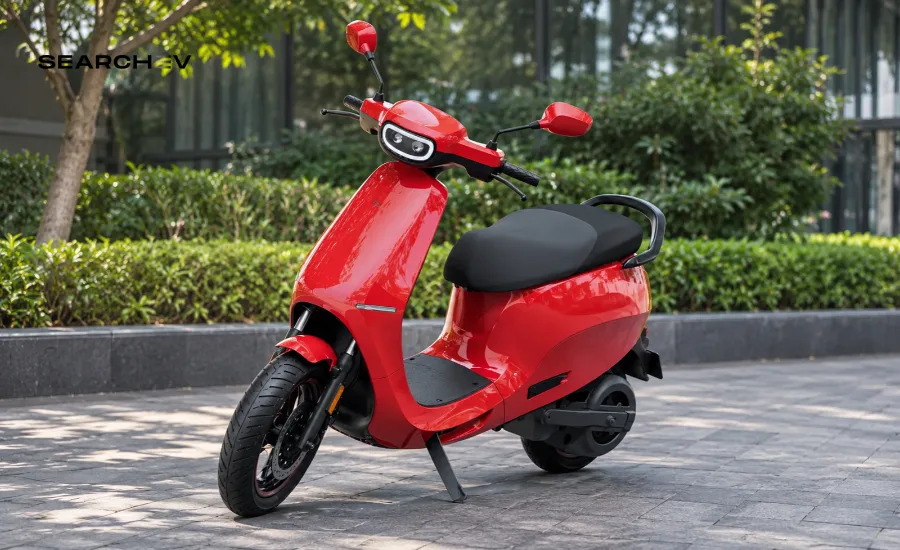
When Ola Electric rolled out its third-generation platform, it addressed two of the biggest complaints from early owners by swapping the belt drive for a quieter chain drive and introducing brake-by-wire regenerative braking. Sitting at the top of the lineup, the Ola S1 Pro Plus Gen 3 offers a 4 kWh pack rated at 242 km and a 5.2 kWh pack using Ola’s in-house 4680 Bharat Cell that claims 320 km of IDC range. With 13 kW of peak power and a 141 kmph top speed on the 5.2 kWh trim, it is quicker than most 150 cc petrol motorcycles. ABS finally gives the scooter the stopping safety its speed demands. While Ola’s service centre backlog in smaller towns still requires patience, very few mass market scooters come close to its straight line performance and range per rupee.
3. Simple One (5 kWh)
| Specification | Details |
| Ex Showroom Price | Rs 2.05 Lakh |
| Battery Capacity & Type | 5.0 kWh Dual Battery (3.7 kWh Fixed + 1.3 kWh Removable) |
| Claimed IDC Range | 265 km per charge |
| Motor Power & Torque | 8.8 kW Peak (4.5 kW Continuous) PMSM Motor |
| Top Speed | 115 kmph and 2.55 seconds |
| Charging Time (0 to 80%) | 5 Hours 20 Minutes (Home) / 2 Hours 15 Minutes (Fast Charger) |
| Key Features | 7-inch TFT Touchscreen, Dual Disc Brakes with CBS, Traction Control, Cruise Control, 30-Litre Boot |
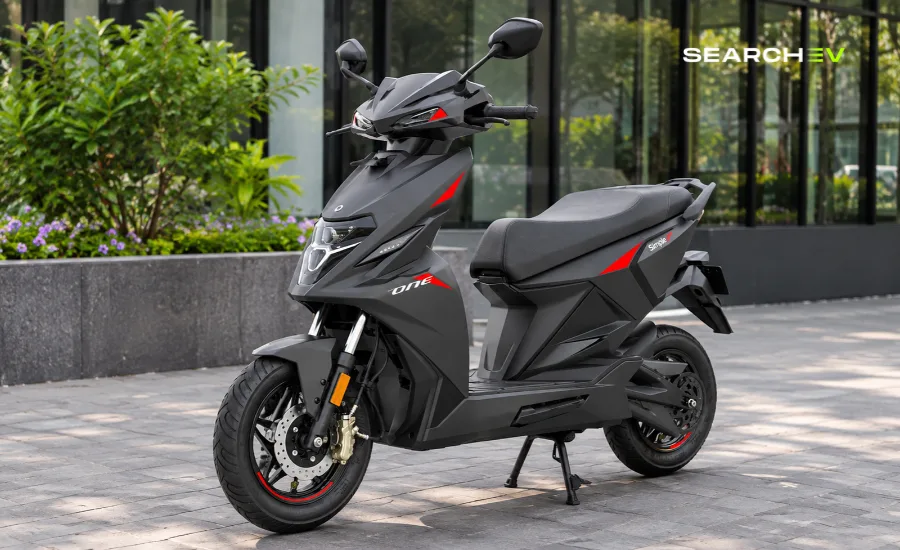
Bengaluru startup Simple Energy took years to scale up production at its Hosur factory, but the updated 2026 Simple One proves the underlying engineering was worth the wait. Instead of relying on a single heavy floorboard pack, it splits its 5 kWh capacity between a 3.7 kWh fixed battery and a 1.3 kWh removable unit tucked inside the boot. That dual battery setup delivers a claimed IDC range of 265 km, or roughly 180 in real-world riding. An 8.8 kW mid-drive motor sends power to the rear wheel, launching the scooter from 0 to 40 kmph in 2.55 seconds on its way to an 115 kmph top speed. Priced at Rs 2.05 lakh ex-showroom, it is expensive, yet its stiff tubular chassis and sharp handling appeal directly to enthusiastic riders.
4. Simple Wave (5 kWh)
| Specification | Details |
| Ex Showroom Price | Rs 1.90 Lakh (Wave Plus 5 kWh) |
| Battery Capacity & Type | 5.0 kWh Fixed Lithium Ion |
| Claimed IDC Range | 243 km per charge |
| Motor Power & Drive | 6.4 kW Peak (3.5 kW Continuous) PMSM Motor with Chain Drive |
| Top Speed | 90 kmph |
| Charging Time (0 to 80%) | 5 Hours 20 Minutes (Home) / 2 Hours 15 Minutes (Fast Charging) |
| Key Features | 70-litre underseat storage, 920 mm long seat, 7-inch display on top trims, traction control, fall alert, dedicated charger bay |
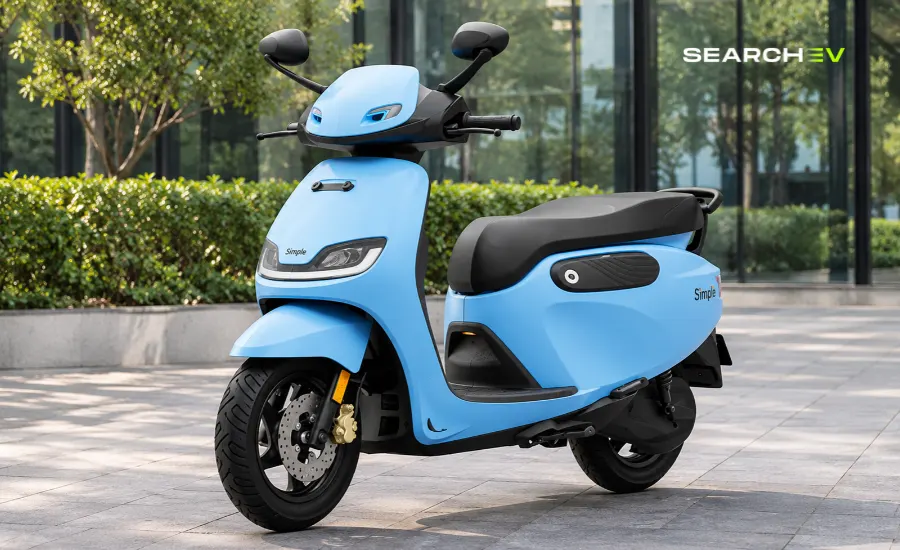
Launched in September 2026 to take on family scooters like the Ather Rizta and TVS iQube, the Simple Wave takes the core powertrain of the Simple One and wraps it in a roomier, utility-focused body. While entry-level trims start at around Rs 1 lakh with smaller batteries, the flagship 5 kWh variants push the claimed IDC range to 243 km. Simple Energy detuned the mid drive motor to 6.4 kW and capped the top speed at 90 kmph to maximise city efficiency. The real highlight here is space. With a 920 mm long flat seat and a massive 70-litre underseat storage bay, it swallows weekly grocery runs or full-face helmets with ease. Buyers should check if Simple Energy has an active dealership in their city before booking, as its retail footprint is still growing.
5. Simple Ultra
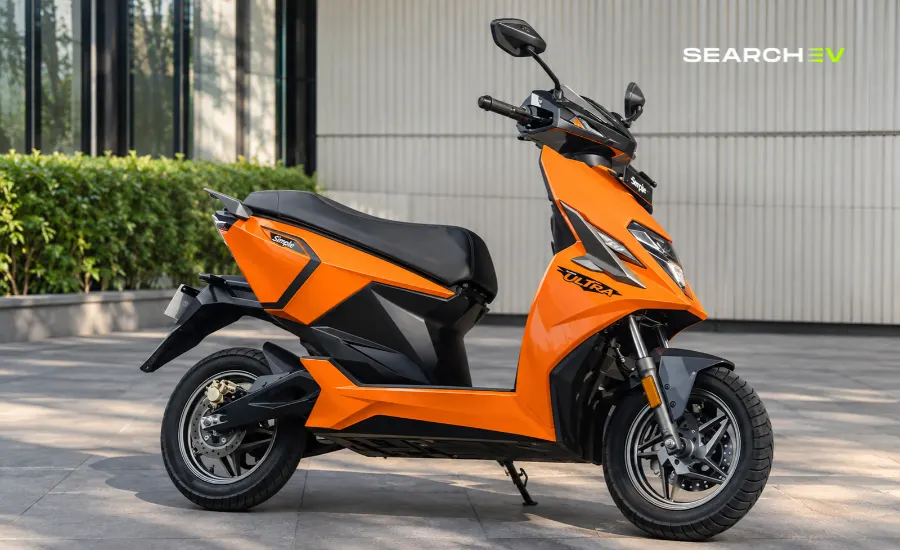
| Specification | Details |
| Ex Showroom Price | Rs 2.45 Lakh |
| Battery Capacity & Type | 6.5 kWh Dual Battery (5.0 kWh Fixed + 1.5 kWh Portable) |
| Claimed IDC Range | 400 km per charge |
| Motor Power & Torque | 8.8 kW Peak (4.5 kW Continuous) PMSM Motor |
| Top Speed | 115 kmph |
| Charging Time (0 to 80%) | 5 Hours 20 Minutes (750W Home) / 2 Hours 15 Minutes (DC Fast) |
| Key Features | 7-inch touchscreen, four ride modes (Rain, Road, Rally, Track), 4-level traction control, TPMS, 35-litre illuminated boot |
If pure distance on a single charge is your primary goal, the Simple Ultra currently sits at the top of the Indian electric scooter chart. Introduced in April 2026 at an ex showroom price between Rs 2.35 lakh and Rs 2.45 lakh, it pairs a 5.0 kWh fixed floorboard pack with a 1.5 kWh portable battery for a combined 6.5 kWh capacity. That massive energy reserve yields an ARAI certified claimed range of 400 km, allowing daily commuters to go an entire week or more between charges. It shares the 8.8 kW motor, 72 Nm torque output, and 115 kmph top speed of the Simple One, alongside four traction control modes and a 7-inch touchscreen. At 139 kg, it feels noticeably heavier than regular 125 cc scooters when pushing it into tight parking spots.
6. Ola S1 X and S1 X Plus (Gen 3) (4 kWh & 5.2 kWh)
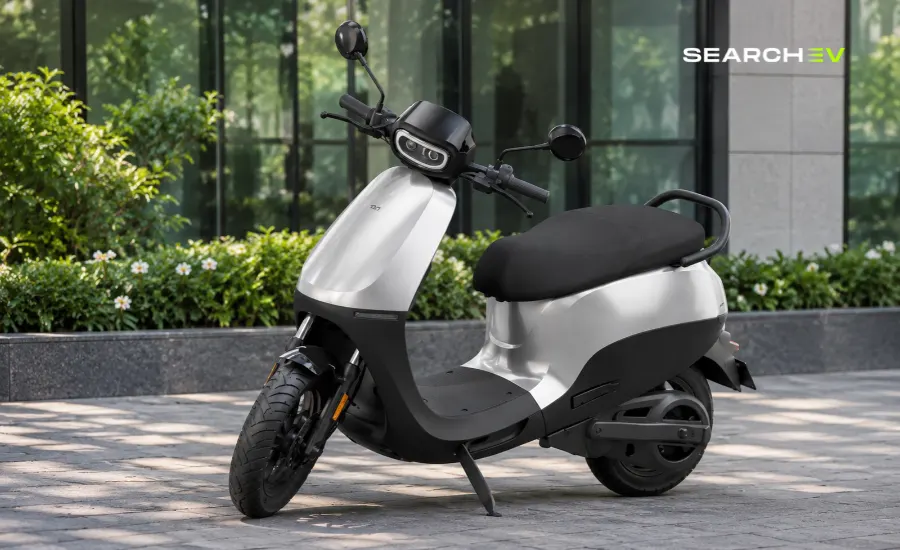
| Specification | Details |
| Ex Showroom Price | Rs 1.22 Lakh to Rs 1.64 Lakh (4 kWh and 5.2 kWh Variants) |
| Battery Capacity & Type | 4 kWh or 5.2 kWh Fixed Lithium Ion |
| Claimed IDC Range | 242 km (4 kWh) / 320 km (5.2 kWh) |
| Motor Power & Drive | 7 kW to 11 kW Peak Mid Drive Motor with Chain Drive |
| Top Speed | 123 kmph to 125 kmph |
| Charging Time | ~6 to 9 Hours (Home Charger) |
| Key Features | 4.3 Inch Colour Segmented LCD Display, Brake by Wire, MoveOS 5 Connectivity, Smart Park, Front Disc with CBS, 34 Litre Boot |
Shoppers searching for an electric scooter with a 200 km range option usually expect to pay well over Rs 1.50 lakh, but the Gen 3 Ola S1 X series brings that capability into a lower price bracket. By replacing the heavy touchscreen with a simpler 4.3 inch colour segmented LCD display and using a physical key or keyless button setup, Ola kept manufacturing costs low without touching the core mechanicals. Both the S1 X and S1 X Plus are available with 4 kWh and 5.2 kWh battery packs, delivering claimed IDC ranges of 242 km and 320 km, respectively. An 11 kW mid-drive motor provides a 123 to 125 kmph top speed, while a 34-litre boot handles daily errands. Skipping ABS for a combined braking system on these trims means riders need to exercise caution at highway speeds.
7. Ultraviolette Tesseract (5 kWh & 6 kWh)
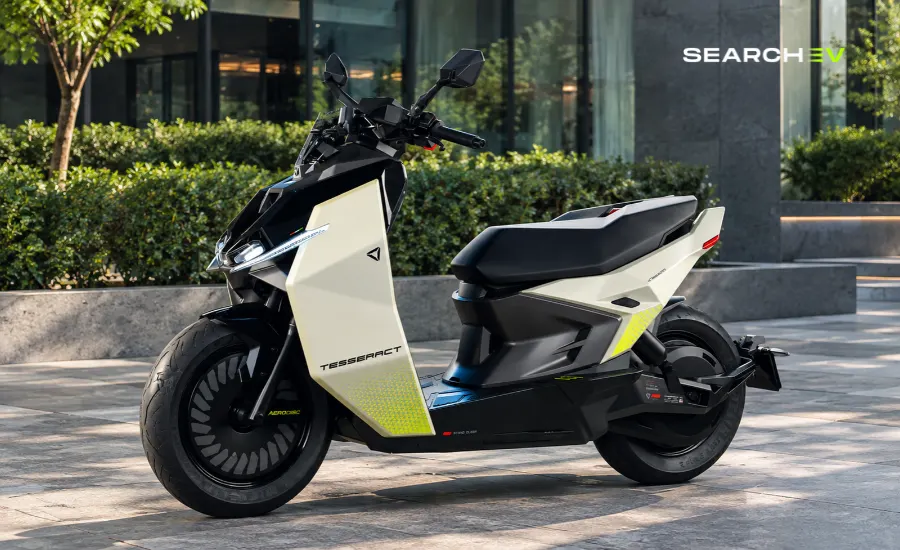
| Specification | Details |
| Ex Showroom Price (Expected) | ~ Rs 2.00 Lakh (6 kWh) |
| Battery Capacity & Type | 5 kWh and 6 kWh Fixed Packs (100V VX100 Architecture) |
| Claimed IDC Range | 220 km (5 kWh) / 261 km (6 kWh) |
| Motor Power | 15 kW (20 bhp) Electric Motor |
| Top Speed | 125 kmph |
| Charging Time (20 to 80%) | Under 30 Minutes (Supernova Fast Charger) / Type 2 AC Onboard Support |
| Key Features | Dual Front & Rear Radars, Dual Dashcams, Adaptive Cruise Control, 14 Inch Alloy Wheels, Dual Channel ABS, 7 Inch Touchscreen, 34 Liter Boot |
Fresh off its European showcase as the Tesseract Maxi at EICMA 2026, Ultraviolette’s first scooter brings motorcycle-grade aerodynamics and electronics to the step-through segment. After delaying deliveries to January 2027 to re-engineer the chassis around a 100-volt architecture, the Bengaluru two-wheeler maker managed to fit a 20 bhp (15 kW) motor without sacrificing its 34-litre underseat boot. While the base 3.5 kWh trim claims 162 km, the 5 kWh and 6 kWh variants offer in excess of 200 km of claimed IDC.
8. Ather Konarc (S 200)
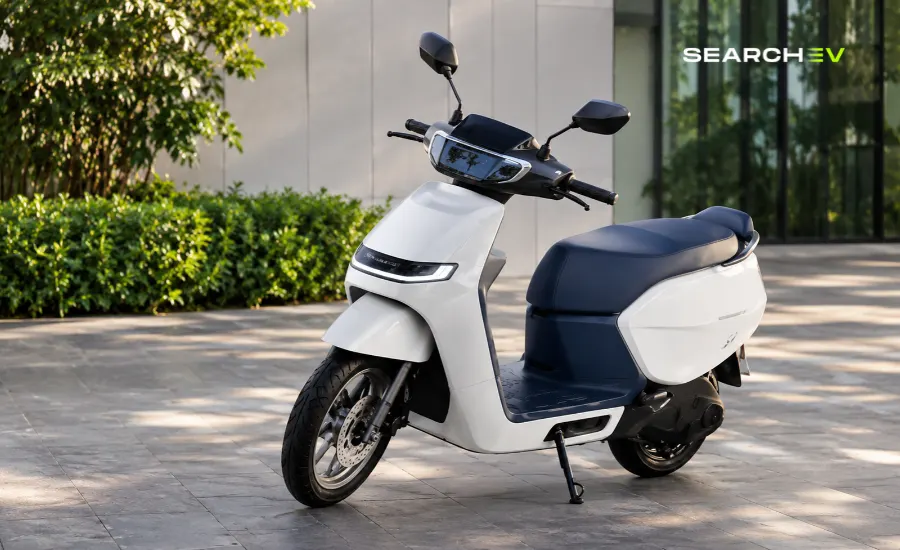
| Specification | Details |
| Ex Showroom Price | To Be Announced |
| Battery Capacity & Type | TBA (Expected ~4.7 kWh) Fixed Pack, IP67 Rated |
| Claimed IDC Range | 200 km per charge |
| Motor Power & Torque | Swingarm-Mounted PMSM Motor |
| Top Speed | 70 kmph |
| Charging Time | TBA (900W combined charging available) |
| Key Features | 14 Inch Front Wheel, 31 Litre Boot, Steel Unibody, 7 Inch Display, Advanced Electronic Braking System |
Stepping into the high-range family commuter space, Ather revealed the Konarc S 200 at its Ather Community Day 2026 event. It builds on a new platform and focuses heavily on rider comfort and practicality rather than aggressive performance. Unlike the sporty 450 series, the Konarc gets a massive 14-inch front wheel paired with long-travel suspension to smooth out broken city roads.
Ather has integrated a swingarm-mounted PMSM motor in the Konarc tuned for a modest 70 kmph top speed, prioritising predictable power delivery and overall battery efficiency. The main draw is the targeted 200 km IDC range, which places it firmly in the long-distance urban commuting bracket. It retains strong everyday usability with a 31-litre underseat storage area and a robust steel unibody chassis. Official pricing is not out yet, and Ather has stated that the S 200 will be available for deliveries next year only.