You just got your first electric car. You plug it in overnight, wake up to a full charge, and feel great about it. Seems like the right thing to do, right? Well—kind of. The honest answer is more interesting than a simple yes or no, and once you understand what’s actually happening inside that battery pack, you’ll never think about charging the same way again.
Let’s break it down properly.
First, a Quick Look at How EV Batteries Work
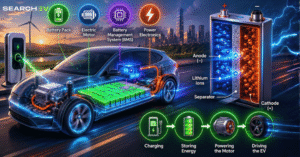
Your EV runs on a lithium-ion battery—the same basic chemistry in your phone and laptop, just much, much bigger. These batteries work by moving lithium ions back and forth between two electrodes. Every time you charge and discharge, those ions shift. Do it too aggressively, too often, or at the extreme ends of the scale, and the materials inside start to wear down faster than they should.
This wear is called battery degradation—and it’s the reason why an EV with 150,000 kilometres on it doesn’t hold quite as much charge as it did when it was new.
Here’s the thing though: degradation is inevitable. The question is just how fast it happens. And that’s where charging habits make a real difference.
So Does 100% Actually Hurt the Battery?
Yes — but with a lot of context.
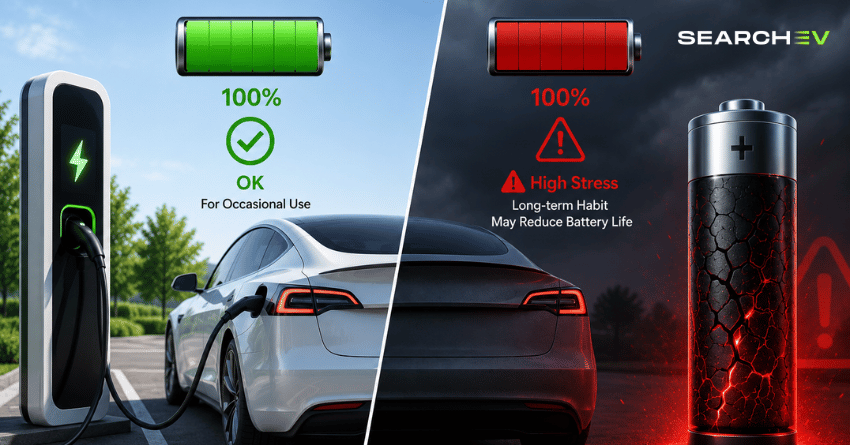
Charging to 100% once in a while won’t destroy your battery. Doing it every single day for years? That quietly adds up to faster degradation than necessary.
Here’s why. When a lithium-ion battery sits at very high states of charge — say, 95% to 100% — the cells are under more chemical stress. The lithium ions are packed tightly into the electrode material, and that sustained pressure causes tiny structural changes over time. It’s not dramatic. You won’t notice it tomorrow or next month. But after two or three years of always charging to full, the battery capacity starts dropping a little faster than it would have otherwise.
The same logic applies to the other end. Letting your battery drain to 0% and leaving it there is equally harsh. Batteries don’t like sitting fully empty, either.
The sweet spot—and this is what battery engineers actually recommend — is keeping your charge somewhere between 20% and 80% for everyday use.
Why Do Most EVs Let You Charge to 100% Then?
Good question. Almost every EV on the market will happily charge to 100% if you ask it to. Manufacturers haven’t blocked it, and there’s a reason for that.
First, there’s the buffer you don’t see. Most EV makers build a hidden buffer into the battery—meaning when your display says 100%, the physical cells inside are not actually at their absolute maximum. Some buffer is kept at the top and bottom so the usable range sits within a safer window. Tesla, Hyundai, and others all do this to varying degrees. So “100%” on your dashboard is not truly 100% at the cell level.
Second, sometimes you genuinely need a full charge. Long road trip? Heading somewhere with no chargers along the way? That’s exactly what the full capacity is there for. Nobody is saying don’t ever charge to 100%. The point is just not to do it as your default, everyday habit when you only need 60 kilometres to get to work and back.
What the Research Actually Says
Studies on lithium-ion battery degradation consistently point to the same culprits: high temperatures, frequent fast charging, and sustained operation at high or low states of charge.
A study from Chalmers University of Technology found that batteries kept between 25% and 75% charge cycles degraded significantly slower than those routinely charged to full. Real-world data from EV fleets has backed this up repeatedly — vehicles where drivers stuck to an 80% daily limit retained more usable range at the 100,000-kilometer mark compared to those who always plugged in to 100%.
That said, most modern EVs are built to handle daily full charges far better than smartphones. The battery management system (BMS) — the brain behind your battery pack — actively monitors cell temperature, voltage, and charge rates to protect the pack. It does a lot of heavy lifting behind the scenes that you never see.
What You Should Actually Do
Here’s practical advice that doesn’t require you to become a battery scientist:
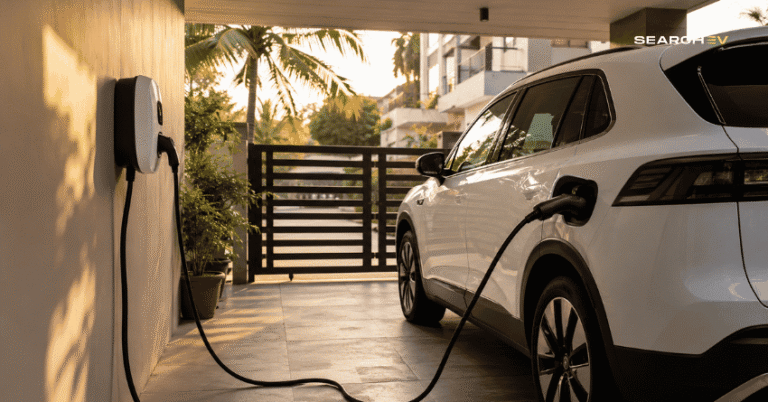
Set your charge limit to 80% for daily driving. Most EVs let you do this directly from the app or the car’s settings. You set it once and forget it. The car stops charging automatically when it hits that limit.
Only charge to 100% when you actually need the range. Planning a long trip? Go for it. That’s what it’s there for.
Don’t leave the car sitting at 100% for days. If you’ve charged to full for a trip but then the trip gets cancelled, plug back in and let it discharge a bit, or just drive it. Sitting fully charged and stationary is harder on the cells than actually using that charge.
Avoid frequent DC fast charging if you can. Fast chargers are brilliant for road trips, but the high current they push into the battery does generate more heat and stress compared to slow overnight charging. Using them occasionally is fine. Relying on them every day is worth reconsidering.
Keep an eye on your battery health report. Many EVs now show you battery health or state of health (SOH) in the app or dashboard. If yours does, glance at it every few months. It’s a great way to catch unusual degradation early.
The Bottom Line
Charging to 100% won’t kill your EV battery overnight. But making it a daily habit, year after year, does accelerate the wear compared to keeping things in that 20–80% window.
Think of it like sleep. Getting six hours occasionally is fine. Making it a permanent routine takes a toll you don’t really notice until it’s been a while.
Your battery is one of the most expensive components in your car. A small change in charging habit — setting that daily limit to 80% — costs you nothing and quietly extends the life of the pack. It’s one of the easiest things you can do, and most EV owners who know about it never look back.
So no, charging to 100% won’t destroy your battery. But you don’t need to do it every day, either.
Stay on top of every EV ownership tip and technology update — SearchEV covers what actually matters for Indian EV owners.