If you’re thinking about buying an electric car in India — or you already own one and are staring at your electricity bill wondering how much of it is the car’s fault — you’ve landed in the right place. Every EV owner ends up asking the same question sooner or later: what is the actual cost for charging electric cars, once you take out all the marketing gloss and get down to rupees and paise?
The honest answer is: it depends on where you live, how you charge, and which car you drive. There’s no single number that applies to all of India. But once you know the formula and the ballpark rates, you can work out your own number in under two minutes — and we’ll walk you through it here with real cars, real tariffs, and real math.
Why Knowing Your EV Charging Cost Actually Matters
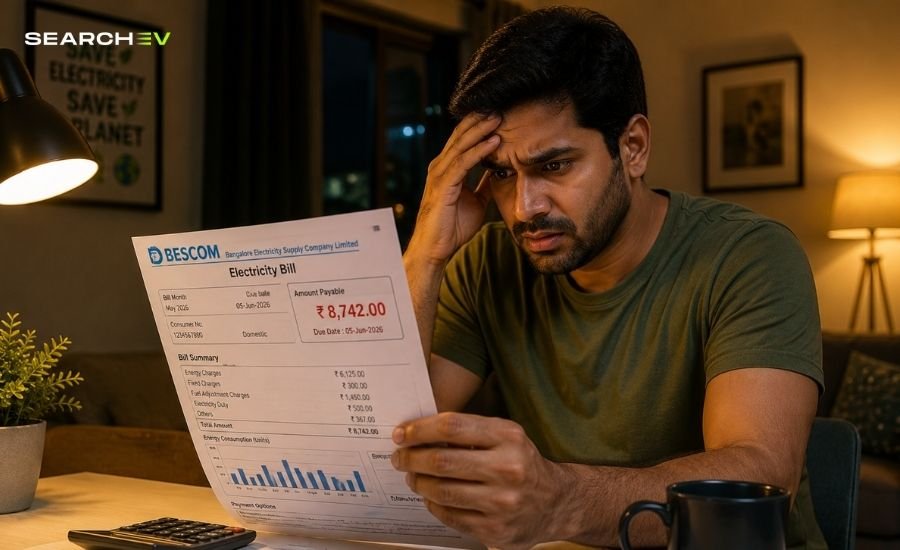
It’s tempting to skip straight to the numbers, but this section is worth thirty seconds because it explains why the numbers matter in the first place.
- Budgeting your monthly running cost: Petrol car owners already know their fuel bill down to the rupee. EV owners often don’t, because the cost is buried inside a household electricity bill rather than a separate fuel receipt.
- Comparing EVs before you buy: A bigger battery isn’t always better value. Two EVs with similar price tags can have very different cost-per-km once you factor in real-world range.
- Deciding between home and public charging: Many new EV owners default to public fast chargers out of habit, not realising they’re paying two to four times more than they would at home.
- Working out your real savings versus petrol: This is usually the deciding factor for first-time EV buyers, and it only makes sense once you know your actual charging cost, not just the ARAI claim.
With that context in place, let’s get into the formula that ties all of this together.
The Golden Formula: How EV Charging Cost Is Calculated
Every electric car charging cost, no matter the brand or battery size, comes down to one simple equation:
Cost per full charge = Battery Capacity (kWh) × Electricity Rate (₹ per unit)
One unit on your electricity bill equals one kWh, so this is a straightforward multiplication. Divide that cost by your car’s real-world range (not the ARAI figure, which is almost always optimistic), and you get your cost per kilometre.
Cost per km = Cost per full charge ÷ real-world range (km)
A Realistic Example: Tata Punch EV
The Tata Punch EV comes with two battery options — a 30 kWh standard pack and a 40 kWh long-range pack. Taking the 40 kWh long-range version, a full charge at ₹8 per unit costs approximately ₹320. In real-world city driving — traffic, AC running, a passenger or two — most owners report around 290 km on a full charge. That works out to roughly ₹1.10 per km. The smaller 30 kWh variant costs less per charge (around ₹240) but naturally covers less distance too, so the cost per km stays in a similar range.
A Realistic Example: MG Windsor EV
The MG Windsor EV has a 38 kWh battery and an ARAI-claimed range of 332 km, but real-world city driving typically nets closer to 250 km. At ₹8 per unit, a full charge costs about ₹304, which comes to roughly ₹1.22 per km — still a fraction of what any petrol hatchback or sedan would cost you.
A Realistic Example: Mahindra XEV 9e
The Mahindra XEV 9e’s larger battery pack (around 79 kWh in the long-range variant) is built for highway comfort rather than pure efficiency. A full home charge at ₹8 per unit costs approximately ₹632. With a real-world range of around 450 km, that comes to about ₹1.40 per km — more than the Punch or Windsor, but still 5-6 times cheaper than running a petrol SUV of comparable size.
Notice the pattern: bigger battery doesn’t automatically mean a worse cost-per-km, but it does mean a bigger one-time charging bill. This is exactly why the comparison table below matters more than looking at any single car in isolation.
Home Charging vs DC Fast Charging Cost: Top 5 EVs in India
Here’s a side-by-side look at five of India’s most-searched electric cars, comparing what a full charge costs at home versus at a DC fast-charging station. We’ve used ₹8 per unit for home charging (a fair average across most Indian cities) and ₹20 per unit for DC fast charging (a realistic mid-point for public networks), along with real-world range rather than the ARAI figure. Note that we have used Nexon EV and Punch EV long-range pack in this table for consistency.
| EV Model | Battery (kWh) | Home Charge Cost (₹8/unit) | DC Fast Charge Cost (₹20/unit) | Real-World Range (km) | Cost/km – Home | Cost/km – DC Fast |
| Tata Nexon EV (LR) | 45 | ₹360 | ₹900 | ~350 | ₹1.03 | ₹2.57 |
| MG Windsor EV | 38 | ₹304 | ₹760 | ~250 | ₹1.22 | ₹3.04 |
| Tata Tiago EV (LR) | 24 | ₹192 | ₹480 | ~220 | ₹0.87 | ₹2.18 |
| Mahindra XEV 9e | 79 | ₹632 | ₹1,580 | ~450 | ₹1.40 | ₹3.51 |
| Tata Punch EV (LR) | 40 | ₹320 | ₹800 | ~290 | ₹1.10 | ₹2.76 |
A quick takeaway from this table: the Tiago EV comes out as the cheapest to run per kilometre, largely because its smaller battery is matched with a lightweight body. The XEV 9e costs the most per km, but that’s the trade-off for a larger battery, longer real-world range, and a more highway-capable car. Across the board, DC fast charging costs roughly 2.3 to 2.7 times more than home charging for the same car — which is the single biggest lever you control as an owner.
Home Charging Cost for Electric Cars in India
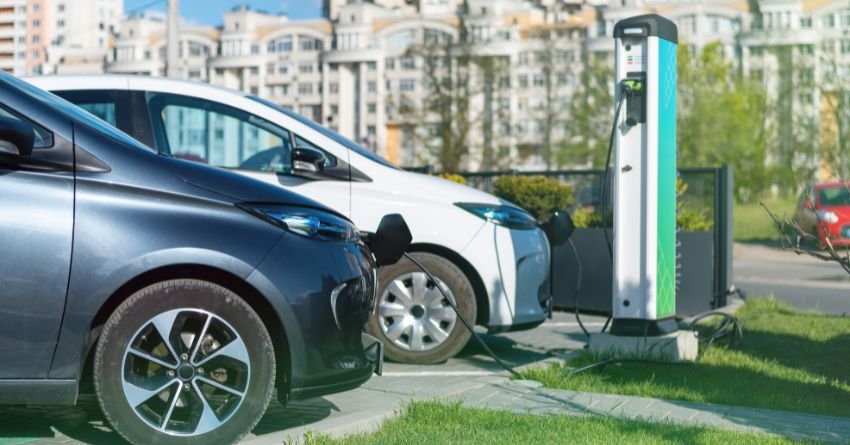
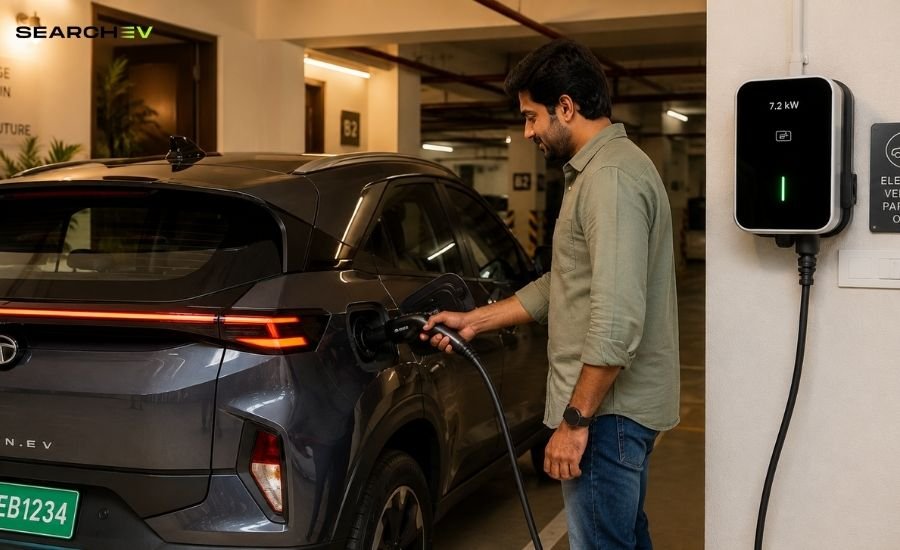
For most Indian EV owners, home charging is the default and, in almost every case, the cheaper option. Using a 7.2 kW AC wall charger, a 30-40 kWh battery typically takes 6-8 hours to charge fully overnight — perfectly suited to plugging in after dinner and waking up to a full battery.
Domestic electricity tariffs in India range roughly from ₹4 to ₹10 per unit depending on your state and consumption slab, so a full home charge for a typical mid-size EV usually falls between ₹250 and ₹450. Some states go further with dedicated EV tariffs that undercut the standard domestic slab, which we cover in the state-wise table below.
Public and DC Fast Charging Cost for EVs
Public charging exists for a different job: topping up quickly on a highway or when you’re away from home and running low. Public AC charging typically costs ₹8 to ₹15 per unit, while DC fast charging — the kind that takes a battery from near-empty to 80% in 30-50 minutes — usually runs ₹15 to ₹25 per unit, and sometimes higher at premium highway stations.
That premium exists because charge point operators are recovering the cost of expensive hardware, land, and grid upgrades, not just the electricity itself. It’s a fair trade for speed, but it’s not meant to be your everyday charging habit — treat it as the highway fuel stop, not the daily fill-up.
EV Charging Cost by State: Electricity Tariff Comparison
India doesn’t run on one electricity price. Every state’s DISCOM sets its own slab-based tariff, and several now offer EV-specific rates that are cheaper than standard domestic slabs. Here’s how the major states compare:
| State | Typical Domestic Rate (₹/unit) | Notes |
| Delhi | ₹3 – ₹8 | First 200 units free for eligible consumers; among the cheapest in India |
| Gujarat | ₹4 – ₹6 | Dedicated EV tariff available in several DISCOMs |
| Madhya Pradesh | ₹4 – ₹6 | Lower slabs favourable for home charging |
| Maharashtra | ₹6 – ₹9 | Slab-based; rates climb with higher monthly consumption |
| Karnataka | ₹6 – ₹9 | Comparable to Maharashtra; Bengaluru has strong charging infra |
| Telangana | ₹5 – ₹9 | Reasonable rates; ToU tariffs available in parts of the state |
| Tamil Nadu | ₹6 – ₹10 | Slab-based pricing; varies with DISCOM zone |
| Uttar Pradesh | ₹5.50 – ₹7 | ToD tariffs available in parts of the state; separate EV tariff category exists |
| Andhra Pradesh | ₹5 – ₹9 | Slab-based; EV-specific tariff category offered by AP DISCOMs |
| Kerala | ₹3.50 – ₹8 | KSEB slabs are among the lower end; strong public charging network |
| Punjab | ₹8 – ₹10 | On the higher end among major states |
If your state isn’t listed here, check your electricity bill for your DISCOM’s current tariff order, or look it up on the government’s e-AMRIT portal — rates are revised periodically and it’s worth confirming the latest slab before you plan your monthly charging budget.
Time-of-Day (ToD) Tariffs: The Easiest Way to Cut Your Bill
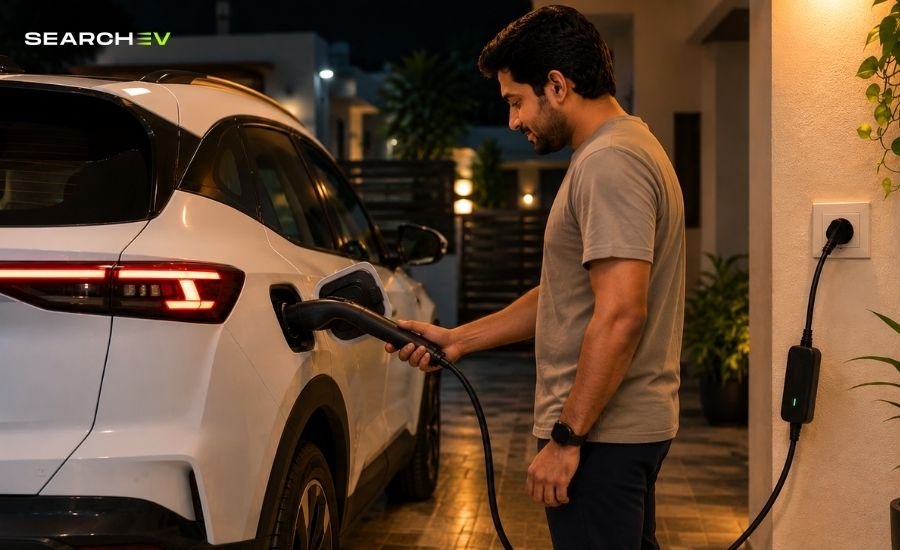
Several states — including Delhi, Maharashtra, Uttar Pradesh, and Telangana — now offer time-of-day tariffs, where the per-unit rate changes depending on when you draw power. Charging between 10 pm and 6 am, when household demand is low, can bring your rate down 20-30% compared to peak evening hours between 6 pm and 10 pm.
If your DISCOM offers this, it’s the single easiest change you can make: set your charger’s schedule to start late at night and finish by morning. Most smart home chargers and several EVs themselves let you schedule this from an app, so it’s a one-time setup rather than a daily habit you have to remember.
Hidden Factors That Change Your Real Charging Cost
- Charging losses: Not all electricity from the wall reaches the battery. Expect 10-15% loss to heat during AC-to-DC conversion, meaning your actual grid draw is somewhat higher than the battery’s rated capacity.
- Battery degradation: An older battery holds slightly less charge over years of use, which quietly increases your effective cost per km even though your tariff hasn’t changed.
- Ambient temperature: Extreme heat or cold pushes the battery management system to work harder, adding a small but real energy cost — relevant in Indian summers, especially in Delhi, Rajasthan, and parts of central India.
- Driving style and AC use: Aggressive acceleration and constant AC use on hot days can lower your real-world range by 10-20%, which directly raises your cost per km even at the same electricity rate.
Practical Tips to Reduce Your EV Charging Cost
- Apply for a dedicated EV tariff or a separate EV meter if your DISCOM offers one — this alone can bring your rate down by ₹1-2 per unit.
- Schedule overnight charging if your state has a Time-of-Day tariff; this is free money left on the table if you’re not using it.
- Reserve DC fast charging for genuine need — road trips and emergencies — rather than routine top-ups.
- If you live in an independent house, consider rooftop solar. Even a modest setup can offset a meaningful share of your daily charging load over time.
- Track your usage with a smart plug or energy monitor so your EV’s contribution to the bill doesn’t stay a mystery.
Verdict: What Should You Actually Expect to Pay?
Strip away the state-by-state variation and the answer settles into a fairly narrow band. For most mid-size electric cars in India, a full home charge will cost you somewhere between ₹250 and ₹450, and your running cost will land between ₹1 and ₹1.5 per km — roughly one-fifth to one-seventh of what a comparable petrol car costs to run. Public DC fast charging will cost two to three times more, and that’s fine occasionally, but it shouldn’t be your daily default.
If there’s one opinion worth holding onto from this entire article, it’s this: your charging cost is decided far more by your habits — home vs public, peak vs off-peak — than by which EV you buy. Pick a car that fits your life, then build a charging routine around your state’s cheapest hours. That’s where the real savings live.
Frequently Asked Questions
1. How much does it cost to fully charge an electric car in India?
On average, a full home charge costs between ₹250 and ₹450 depending on your car’s battery size and your state’s electricity tariff, which typically ranges from ₹4 to ₹10 per unit.
2. Is charging an EV at home cheaper than at a public charging station?
Yes, significantly. Home charging uses your regular domestic tariff, while public DC fast charging typically costs two to three times more per unit due to infrastructure and service costs.
3. How is EV charging cost calculated?
Multiply your car’s battery capacity in kWh by your electricity rate per unit to get the cost of a full charge. Divide that by your real-world range to get your cost per kilometre.
4. Which Indian state has the cheapest EV charging cost?
Delhi generally offers the lowest effective rates, with the first 200 units free for eligible consumers, followed closely by Gujarat and Madhya Pradesh, which have lower base slabs and dedicated EV tariffs in some areas.
5. How much cheaper is an EV to run compared to a petrol car in India?
Most electric cars cost ₹1 to ₹1.5 per km to run, compared to ₹7 to ₹9 per km for a similar petrol car — making EVs roughly five to seven times cheaper to run per kilometre.
6. Does fast charging cost more than slow home charging?
Yes. DC fast charging is priced at a premium, typically ₹15 to ₹25 per unit versus ₹4 to ₹10 per unit for home AC charging, because it involves higher-cost equipment and faster power delivery.