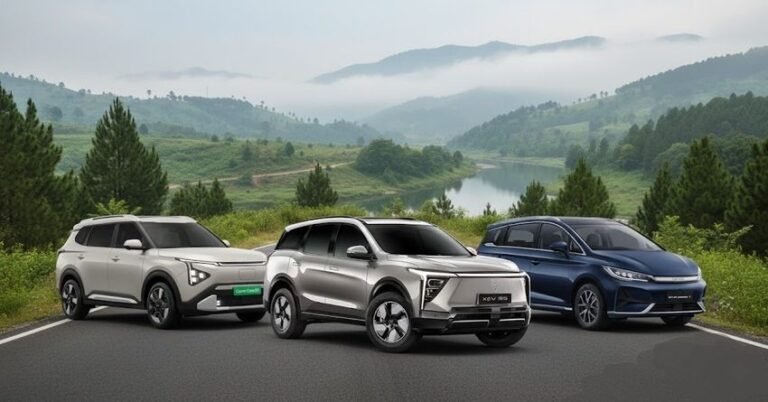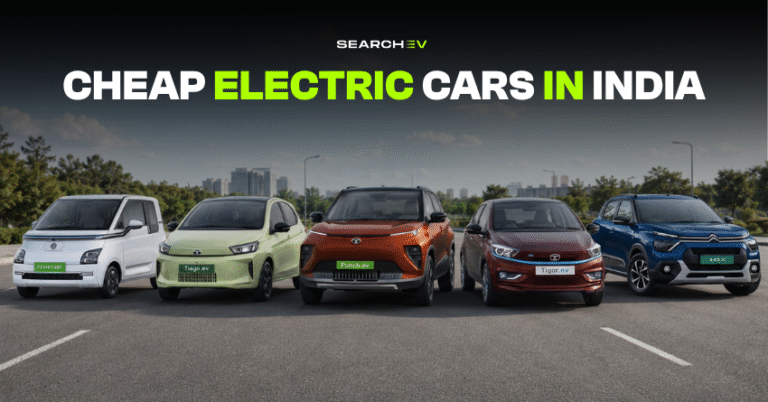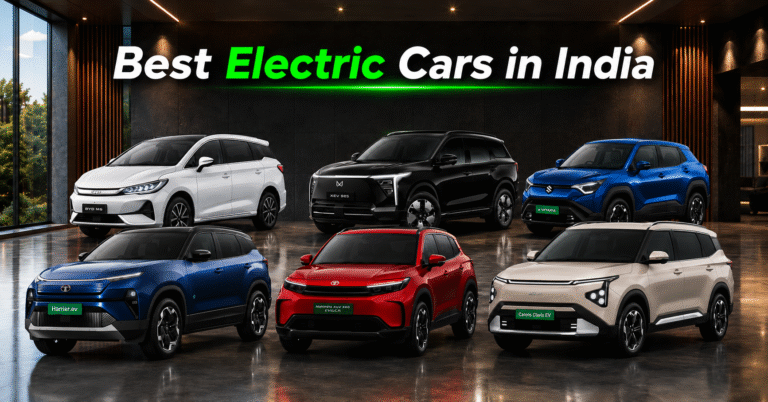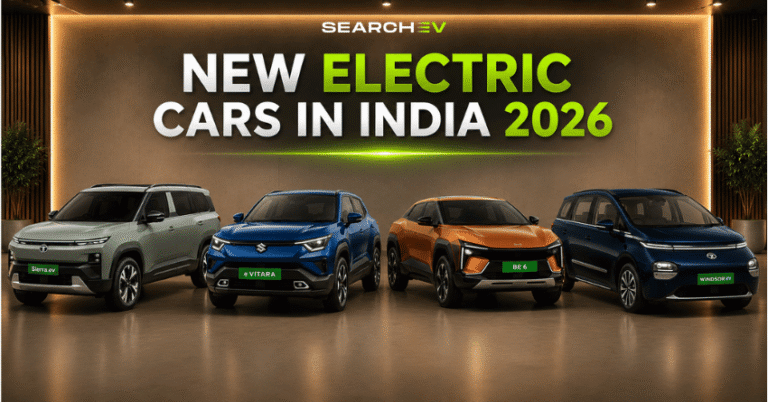
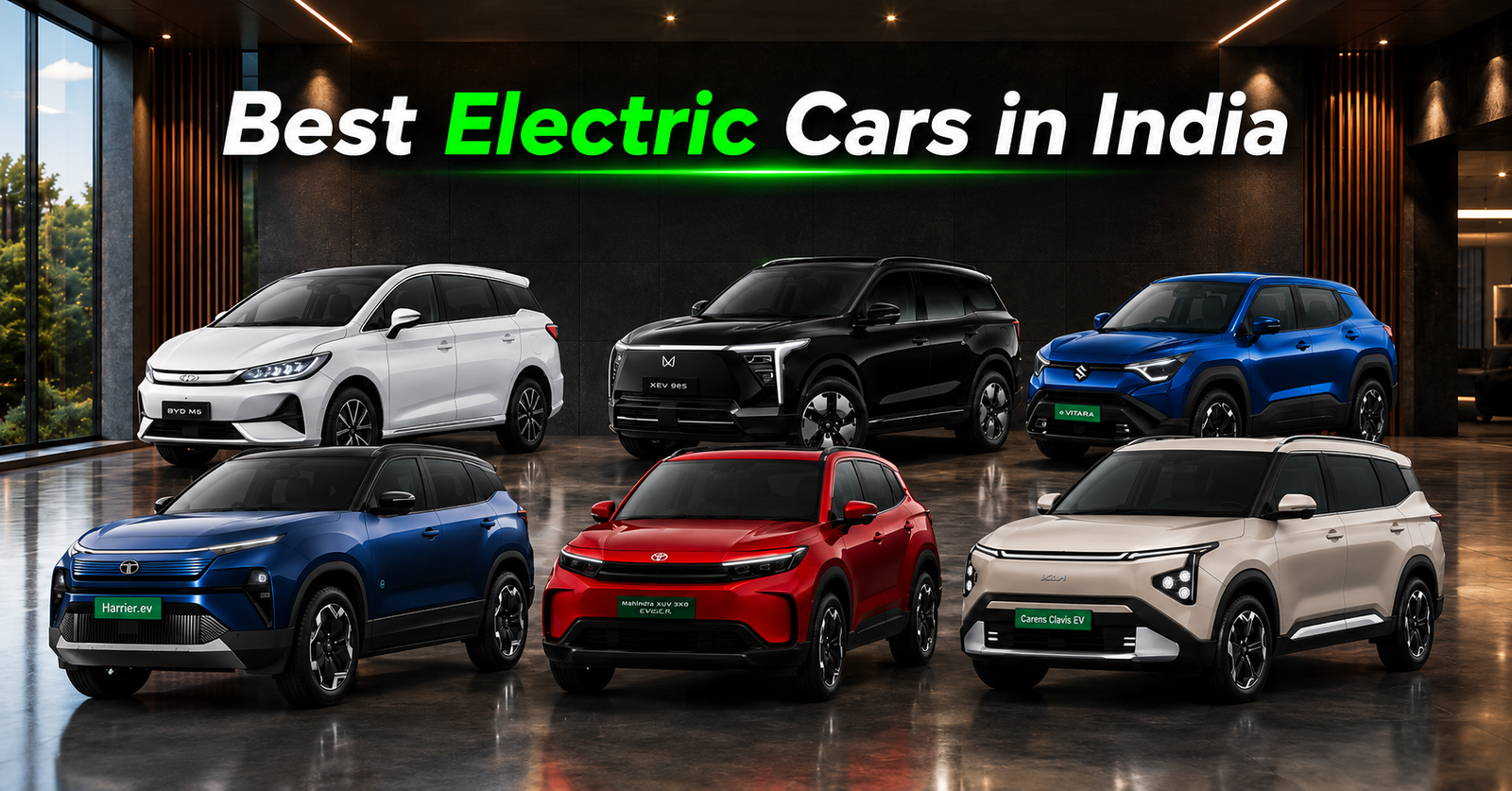
India’s EV market has changed a lot in just one year. New names like the Tata Sierra EV and Mahindra XEV 9S have entered, Toyota has finally launched its first EV, and BYD now has a proper 7-seater electric MPV on sale. That’s a lot to keep track of if you’re actually trying to buy one.
So here are 10 electric cars you can buy in India right now (July 2026), with real numbers — battery size, range, power, and price — plus who each one actually suits.
Table of Contents
- Quick Comparison Table
- Tata Punch EV
- Tata Harrier EV
- Tata Sierra EV
- Mahindra BE 6
- Mahindra XEV 9S
- Kia Carens Clavis EV
- Maruti Suzuki e Vitara
- Toyota Urban Cruiser Ebella
- BYD eMax7
- Hyundai Creta Electric
- Full Spec Comparison Table
- Our Honest Opinion – Which One Should You Buy?
Quick Comparison: 10 Best Electric Cars in India
| Vehicle Name | Battery Pack | Best For |
| Tata Punch EV | 30 kWh / 40 kWh | First-time EV buyers on a tight budget, city driving |
| Tata Harrier EV | 65 kWh / 75 kWh | Buyers who want a big, premium AWD electric SUV |
| Tata Sierra EV | 63 kWh / 75 kWh | Buyers who want retro design with modern EV range |
| Mahindra BE 6 | 59 kWh / 79 kWh | Enthusiasts who want performance and long range |
| Mahindra XEV 9S | 59 / 70 / 79 kWh | Families who need a 7-seater electric SUV |
| Kia Carens Clavis EV | 42 kWh / 51.4 kWh | Families wanting a practical 6/7-seater EV |
| Maruti Suzuki e Vitara | 49 kWh / 61 kWh | Buyers who trust Maruti’s service network |
| Toyota Urban Cruiser Ebella | 49 kWh / 61 kWh | Buyers who want Toyota’s reliability tag on an EV |
| BYD eMax7 | 55.4 kWh / 71.8 kWh | Families who want a proper electric MPV |
| Hyundai Creta Electric | 42 kWh / 51.4 kWh | Buyers who want a proven, familiar SUV, now electric |
Tata Punch EV
Price: ₹9.69 – ₹12.59 Lakh (ex-showroom, approx.; BaaS option starts from ₹6.49 Lakh)
Battery: 30 kWh (Medium Range) / 40 kWh (Long Range)
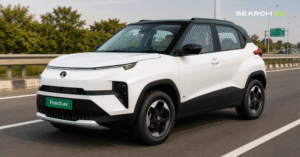
The Punch EV is the entry point into EVs for most Indian buyers. It’s a small, simple car built for the city, not the highway, and that’s exactly what makes it work for most people’s daily driving.
Main Specs & Features
| Specification | Details |
| Battery Options | 30 kWh / 40 kWh |
| Claimed Range (ARAI) | 375 km (MR) / 468 km (LR) |
| Power | Up to 95 kW (Long Range) |
| Fast Charging (DC) | 65 kW charger adds ~135 km in 15 minutes (LR) |
| Seating | 5 |
| Safety Rating | 5-star Global NCAP |
| Boot Space | 366 litres |
Key Features
- New-gen LFP prismatic cell battery, denser than the older pack
- Lifetime HV battery warranty (on the 40 kWh Long Range)
- Ventilated front seats and automatic climate control (facelift addition)
- 10.25-inch touchscreen and 10.25-inch digital driver display on higher trims
- Battery-as-a-Service option for a much lower entry price
Who Should Buy It
- First-time EV owners who want low running cost without a big loan
- People who mainly drive within the city, not highway
- Buyers who already trust Tata’s service network
Who Should Skip It
- Anyone who does frequent 200+ km highway trips
- Buyers who want a spacious cabin for a family of 5 with luggage
Tata Harrier EV
Price: ₹21.69 – ₹29.68 Lakh (ex-showroom, approx.)
Battery: 65 kWh / 75 kWh
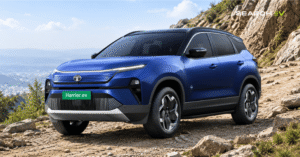
The Harrier EV is Tata’s flagship electric SUV and its first with all-wheel drive (Tata calls it QWD). It’s a big, road-presence-heavy SUV that feels premium inside, though this one is a proper ICE-to-EV conversion rather than a car built electric from scratch.
Main Specs & Features
| Specification | Details |
| Battery Options | 65 kWh / 75 kWh |
| Claimed Range (ARAI) | 538 km / 627 km |
| Power | 175 kW (RWD) / up to 291 kW (QWD dual-motor) |
| Fast Charging (DC) | 20–80% in about 25 minutes (120 kW) |
| Infotainment | 14.5-inch Samsung QLED screen |
| ADAS | Level 2 |
| Battery Warranty | Lifetime (first owner) |
Key Features
- All-wheel drive (QWD) option, a first for Tata
- 360-degree camera with transparent mode
- Ventilated seats and panoramic sunroof
- 502-litre boot plus a 67-litre frunk
- Multiple terrain response modes (Rock Crawl, Mud, Sand, Snow)
Who Should Buy It
- Buyers who want the biggest, most feature-loaded Tata EV on sale
- Anyone who values AWD capability for hilly or wet regions
- Families who need a large, comfortable cabin
Who Should Skip It
- Buyers on a strict budget — this is Tata’s most expensive EV
- Anyone bothered that it’s a converted ICE platform, not a born-electric one
Tata Sierra EV
Price: ₹18.79 – ₹25.99 Lakh (ex-showroom)
Battery: 63 kWh / 75 kWh
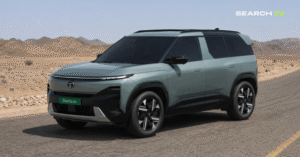
The Sierra name carries a lot of nostalgia in India, and Tata has brought it back as an EV that borrows its battery and motors from the Harrier EV, just in a slightly smaller, more affordable package. The brand-new Sierra EV (launched June 2026), so it doesn’t have a long ownership track record yet.
Main Specs & Features
| Specification | Details |
| Battery Options | 63 kWh / 75 kWh |
| Claimed Range (ARAI) | 565 km / 665 km |
| Power | 175 kW (RWD) / up to 291 kW (QWD dual-motor) |
| Fast Charging (DC) | 20–80% in about 26 minutes (120 kW) |
| Infotainment | 12.3-inch touchscreen, 12-speaker JBL audio |
| Battery Warranty | Lifetime (first owner) |
| 0-100 km/h | 5.8 seconds (dual-motor top variant) |
Key Features
- Retro-inspired design that pays homage to the original 1992 Sierra
- V2L and V2V charging (can power devices or another EV)
- 360-degree camera and terrain response modes
- Triple-screen dashboard on top variants
- Lifetime high-voltage battery warranty
Who Should Buy It
- Buyers who love the retro Sierra design and want something different-looking
- Anyone who wants Harrier-level range and tech for a bit less money
- Buyers comfortable being early adopters of a brand-new model
Who Should Skip It
- Buyers who prefer a proven car with a longer ownership history
- Anyone who needs a spare tyre as standard (it’s a paid extra here)
Mahindra BE 6
Price: ₹18.90 – ₹28.49 Lakh (ex-showroom)
Battery: 59 kWh / 79 kWh
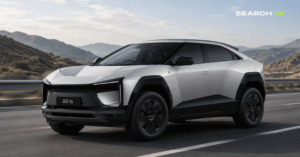
If you want the most range and the most performance in this list, this is it. The BE 6 is Mahindra’s most ambitious EV, built on a dedicated electric platform, and it doesn’t feel like a “budget EV” at all once you’re behind the wheel.
Main Specs & Features
| Specification | Details |
| Battery Options | 59 kWh / 79 kWh |
| Claimed Range (MIDC) | 557 km / 682 km |
| Power | Up to 172 kW / 210 kW |
| 0-100 km/h | 6.7 seconds (top variant) |
| Fast Charging (DC) | 20–80% in 20 minutes |
| Infotainment | Dual 12.3-inch screens |
| ADAS | Level 2 |
Key Features
- Dual 12.3-inch screens for driver and infotainment
- Fastest DC charging on this list (20-80% in 20 minutes)
- Level 2 ADAS
- Sportiest 0-100 km/h time in this segment
- Panoramic sunroof and premium cabin finish
Who Should Buy It
- Buyers who care about performance and want the longest real-world range here
- Tech-focused buyers who want a genuinely modern cabin
- Anyone comfortable paying closer to 30 lakh for the top variant
Who Should Skip It
- Families who need rear headroom for tall passengers – it’s tight due to the coupe styling
- Buyers who want a car with wide rearward visibility for easy parking
Mahindra XEV 9S
Price: ₹19.95 – ₹29.45 Lakh (ex-showroom)
Battery: 59 kWh / 70 kWh / 79 kWh
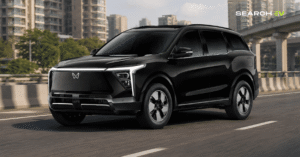
The XEV 9S is Mahindra’s answer to buyers who want a 7-seater EV. It’s built on the same INGLO electric platform as the BE 6, just with a bigger, more practical body and 3 rows of seats.
Main Specs & Features
| Specification | Details |
| Battery Options | 59 kWh / 70 kWh / 79 kWh |
| Claimed Range (MIDC) | 521 km / 600 km / 679 km |
| Power | 170 kW / 180 kW / 210 kW |
| Seating | 7 |
| Fast Charging (DC) | 20–80% in 20 minutes (180 kW) |
| Infotainment | Triple 12.3-inch screen setup |
| ADAS | Level 2+ |
Key Features
- Only born-electric 7-seater SUV in this price range
- 16-speaker Harman Kardon sound system
- 150-litre frunk plus regular boot space
- Massive panoramic sunroof
- 5 regenerative braking modes with one-pedal driving
Who Should Buy It
- Families who specifically need a 3-row electric SUV
- Buyers who want long-distance capability with the 79 kWh pack
- Anyone who wants the newest tech Mahindra has to offer
Who Should Skip It
- Small families or singles who don’t need 3 rows — you’ll be paying for space you won’t use
- Buyers wary of a very new nameplate with limited long-term ownership data
Kia Carens Calvis EV
Price: ₹17.99 – ₹24.99 Lakh (ex-showroom, approx.) BaaS starts from ₹12.84 lakh)
Battery: 42 kWh / 51.4 kWh
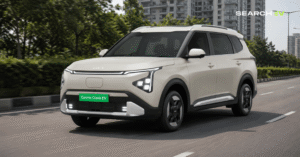
The Carens Clavis EV takes Kia’s popular family MPV and gives it an electric powertrain — the same battery and motor as the Hyundai Creta Electric, in fact. If you need 6 or 7 seats and don’t want an SUV shape, this is one of the few EVs that fits the bill.
Main Specs & Features
| Specification | Details |
| Battery Options | 42 kWh / 51.4 kWh |
| Claimed Range (ARAI) | 404 km / 490 km |
| Power | 99 kW / 126 kW |
| Seating | 6 or 7 (both offered) |
| Fast Charging (DC) | 10–80% in about 39 minutes (100 kW) |
| ADAS | Level 2 (20 features) |
| Airbags | 6 |
Key Features
- Choice of 6-seater (captain seats) or 7-seater layout
- Battery-as-a-Service option to lower entry cost
- Dual-pane panoramic sunroof
- Flat-folding rear rows, good for camping or big luggage
- BOSE 8-speaker audio on top trim
Who Should Buy It
- Families who want maximum seating flexibility in an EV
- Buyers who want an MPV shape instead of an SUV
- Anyone who wants lower upfront cost via the BaaS plan
Who Should Skip It
- Buyers who specifically want SUV road presence and higher ground clearance
- Anyone chasing the longest range in this budget — rivals do better here
Maruti Suzuki e Vitara
Price: ₹15.99 Lakh onwards (ex-showroom, approx.) BaaS starts from ₹10.99 lakh)
Battery: 49 kWh / 61 kWh
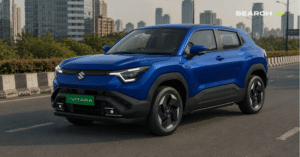
Maruti took its time entering the EV space, and it shows — the e Vitara feels like a car built properly for electric use, not converted from a petrol model. This is the HEARTECT-e platform, co-developed with Toyota
Main Specs & Features
| Specification | Details |
| Battery Options | 49 kWh / 61 kWh |
| Claimed Range | Up to 440 km / 543 km |
| Power | 106 kW / 128 kW |
| Drivetrain | Front-wheel drive |
| Ground Clearance | 180 mm |
| Airbags | 7 |
| Seating | 5 |
Key Features
- Built on a dedicated EV platform, not a converted petrol car
- 10-way power-adjustable driver seat
- Multi-colour ambient lighting
- 7 airbags as standard
- Battery-as-a-Service (BaaS) option to lower entry price
Who Should Buy It
- Buyers who want Maruti’s massive service network without compromise
- Those who want the longest range in this price bracket
- People who prefer a more driver-focused, agile SUV feel
Who Should Skip It
- Buyers who want maximum cabin space – rivals edge it out here
- Anyone who wants AWD (only FWD is available in India for now)
Toyota Urban Cruiser Ebella
Price: ₹17.99 – ₹23.60 Lakh (ex-showroom, approx.) BaaS starts from ₹15.25 lakh)
Battery: 49 kWh / 61 kWh
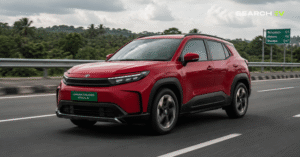
Toyota’s very first EV, the Urban Cruiser Ebella, is basically an e Vitara underneath, rebadged with Toyota styling and backed by Toyota’s own service network. It plays it safe rather than radical, which is exactly the point for a lot of buyers.
Main Specs & Features
| Specification | Details |
| Battery Options | 49 kWh / 61 kWh |
| Claimed Range (ARAI) | 440 km / 543 km |
| Power | 106 kW / 128 kW |
| Fast Charging (DC) | 10–80% in about 45 minutes (70 kW) |
| Seating | 5 |
| Airbags | 7 |
| Battery Warranty | 8 years / 200,000 km |
Key Features
- LFP battery chemistry for long-term durability
- Ventilated front seats and JBL sound system
- Panoramic roof and 12-colour ambient lighting
- V2L to power external devices
- Assured buyback and Battery-as-a-Service options
Who Should Buy It
- Buyers who want Toyota’s brand trust and after-sales reputation in an EV
- Those who want a straightforward, no-drama EV ownership experience
- Anyone who prefers understated styling over an aggressive EV look
Who Should Skip It
- Buyers who want the most car for their money — it’s priced above its Maruti twin
- Anyone who wants class-leading cabin space or boot size
BYD eMax 7
Price: ₹26.90 – ₹29.90 Lakh (ex-showroom)
Battery: 55.4 kWh / 71.8 kWh
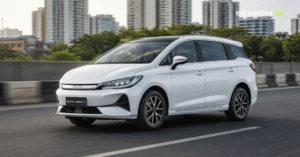
The eMax7 is one of the very few genuine electric MPVs on sale in India. If your family needs 6 or 7 seats and you don’t want an SUV, and budget stretches close to 30 lakh, this is worth a serious look.
Main Specs & Features
| Specification | Details |
| Battery Options | 55.4 kWh / 71.8 kWh |
| Claimed Range | 420 km / 530 km |
| Power | 120 kW / 150 kW |
| Seating | 6 or 7 |
| Fast Charging (DC) | 0–80% in about 37 minutes (115 kW) |
| Battery Warranty | 8 years / 160,000 km |
| Ground Clearance | 170 mm |
Key Features
- Rotating 12.8-inch touchscreen
- Blade battery technology, known for safety and longevity
- Ventilated captain seats in the middle row
- Panoramic sunroof and 360-degree camera
- Level 2 ADAS with 6 airbags
Who Should Buy It
- Families who specifically want an electric MPV, not an SUV
- Buyers who value ride comfort on long family trips
- Anyone comfortable with a smaller dealer/service network than the big brands
Who Should Skip It
- Buyers who want the tightest turning radius — it’s a long MPV, tricky in packed parking lots
- Anyone budgeting well under 25 lakh — this is the priciest car on this list
Hyundai Creta Electric
Price: ₹18.02 – ₹24.70 lakh (ex-showroom) BaaS starts from ₹10.99 lakh
Battery: 42 kWh / 51.4 kWh
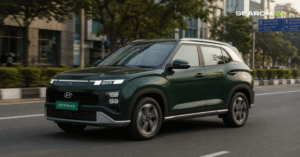
The Creta name alone sells cars in India. Hyundai took the SUV everyone already trusts and made a Creta electric. It’s not the most exciting EV on this list, but it’s one of the safest bets if you don’t want to gamble on a brand-new nameplate.
Main Specs & Features
| Specification | Details |
| Battery Options | 42 kWh / 51.4 kWh |
| Claimed Range | 390 km / 473 km |
| Power | 99 kW / 128 kW |
| Fast Charging (DC) | 10–80% in about 58 minutes |
| Sunroof | Panoramic sunroof / Panoramic glass roof |
| ADAS | Level 2 |
| V2L (Vehicle to Load) | Yes, on top trim |
Key Features
- Panoramic sunroof with voice control
- Level 2 ADAS suite
- Vehicle-to-Load (V2L) on the top trim
- Dual wireless phone chargers
- Familiar Creta cabin layout and build quality
Who Should Buy It
- Existing Creta owners who want to move to electric without changing what they know
- Families who value space, comfort, and a familiar cabin layout
- Buyers who want strong resale value backed by Hyundai’s brand pull
Who Should Skip It
- Buyers looking for a car that feels genuinely “new” – this is an ICE car converted to EV
- Those chasing outright performance numbers
Full Spec Comparison Table
| Model | Battery | Range (Claimed) | Power | Price Range |
| Tata Punch EV | 30/40 kWh | 375/468 km | Up to 95 kW | ₹9.69–12.59 L |
| Tata Harrier EV | 65/75 kWh | 538/627 km | 175/up to 291 kW | ₹21.49–30.23 L |
| Tata Sierra EV | 63/75 kWh | 565/665 km | 175/up to 291 kW | ₹18.79–25.99 L |
| Mahindra BE 6 | 59/79 kWh | 557/682 km | Up to 172/213 kW | ₹18.90–28.49 L |
| Mahindra XEV 9S | 59/70/79 kWh | 521/600/679 km | 170/180/210 kW | ₹19.95–29.45 L |
| Kia Carens Clavis EV | 42/51.4 kWh | 404/490 km | 99/126 kW | ₹18.00–26.00 L |
| Maruti e Vitara | 49/61 kWh | 440/543 km | 106/135 kW | ₹15.99 L onwards |
| Toyota Ebella | 49/61 kWh | 440/543 km | 106/128 kW | ₹17.99–23.60 L |
| BYD eMax7 | 55.4/71.8 kWh | 420/530 km | 122/152 kW | ₹26.90–29.90 L |
| Hyundai Creta Electric | 42/51.4 kWh | 390/473 km | 99/128 kW | ₹17.99–23.50 L |
Our Honest Opinion – Which One Should You Buy?
Ten cars are a lot to choose from, so here’s how we narrow it down.
If you’re just starting out with EVs and mostly drive in the city, get the Tata Punch EV. It’s the cheapest way in, and you don’t need 600 km of range for a 30 km commute.
If you need a proper 3-row family EV, it comes down to two choices: the Mahindra XEV 9S if you want an SUV body and the newest tech, or the Kia Carens Clavis EV if you want an MPV shape and lower running costs. The BYD eMax7 is worth a look too, but only if your budget is close to 30 lakh and you specifically want MPV comfort over SUV styling.
If you want a name you already trust for a 5-seater SUV, the Hyundai Creta Electric or Maruti e Vitara are the safe, sensible picks. The Toyota Ebella sits in the same space but currently costs more than its Maruti twin for largely the same car.
If range and performance matter more than anything else, the Mahindra BE 6 is still hard to beat pound-for-pound.
And if you want the biggest, most premium Tata EV with AWD, the Tata Harrier EV is the one — just be ready to spend close to 30 lakh for it. The Tata Sierra EV gives you almost the same range and tech for noticeably less money, if you’re fine with a brand-new model that hasn’t built up a long ownership track record yet.
There’s no single “best” EV in this list. Match the car to your seating need, your budget, and how far you actually drive — not to the spec sheet with the biggest numbers.
Note: Prices, Range, specifications, charging times, and features change often as manufacturers update variants through the year. Always confirm the latest figures with the dealership or the official brand website before making a final call.