Quick Reads
- Citroen has aggressively repositioned the newly launched eC3X with a Battery-as-a-Service (BaaS) scheme, dropping its entry price to just Rs 6.89 lakh, making it one of the most accessible electric vehicles in India.
- The Tata Punch EV remains the undisputed tech benchmark in this segment, offering potent performance, 122 hp of power, and premium features like a 360-degree camera and ventilated seats.
- The eC3X’s BaaS pricing makes it a direct fiscal alternative to the entry-level Tata Tiago EV, forcing buyers to choose between a larger cabin with a battery subscription or a smaller hatchback with full battery ownership.
Introduction
The sub-4-meter electric SUV space is officially heating up. For buyers looking to transition to zero-emission mobility without crossing the Rs 15 lakh barrier, the choices have primarily revolved around Tata Motors. However, Citroen has changed the dynamics to some extent with the launch of the updated eC3. It now carries the ‘X’ moniker much like we have seen other Citroen cars doing recently.
The brand has made an attempt to increase the premium quotient of the vehicle with added features, improved interiors, and a slightly greater claimed range. Further lowering the barrier to entry, is the Battery-as-a-Service (BaaS) ownership model.
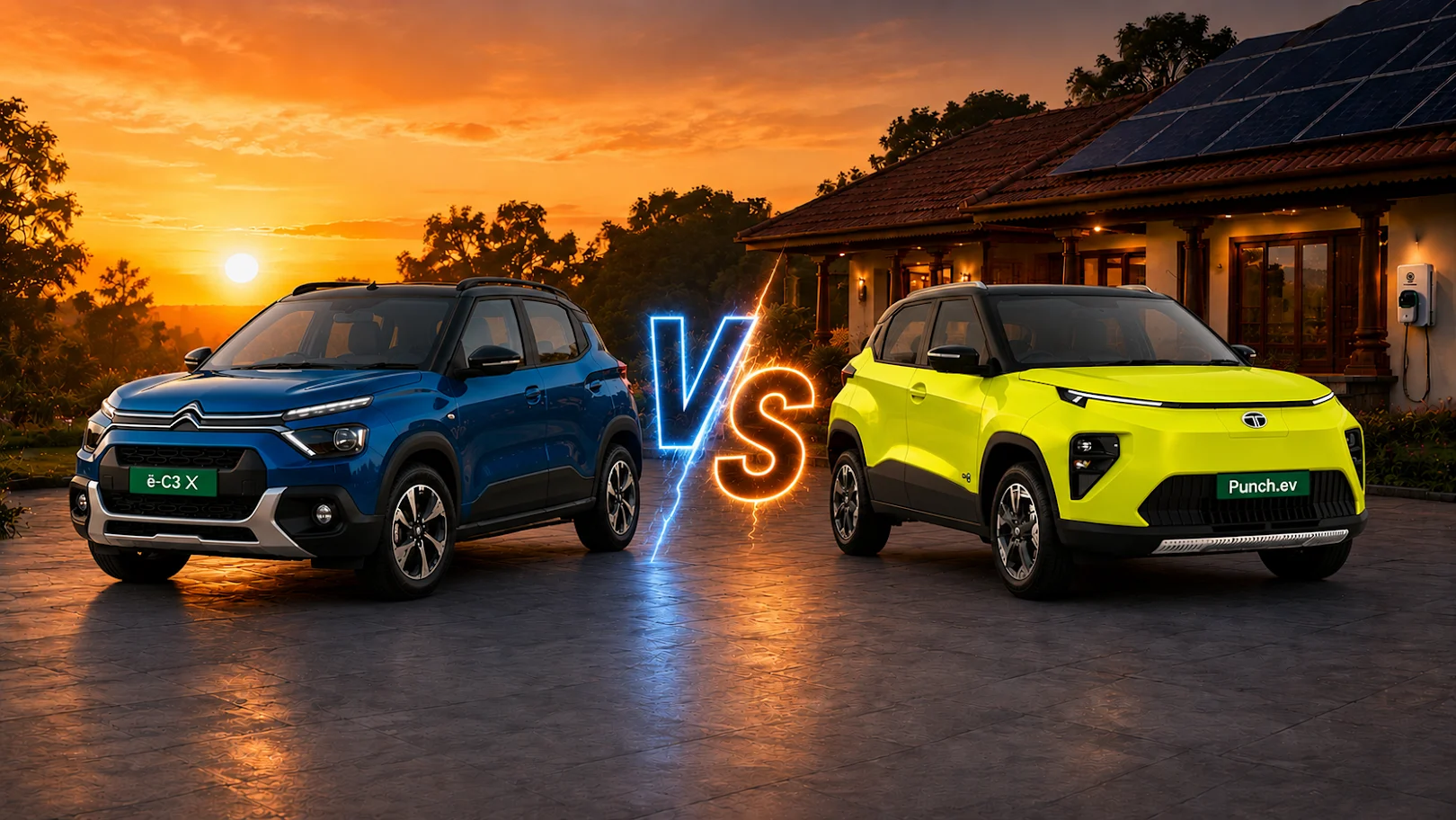
Here is a comprehensive breakdown of how the aggressively priced Citroen eC3X compares to the segment-leading Tata Punch EV, and whether the new pricing strategy makes it a smarter buy.
Pricing and The BaaS Factor
The most significant talking point of the eC3X is its revised pricing structure. Citroen has adopted the Battery-as-a-Service (BaaS) model, which separates the cost of the car from the battery pack.
| Model | Starting Price (Ex-Showroom) | Top-Spec Price (Ex-Showroom) | Battery Subscription Cost |
| Citroen eC3X (With BaaS) | Rs 6.89 lakh | – | Rs 2.26 per km |
| Citroen eC3X (Without BaaS) | Rs 10.25 lakh | – | None |
| Tata Punch EV (With BaaS) | Rs 6.49 lakh | – | Rs 2.6 per km |
| Tata Punch EV
(Without BaaS) |
Rs 9.69 lakh | Rs 12.59 Lakh | None |
With BaaS, the upfront cost of the eC3X drops significantly compared to its standard ex-showroom price. However, buyers must pay a battery rental fee of Rs 2.26 for every kilometre driven. The Tata Punch EV also offers the option between a traditional full-ownership model and a BaaS option.
Citroen eC3X vs Punch EV: Performance, Battery, and Range
Under the floorboards, these two sub-compact electric vehicles take fundamentally different approaches to propulsion. The Punch EV relies on a high-voltage, liquid-cooled architecture designed for performance flexibility, whereas the eC3X opts for an air-cooled, cost-optimised setup geared primarily toward predictable urban commuting.
| Specification | Citroen eC3X | Tata Punch EV (Standard Range) | Tata Punch EV (Long Range) |
| Battery Capacity | 29.2 kWh | 30.0 kWh | 40.0 kWh |
| Battery Thermal Management | Air-Cooled | Liquid-Cooled | Liquid-Cooled |
| Max Motor Power | 42 kW (57 hp) | 65 kW (88 hp) | 90 kW (122 hp) |
| Max Torque | 143 Nm | 154 Nm | 190 Nm |
| ARAI Certified Range | 325 km | 375 km | 421 km |
| Top Speed | 107 km/h | 120 km/h | 140 km/h |
| DC Fast Charging Time | 57 minutes (10-80%) | 30 minutes (10-80%) | 26 Mins (20-80%) |
The Citroen eC3X is the one with the more modest power output, producing 57 hp and 143 Nm of torque. The ARAI claimed range has gone up by 79 km compared to the pre-facelift model, but still isn’t a match to the Punch EV.
The Tata Punch EV is built on the brand’s dedicated pure-EV acti.ev architecture. It offers the bigger, and more advanced battery pack right from the base variant. The Citroen EV doesn’t offer a long-range version on higher trims, so you are only left with the Punch EV, in case you have longer commutes.
However, where the Citroen truly shines is its suspension tuning; the ride quality over broken roads is exceptionally plush, which reminds you just how good French engineering can be.
Citroen eC3X vs Punch EV: Features and Tech
If technology is your primary deciding factor, the Tata Punch EV operates in a completely different league.
The separation between these two cabins becomes very noticeable when you compare their equipment sheets. Tata has packed the Punch EV to the gills with premium luxury features traditionally reserved for higher segments. While Citroen has added more features with the facelift, it’s still not a full match to the Tata’s.
Common Ground: Shared Features
Both vehicles establish a solid baseline of modern necessities:
- Large Touchscreen Infotainment: Both feature high-definition widescreen displays (10.25-inch in the Punch, and 10.2-inch in the eC3X) supporting wireless Apple CarPlay and Android Auto.
- Connected Car Technology: Proprietary telematics app suites (iRA.ev for Tata, Citroen Connect 2.0 for Citroen) allow users to monitor battery health, track charging status, access geo-fencing diagnostics, and more.
- Multi-Mode Regenerative Braking: Both vehicles allow the driver to toggle through different levels of energy recuperation to maximise real-world range during stop-and-go city traffic.
- Digital Instrumentation: Traditional analogue dials are discarded in favour of digital driver information displays providing crucial EV-specific metrics such as distance-to-empty, state-of-charge (SOC), and real-world efficiency readouts.
Tata Punch EV Highlights:
Here are some features unique to the Tata Punch EV:
- 360-degree surround-view camera
- Ventilated front seats
- electric sunroof
- Standard 6 airbags across all variants
- Electronic Parking Brake with Auto-Hold
- Frunk Storage
The Citroen eC3X on the other hand, focuses on core cabin comfort and an airy, spacious feel, but it surely misses out on the modern “feel-good” features that Indian buyers increasingly demand with modern electric cars.
The Wildcard Comparison: Citroen eC3X vs Tata Tiago EV
The introduction of the BaaS scheme for the eC3X creates one more confusion for potential buyers. At an upfront cost of Rs 6.89 lakh, the mid-size Citroen eC3X sits right next to the starting price of the much smaller Tata Tiago EV hatchback (Rs 6.99 lakh). Does it make sense to buy the eC3X over the Tiago EV?
The Case for the eC3X over Tiago EV: You are essentially getting a vehicle that is one segment larger for the same upfront money. The eC3X offers substantially more rear-seat legroom, superior ground clearance (170 mm), a larger boot, and a highly absorbent SUV-like ride quality that the compact Tiago EV cannot match.
The Catch: The mental math required for BaaS. With the Tiago EV, your running costs are purely electricity (roughly Rs 1 to Rs 1.5 per km depending on home charging rates). With the eC3X BaaS, you must factor in the Rs 2.26 per km subscription plus the cost of electricity. If your daily commute is extensive, the recurring subscription cost of the eC3X will quickly negate the initial savings, making the fully-owned Tiago EV a financially smarter long-term proposition.
Conclusion: Which Electric Vehicle Should You Buy?
- Buy the Citroen eC3X (With BaaS) if: You strictly want a spacious, comfortable family car with great ride quality for occasional weekend city use, and you want to keep your initial loan amount or upfront cash payout as low as possible.
- Buy the Tata Punch EV if: You want a fully loaded, primary vehicle. If you demand premium features, robust safety tech, and plan on taking occasional highway trips, the Punch EV is a great buy.
- Buy the Tata Tiago EV if: You want the absolute lowest running costs for heavy daily city commuting. If you drive over 1,500 km a month, the math heavily favours the lower upfront cost of the Tiago EV.