Quick Reads
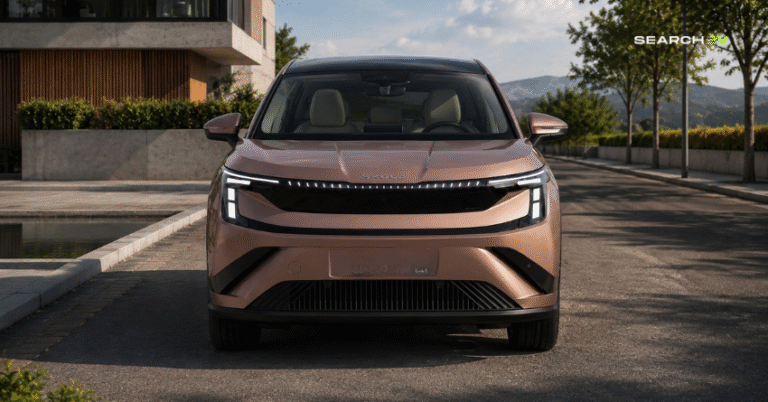
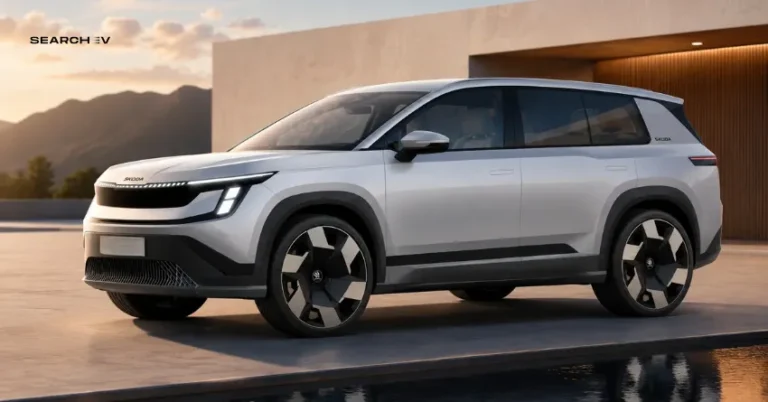
- The newly unveiled Skoda Peaq is the brand’s first-ever three-row electric SUV and the largest, most expensive vehicle in its global lineup.
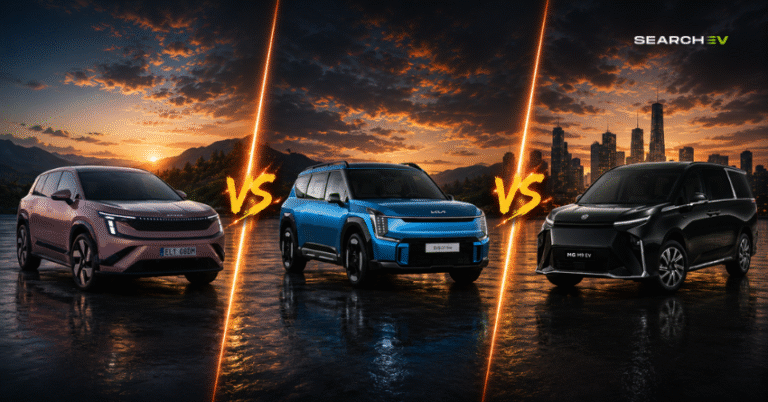
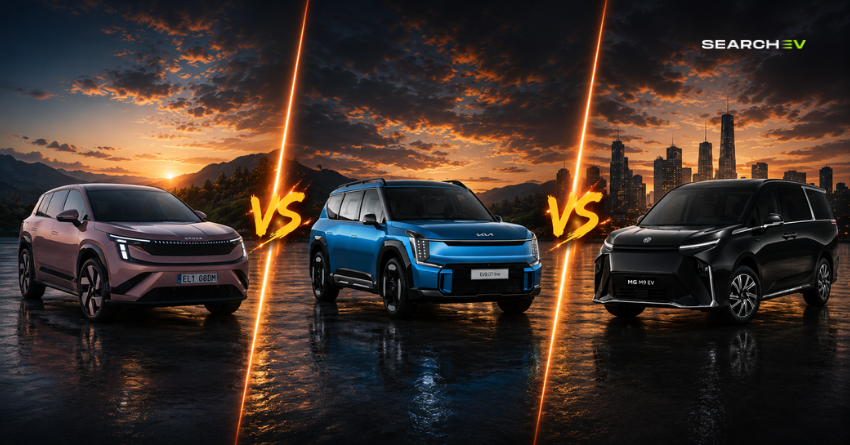
- Skoda is evaluating the Peaq for an Indian launch as a Completely Built Unit (CBU) import. If introduced, the Peaq will compete against the likes of the Kia EV9 and MG M9.
- The MG M9 is the largest model in every physical metric, while the Skoda Peaq is the most compact of the trio, measuring under the 5-meter mark.
Skoda has unveiled a new electric SUV in the upper echelons of electric mobility: the Skoda Peaq. Marking a historic milestone for the Czech automaker, the newly unveiled Skoda electric SUV officially takes the crown as the largest and most expensive vehicle in Skoda’s entire production lineup.
As the Indian market witnesses a rapid expansion of high-end, multi-row family EVs, Skoda Auto India is actively evaluating the possibility of bringing the Peaq to our shores. In case this is approved, it will come to the market as a Completely Built Unit (CBU) import, which would be the most premium halo product for elevating the premium image of the brand in the country. With its price tag falling in the range of Rs 70 lakh – 90 lakh, the Peaq would directly compete with the likes of the Kia EV9 and luxurious EVs such as MG M9.
Exterior Design: Three Distinct Approaches to Size
Despite all three vehicles commanding massive road presence, their design philosophies are vastly different.
The Skoda Peaq serves as the poster child for the Czech brand’s new ‘Modern Solid’ design language. The front is dominated by a gloss-black ‘Tech Deck’ panel that replaces the traditional grille, flanked by T-shaped Matrix LED headlights and a connected LED light bar with vertical illuminated slats. Down the side, it features flush-fitting door handles, a relatively flat beltline, and large aero-optimized wheels ranging from 19 to 21 inches, giving it a sophisticated, understated European stance.
The Kia EV9, in contrast, has a hyper-futuristic, and boxy silhouette. It looks unapologetically like a traditional large SUV but is detailed with striking EV-specific elements. Its upright fascia features the digital ‘Tiger Nose’ grille and vertical ‘Star Map’ LED daytime running lights. The squared-off wheel arches with gloss black cladding and the sharp, angular window line give the EV9 an imposing, almost rigid presence on the road.
The MG M9 takes an entirely different approach, strictly adopting the traditional van-like proportions of an ultra-luxury MPV. While it lacks the rugged SUV appeal of the Peaq and EV9, it maximises its footprint for pure passenger volume. The front features a split-headlight design with a sleek LED light bar spanning the hood. Its defining exterior trait is its massive, electrically operated sliding rear doors, which clearly signifies its chauffeur-driven focus.
Interior and Cabin Experience
When evaluating vehicles costing north of Rs 70 lakh, the cabin experience is the primary deciding factor.
Inside the Skoda Peaq, you get a dual-tone, rather minimalist, design language. It also utilises sustainable and recycled materials. The dashboard is anchored by a massive, portrait-oriented 13.6-inch touchscreen, paired with a 10-inch digital instrument cluster. Unlike many modern EVs, Skoda has smartly retained physical toggle switches for essential climate and volume controls. The Peaq offers an optional ‘Relax Package’ that adds massaging front seats with leg rests and a panoramic sunroof with adjustable opacity segments.
The Kia EV9 offers a highly digitised and airy cabin, highlighted by a ‘Trinity Display’ setup that integrates two 12.3-inch screens into a single sweeping glass housing. The Indian-spec EV9 is offered in a 6-seater configuration, featuring second-row captain chairs that offer heating, ventilation, and massage functions, along with airline-style winged headrests.
The MG M9 is arguably the most opulent in the second row. Positioned as a direct, electric alternative to the Toyota Vellfire, the M9’s cabin is draped in Cognac Brown leather and suede. It features ‘Presidential’ captain chairs in the middle row that offer 16-way electronic adjustment, heating, ventilation, massage, and fold-out ottomans. Control over these features is managed via dedicated touchscreens built into the seat armrests, making it the ultimate vehicle for those who prefer to be driven.
Skoda Peaq vs Kia EV9 vs MG M9: Dimensions Comparison
A look at the physical footprint of these three vehicles reveals how their differing body styles dictate their overall size.
| Dimension | Skoda Peaq (SUV) | Kia EV9 (SUV) | MG M9 (MPV) |
| Length | 4,874 mm | 5,015 mm | 5,200 mm |
| Width | 1,867 mm | 1,980 mm | 2,000 mm |
| Height | 1,664 mm | 1,780 mm | 1,800 mm |
| Wheelbase | 2,965 mm | 3,100 mm | 3,200 mm |
| Boot Space (All Rows Up) | 299 Litres | 333 Litres | 945 litres |
| Seating Capacity | Up to 7 | 6 | 7 |
The MG M9 is substantially larger in every metric, translating to unmatched third-row space. The Skoda Peaq is the most compact of the trio, slipping comfortably under the 5-meter mark, which may make it the most manageable to drive in congested Indian city traffic.
Skoda Peaq’s Powertrain And Highlights
The Skoda Peaq is built upon the Volkswagen Group’s dedicated MEB+ electric architecture, stretched to its absolute limits to accommodate the three-row layout.
Skoda will offer the Peaq globally in three distinct configurations: the 60, 90, and the range-topping 90x.
- Battery and Range: The entry-level ’60’ variant utilises a 63 kWh battery pack, delivering a claimed range of 459 km. The ’90’ and ’90x’ variants step up to a much larger 91 kWh battery, which pushes the maximum claimed driving range up to an impressive 647 km on a single charge.
- Performance: The base models utilise a rear-mounted single electric motor producing either 204 hp or 286 hp. The flagship ’90x’ variant employs a dual-motor, all-wheel-drive setup that generates a combined 299 hp, allowing the heavy SUV to sprint from 0-100 km/h in 6.7 seconds.
- Charging: The 91 kWh battery supports high-speed DC fast charging up to 199 kW, enabling a 10 to 80 percent charge in just 28 minutes.