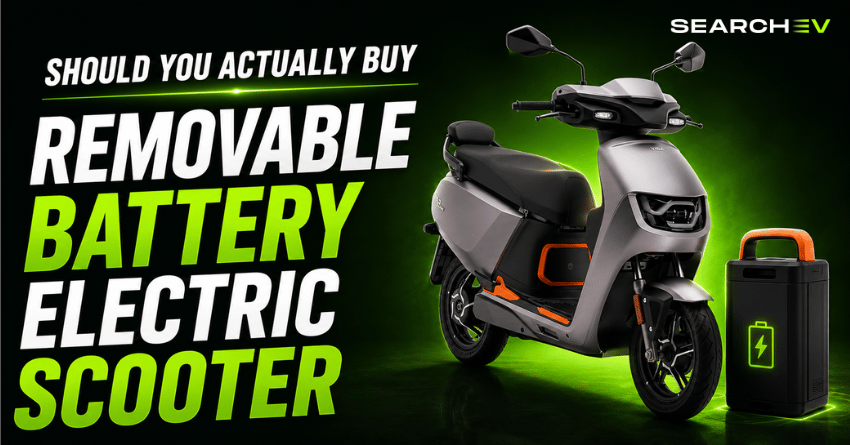
Every EV showroom salesperson will tell you their scooter is the best one. Every YouTube review makes every model look perfect in a five-minute video shot on a smooth, empty road. So, when it comes to removable battery scooters specifically, how do you actually know if they are worth your money or just another feature that sounds good on paper?
Let us cut through the noise. This article looks at this from the perspective of someone who has to live with the scooter every single day — not someone reviewing it for a week and handing it back.
What You Are Actually Paying For
A removable-battery scooter usually costs a little more than a similar fixed-battery model from the same brand. Sometimes it is a few thousand rupees more. Sometimes the difference is built into a higher variant altogether.
What you get for that extra money is not more power or more speed. It is convenient. Pure and simple. The ability to take the battery out, carry it inside your home, and charge it without depending on where the scooter is parked.
If that sentence does not sound like a big deal to you, you probably have a dedicated parking spot with a power socket nearby. In that case, keep reading, because this article will help you figure out if you are the exception.
The Real Question—Where Do You Park Your Scooter
This is the single most important question, and most people skip over it when buying.
If you live in an independent house with your own parking space and an outdoor socket nearby, a fixed-battery scooter charges just fine overnight. You plug it in where it sits. No drama.
If you live in an apartment — especially an older building — things get complicated fast. Many basements and stilt parking areas in Indian apartments have zero power points. The ones that do often have a single shared socket for an entire floor of two-wheelers, which turns into a daily fight over who gets to charge first.
This is exactly the situation where a removable battery earns its extra cost back within the first month. You are not fighting over a socket, not running an extension cable down three floors. You take the battery, you go home, and you charge it next to your bed like a phone.
Real Numbers — What Owners Actually Report
People who already own removable battery scooters in India consistently mention a few things in reviews and forums.
The battery typically weighs between 7 and 14 kg, depending on the model. Carrying this up one or two floors is manageable for most people. Above the third floor without a lift, it starts becoming a genuine chore—something to seriously think about if your building has no elevator.
Charging time at home using the standard charger is usually 4 to 6 hours for a full charge from near empty. Most owners simply plug it in at night, and it is ready by morning—exactly like charging a phone.
Range numbers in real city traffic tend to be slightly lower than the claimed figures—this is true for every electric scooter, removable or not. A scooter claiming 85 km typically delivers 55 to 65 km in actual Bengaluru, Mumbai, or Delhi traffic with stop-and-go riding, AC charging losses, and occasional hard acceleration.
Where It Genuinely Makes Sense
Delivery riders and gig workers. If your scooter is your livelihood and you cover 80 to 100 km a day, having a spare battery changes everything. Charge one while riding on the other. Zero downtime, zero waiting at charging stations, zero lost income.
Apartment dwellers without charging points. This is the single biggest reason removable battery scooters exist. If your building management has not installed EV charging infrastructure—and most older buildings have not—this feature alone can be the deciding factor in your purchase.
People who travel between two locations regularly. If you split time between a home and a relative’s place or between a hostel and home during weekends, a removable battery means you are never stuck wondering where to charge it.
Renters who move frequently. Setting up a dedicated charging point in a rented home often requires landlord permission and electrical work that landlords are reluctant to allow. A removable battery sidesteps this entirely.
Where It Might Not Be Worth the Extra Cost
If you have your own house with a socket near the parking. The extra cost buys you a feature you will likely never use. A fixed battery scooter charges just fine in this situation, and you might get slightly more range for the same price since fixed batteries can sometimes be packed slightly larger.
If you live on a high floor with no lift. Carrying 10+ kilograms up five or six flights of stairs every single day gets old fast. In this case, look for a scooter with a charging port that lets you charge while the battery stays inside—some removable battery models offer this hybrid option.
If your daily distance is very short. If you ride less than 15 to 20 km a day and can charge once every two or three days, the urgency around charging convenience drops significantly. A fixed battery becomes a much smaller inconvenience when you are not plugging in every single night.
The Honest Verdict
Here is the straightforward answer. A removable battery is not a gimmick, and it is not unnecessary marketing either. It solves a very real, very common Indian problem — the lack of EV charging infrastructure in residential buildings.
If that problem applies to you, the extra cost is genuinely worth it. You will use this feature every single day for years, and it removes one of the biggest daily frustrations that EV owners in India deal with.
If that problem does not apply to you—because you already have convenient charging at your parking spot—then you are paying extra for something you will rarely, if ever, use. In that case, a fixed battery scooter with possibly better range for the same money makes more sense.
The right question to ask yourself before buying is not “Is a removable battery good or ‘bad’?”—it is “Do I have a place to charge my scooter where it normally parks?” “Your honest answer to that one question tells you everything you need to know.