India crossed 29,000 public EV charging stations in early 2026. Four years ago there were barely 5,000. The government has targets, the money is flowing, new chargers are going up.
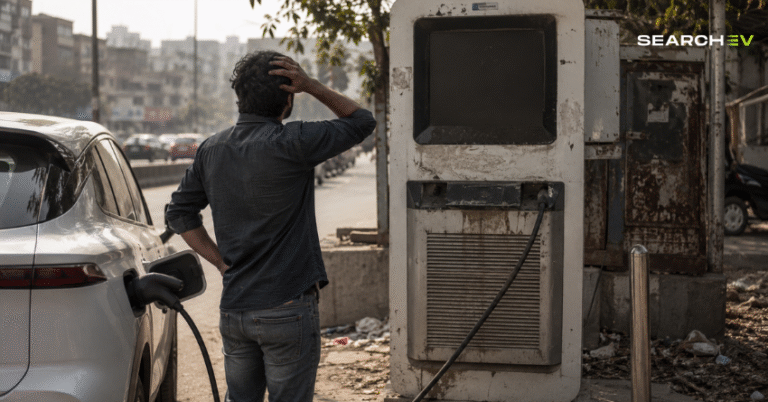
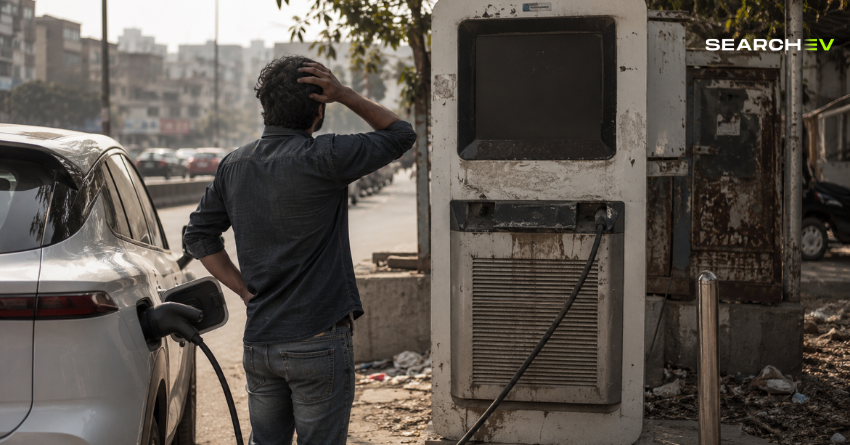
And yet ask any EV owner who relies on public charging what their experience is like, and you get the same story every time. You arrive at a charger listed as available. It isn’t working. Or it’s occupied by a car that finished an hour ago. Or it charges at a fraction of the rated speed. Or the payment system just doesn’t go through.
The number of chargers being installed is not the problem. What’s being installed, where, and whether it actually works — that’s the problem.
The Numbers Behind the Frustration
Let’s put some real figures on this, because the scale of the gap is genuinely striking.
India in early 2026 has roughly one public charger for every 235 EVs on the road. The global benchmark considered functional for EV adoption is one charger for every 6 to 20 vehicles. We’re not close. We’re not even in the same conversation.
But the availability gap isn’t even the most frustrating part. The reliability gap is.
Approximately 18% of nationally installed charging stations were reported as non-operational in March 2026 data. Some networks have reported non-functional rates as high as 60%. So of the 29,000 chargers that exist on paper, a meaningful chunk aren’t actually available when an owner pulls up to them — whether due to hardware failures, grid connectivity issues, or payment system breakdowns that never got fixed.
Half of all public chargers in India are reported as non-functional at any given time. You read that correctly. Not degraded performance. Non-functional.
It’s Not Just About More Chargers
Here’s what gets missed in most coverage of this issue — the problem isn’t simply that India needs more chargers. It’s that the chargers being installed are often in the wrong places, on grids that can’t reliably support them.
A single DC fast charger — the kind that can add 100 km of range in 20 minutes — requires a dedicated power connection that most urban commercial locations aren’t set up to provide. Indian city grids were not designed for sudden, concentrated high-load demand of this kind. Deploying fast chargers at scale requires grid upgrades that are slow, expensive, and dependent on coordination between chargepoint operators, distribution companies, and local authorities — none of whom are working from the same playbook right now.
The result is that many installed chargers operate as slow AC chargers even when listed as fast chargers, because the power supply can’t sustain the rated output consistently. Understanding the difference between fast charging and slow charging matters here — an owner arriving expecting a 45-minute charge who gets a 4-hour charge has a very different experience of “availability.”
Location planning has also been poor. Chargers have been placed on sidewalks, in areas of genuinely low footfall, and at sites without shade or basic facilities — locations chosen because they were easy to get approval for, not because EV owners would actually use them. Tamil Nadu is currently the only state where roughly 90% of chargers sit within 1 km of a highway. Every other state trails significantly.
The Highway Problem
For anyone considering longer drives, highway charging anxiety is real and entirely justified right now.
India needs an estimated 1.32 million public charging stations to support 30% EV penetration by 2030 — over 40 times the current installed base. The PM E-DRIVE scheme has allocated ₹2,000 crore for 72,300 new stations across 50 national highway corridors. Even at full execution, that gets India to roughly 100,000 stations. The gap between 100,000 and 1.32 million doesn’t close through government schemes alone.
Private operators won’t invest in locations that don’t generate enough sessions to cover costs — which means the routes that EV owners need most for highway travel will remain underserved the longest.
What Actually Needs to Change
More chargers is the easy answer. The harder, more important changes are these:
- Reliability standards with consequences. Installed chargers need uptime mandates — not voluntary targets. A charger that’s non-functional 40% of the time should not count toward an operator’s network numbers. Right now there’s no mechanism that enforces this.
- Grid readiness before installation. The sequencing needs to flip. Currently, chargers go up and grid upgrades happen later — sometimes never. Power infrastructure needs to be confirmed before a charger gets approved, not after it’s already failing.
- Real-time public data on charger status. Several apps show charger locations. Almost none show live, reliable operational status. An owner has no way to know if the charger they’re driving 8 km toward is actually working until they’re standing in front of it.
The Bottom Line
India’s EV ambition is real and the intent at the policy level is genuine. But intent doesn’t charge a car. A charger that’s technically installed but functionally unavailable is worse than no charger in some ways — because it gives owners false confidence and then fails them in the moment that matters.
The EV adoption curve in India will stall if charging doesn’t catch up — not in the number of stations, but in the reliability, placement, and power capacity of the ones being built. Owners deserve better than a 50% coin flip every time they pull up to a public charger.
Stay on top of every EV infrastructure development and ownership guide — SearchEV covers what actually matters for Indian EV owners.