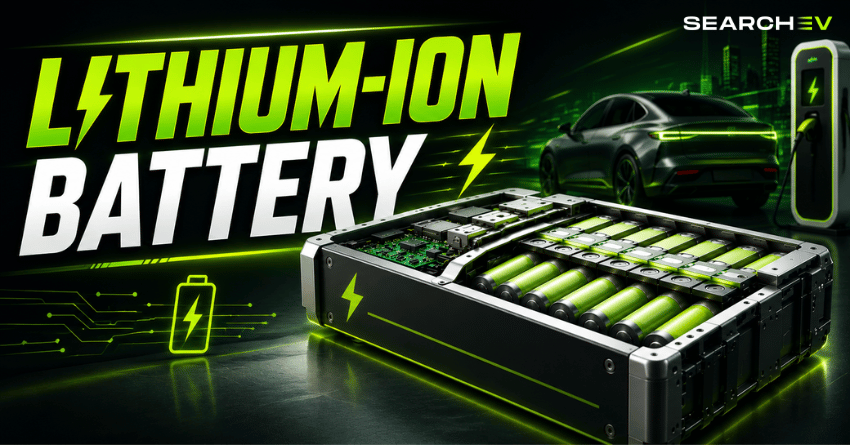
Pick up your phone. Look at your laptop. Sit inside an electric car. All three of them are running on the same basic battery technology. Lithium-ion. It is everywhere, and most people have no idea how it actually works or why it became the one battery that the entire world decided to build around.
This is not a textbook explanation. This is the real story of what a lithium-ion battery is, how it works inside your EV, and why no other battery has been able to knock it off the top spot—yet.
Where It All Started
Lithium-ion batteries did not appear out of nowhere. Scientists spent decades trying to figure out how to make a battery that was small, light, rechargeable, and powerful enough to be useful. The breakthrough came in the early 1990s when Sony commercialised the first lithium-ion battery for consumer electronics.
Within a few years, it was in laptops. Then phones. Then, eventually, electric vehicles. Every time the technology moved into a new application, engineers scaled it up, improved it, and pushed it further. The EV battery pack in a Tata Nexon or a Tesla today is the result of thirty years of continuous improvement.
What Is a Lithium-Ion Battery in Simple Terms
Let us break this down in the easiest way possible
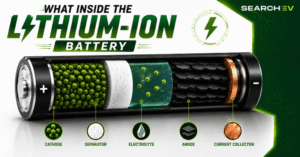
Every battery has two ends — a positive end and a negative end. These are called the cathode and the anode. In between them is a liquid called the electrolyte. When you charge the battery, tiny charged particles called lithium ions move from the cathode through the electrolyte and take up residence in the anode. When you use the battery — when you drive your EV — those ions travel back the other way, and that movement is what creates electricity to power the motor.
That is it. Lithium ions are moving back and forth. Charge, discharge, charge, discharge. Thousands of times over the life of the battery.
The reason lithium is used for this job is simple. Lithium is the lightest metal on the periodic table. Light metal means light battery. A light battery means more range without adding unnecessary weight to the vehicle.
What Is Actually Inside the Battery Pack
When people say “lithium-ion battery,” they are usually talking about a single cell. But your EV does not run on one cell. It runs on hundreds or even thousands of them, all connected together into a large battery pack.
Each individual cell looks like either a small cylinder—similar to an AA battery but bigger—or a flat rectangular pouch. These cells are grouped into modules. Modules are grouped into the full battery pack. The pack sits underneath the floor of most EVs, which is why electric cars have a flat floor inside.
Managing all those cells is a piece of software called the Battery Management System, or BMS. The BMS watches the temperature of every cell, makes sure they all charge and discharge evenly, and protects the pack from getting too hot or too cold. Without the BMS, a lithium-ion battery would degrade very fast and become dangerous. With it, the battery behaves predictably and safely for years.
Why Lithium-Ion Became the Standard for EVs
This is the question worth sitting with for a moment. There are other battery chemistries in the world. So why did lithium-ion win?
Three reasons.
First — energy density. Lithium-ion packs more energy into a smaller and lighter space than almost any other rechargeable battery. In an EV, energy density translates directly into range. More energy per kilogram of battery means your car goes further before needing a charge.
Second — rechargeability. Lithium-ion batteries can be charged and discharged thousands of times before they significantly degrade. An EV battery is expected to last at least 8 to 10 years under normal use. That kind of long-term durability was impossible with older battery technologies like nickel-cadmium or lead-acid.
Third — improving cost. When lithium-ion batteries first appeared in EVs, the cost per kWh was extremely high. Over the last fifteen years, that cost has dropped by more than 90 per cent. Today, lithium-ion battery packs cost around 100 to 115 US dollars per kWh—a number that was unimaginable a decade ago. As production scaled up globally, costs kept falling, which is why affordable EVs like the Tata Nexon and MG Comet exist today.
The Different Types of Lithium-Ion Batteries
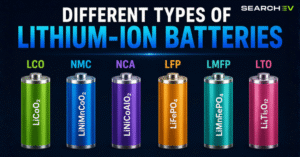
Here is something that confuses a lot of people. LFP, NMC, NCA — these are all types of lithium-ion batteries. They work on the same basic principle, but the materials used in the cathode are different, and those material differences have an impact on the battery’s performance.
NMC uses nickel, manganese, and cobalt. It provides high energy density and good range, which is why most premium EVs use it. But it is more sensitive to heat and more expensive to make.
LFP uses iron and phosphate instead. Lower energy density than NMC, which means slightly less range for the same battery size. But it is far safer in heat, lasts much longer, and costs significantly less. This is why most Indian EVs—Tata Nexon, Ola S1, TVS iQube—have moved to LFP. Indian summers are brutal, and LFP simply handles them better.
NCA uses nickel, cobalt, and aluminum. Highest energy density of the three, used in Tesla’s original vehicles. Expensive and requires careful management.
All three are lithium-ion. The chemistry inside the cathode is what makes them different from each other.
What Are the Weaknesses of Lithium-Ion
Being honest here matters.
Lithium-ion batteries do not like extreme heat. Keeping them at very high temperatures for long periods accelerates degradation. This is why parking your EV in direct sunlight for hours every day quietly shortens battery life faster than normal use does.
They also do not like sitting at very high or very low states of charge for long periods. The sweet spot for daily use is between 20 and 80 percent. Most EV manufacturers now let you set a charge limit in the app for exactly this reason.
And lithium itself — the raw material — is not unlimited. It is mined from specific regions of the world, which creates supply chain risks and cost volatility. This is one of the main reasons battery companies are developing sodium-ion and solid-state alternatives. Not because lithium-ion is broken, but because the world needs something that does not depend on one raw material.
Why It Still Has No Real Competition Yet
Solid-state batteries promise better performance and safety—but they are not in production vehicles yet at any meaningful scale. Sodium-ion is emerging and genuinely exciting for affordable EVs—but energy density is still catching up to lithium-ion.
For now, lithium-ion is still the most practical, most proven, and most cost-effective battery technology available for electric vehicles. It powers the Nexon you see on Bengaluru roads. It powers the scooter your neighbour charges every night. It powers the Tesla, doing 500 km on a single charge in Europe.
Thirty years of refinement built something that still has no clear replacement in sight. That is not a small achievement.