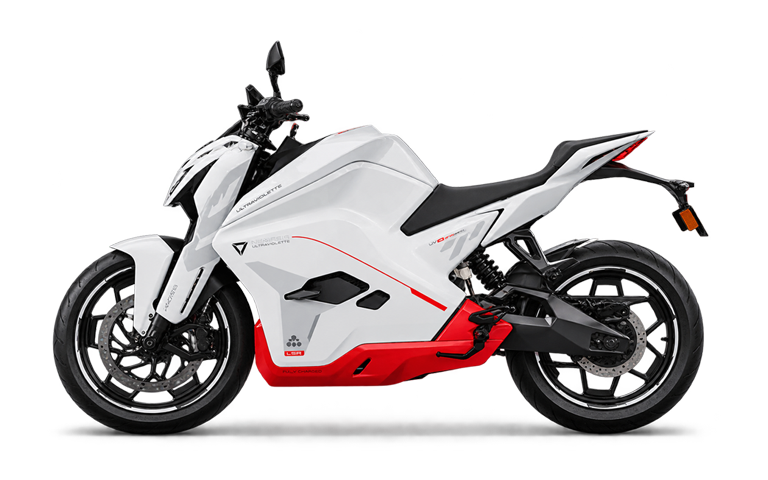
Ultraviolette F77 SuperStreet Expert Review
- Electric
- Bike
- 2 Seater
What's good
-
Futuristic, eye-catching design
-
Gets a comfortable and upright riding position
-
Nimble and stable handling in corners
-
Same frantic performance as other Ultraviolette bikes
What's not so good
-
Real-world range is significantly lower in the Ballistic mode
-
Stiff suspension can feel quite firm over rough roads
-
The turning radius is a little wider
-
No storage space for utility
The Ultraviolette F77 SuperStreet is a high-performance electric motorbike designed for both speed enthusiasts and everyday riders. It comes equipped with advanced features like a 5-inch TFT display, dual-channel ABS, dynamic stability control, multiple riding modes, and over-the-air upgrades. With a top speed of 155 km/h, quick acceleration, and a range of up to 323 km, it stands out as one of the greatest EVs in its class, combining power, technology, and safety in a stylish design.
What's good
-
Futuristic, eye-catching design
-
Gets a comfortable and upright riding position
-
Nimble and stable handling in corners
-
Same frantic performance as other Ultraviolette bikes
What's not so good
-
Real-world range is significantly lower in the Ballistic mode
-
Stiff suspension can feel quite firm over rough roads
-
The turning radius is a little wider
-
No storage space for utility
The Ultraviolette F77 SuperStreet is a high-performance electric motorbike designed for both speed enthusiasts and everyday riders. It comes equipped with advanced features like a 5-inch TFT display, dual-channel ABS, dynamic stability control, multiple riding modes, and over-the-air upgrades. With a top speed of 155 km/h, quick acceleration, and a range of up to 323 km, it stands out as one of the greatest EVs in its class, combining power, technology, and safety in a stylish design.
Ultraviolette F77 SuperStreet Expert Review
SEV Score

Prashanth Jagadeesh
Tested and reviewed by SEV Experts on 8 parameters
SEV Score

Prashanth Jagadeesh
Tested and reviewed by SEV Experts on 8 parameters
Expert Verdict
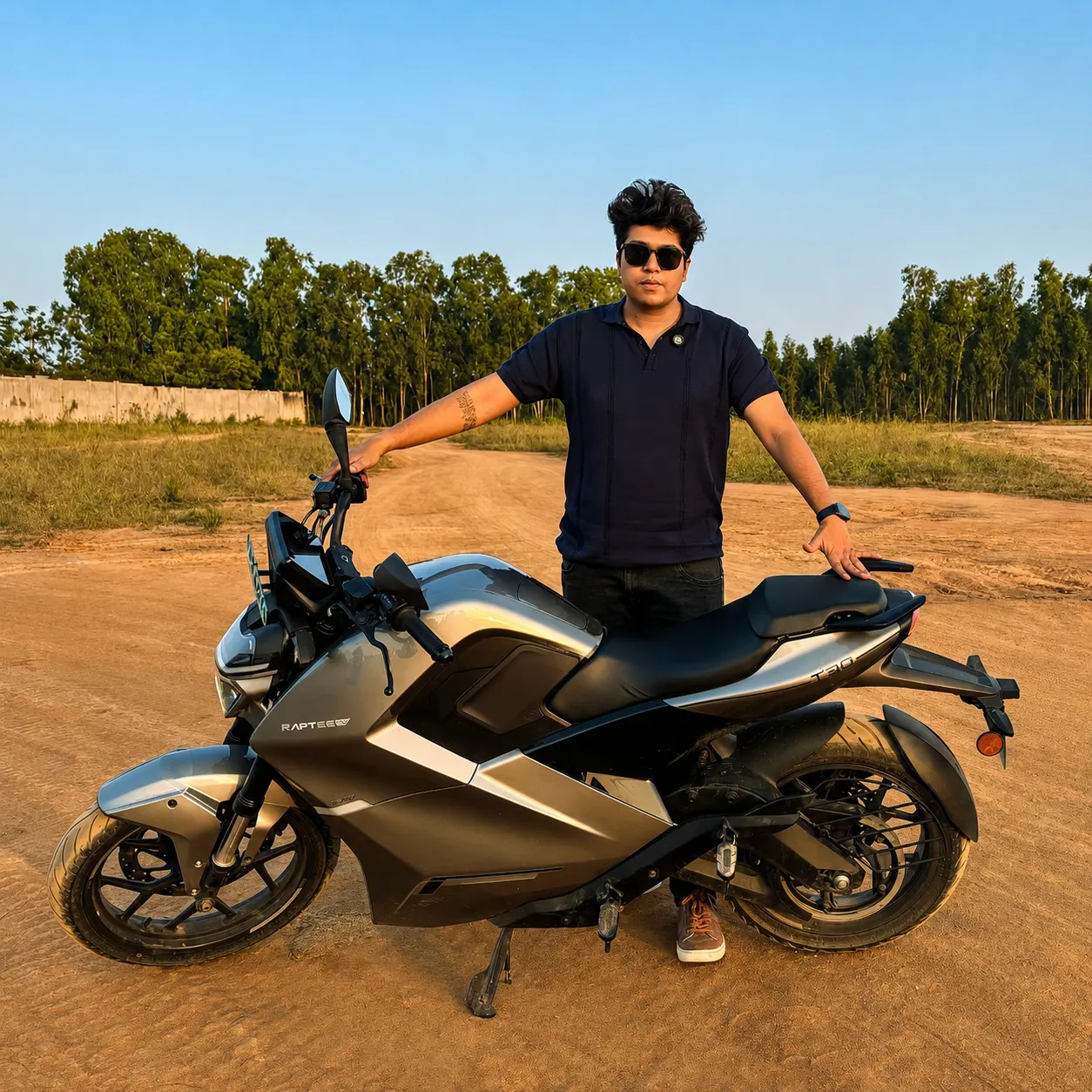
The F77 SuperStreet is Ultraviolette’s answer to riders who liked the looks and pace of the F77 Mach 2 but not its crouch. The motor, battery packs, frame, suspension, and brakes all carry over; what’s new is a one-piece handlebar that sits taller and wider on risers. Pricing puts the SuperStreet above other-brand electric motorcycles such as the Raptee T30 and Royal Enfield’s Flying Flea C6. For that money, it delivers strong, effortless acceleration, a long certified range on the Recon, and a far friendlier riding position than the Mach 2 but remains a niche option.
Ultraviolette F77 SuperStreet Design
Exterior
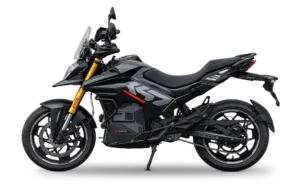
Telling the SuperStreet apart from the Mach 2 takes a second look. The shape that first appeared on the original F77 is intact: a sharp, angular LED headlamp with a V-shaped position lamp, chunky covers wrapped around the upside-down fork, broad one-piece side panels, and a pointed tail with the grab handles moulded in. The design has been on the road for several years now, and it hasn’t dated. It still draws attention wherever it’s parked.
The changes are concentrated around the handlebar. The clip-ons make way for a conventional bar mounted on risers and held by a new aluminium triple clamp, and the small screen up front covers the risers so the conversion doesn’t look bolted on. The headlamp cowl has been reshaped to suit, and the 5-inch colour display now sits at a slightly more upright angle that makes it easier to read at a glance. In profile, the stance stays low and purposeful, with 17-inch alloy wheels, a 150-section rear tyre and a 320 mm front disc that fills much of the front wheel. A twin LED tail lamp with a central brake light and LED hazard lights at both ends complete the lighting.
Build Quality & Fit and Finish
The hardware under the bodywork includes a steel trellis frame with an aluminium bulkhead, a 41 mm upside-down fork, a fixed four-piston radial front calliper working with Bosch ABS, and an all-aluminium battery enclosure. The new handlebar parts are finished to the same standard as the rest of the motorcycle, and the way the screen and cowl wrap around the risers, it doesn’t look like an afterthought.
Ultraviolette F77 SuperStreet Features
Both variants of the Ultraviolette F77 SuperStreet share the 5-inch colour TFT, controlled through switch cubes on either side of the handlebar, with two selectable display themes running on Ultraviolette’s own Linux-based software. Connectivity covers an embedded SIM for 4G LTE, Wi-Fi, Bluetooth, and GPS with GLONASS, linking the bike to the companion app. The display uses an aircraft-inspired layout; some of the smaller readouts can take a moment to find, but the information you check most often is easy to pick out.
Standard equipment on both trims includes hill hold, dynamic stability control, switchable ABS, a walking-pace forward and reverse function for parking, and a setting that caps the maximum charge level to reduce battery wear, app-based location tracking, and a low-power storage mode that protects the battery when the bike sits unused for weeks.
The split between the trims is where the Standard gives ground. The Recon gets ten levels of regenerative braking and four-level traction control as standard. The Standard ships with three regen levels, with ten available as an option, and lists traction control as an optional extra. Regen is adjusted on the move through buttons on the left switch cube; at its strongest setting it slows the bike firmly without feeling abrupt, and at zero the bike coasts freely off the throttle. Tyre pressure monitoring is optional on both.
There’s also an optional connected package, which Ultraviolette calls Violette A.I., covering crash detection with alerts to contacts, tamper and movement alerts, remote immobilisation, an anti-collision warning function and daily ride analytics.
The F77 SuperStreet is well equipped, taking into account both standard and optional features; however, comparable petrol-powered motorcycles do offer extras at this price. The KTM 390 Duke, for instance, includes traction control, cornering ABS and cruise control, and even the TVS Apache RTR 310, which is cheaper, gets traction control and cruise control. Cruise control doesn’t appear on either SuperStreet variant’s specification, which is a gap on a motorcycle this capable on the highway.
Ultraviolette F77 SuperStreet Performance & Range
Both variants of the Ultraviolette F77 SuperStreet use a permanent magnet AC motor with ride-by-wire throttle control. The Standard makes 27 kW (36.2 hp) and 90 Nm, and the Recon 30 kW (40.2 hp) and 100 Nm. Claimed acceleration is 0 to 60 km/h in 2.9 seconds for the Standard and 2.8 seconds for the Recon, with 0 to 100 km/h in 7.8 and 7.7 seconds, respectively, and both top out at 155 km/h. That 0.1-second gap is the whole performance difference on paper; the Standard’s lower output is largely offset by carrying 10 kg less weight thanks to the smaller battery.
Those figures don’t fully describe how the SuperStreet feels. The full torque is there from the moment the throttle opens, so it pulls away from a signal with a clean, uninterrupted surge. The throttle is precise and easy to modulate, and there are three riding modes, called Glide, Combat and Ballistic, running from relaxed to aggressive. Glide is the one for crawling through town and stretching the range, Combat sharpens the response for everyday riding, and Ballistic is properly quick. Beyond city speeds, the acceleration is closer to that of a 300cc-class petrol naked, so the SuperStreet feels most special in the first few seconds of every pull.
With a single-speed drivetrain there are no gears or clutches to manage, so stop-go commutes become far less tiring, and overtakes are a matter of simply rolling the throttle. Refinement is excellent. There’s no vibration through the bar, seat or pegs at any speed. Riders who value the soundtrack of a petrol engine will miss it; others may find the calm makes long stretches less tiring. Over short bursts of repeated hard running, output doesn’t appear to tail off noticeably.
Range is where the variants separate. The Standard’s certified IDC figure is 211 km, and the Recon’s is 323 km. According to Ultraviolette, in the glide mode, the expected real-world range would be close to 183 km for the Standard and 266 km for the Recon and fall up to around 128 km and 186 km,, respectively, in Ballistic mode.
Ultraviolette F77 SuperStreet Ride & Handling
The Ultraviolette F77 SuperStreet keeps the Mach 2’s seat and footpegs, but the new bar changes the posture completely. You sit upright, like on a typical naked streetfighter, with far less weight on your wrists and lower back. The footpegs were kept where they are deliberately to preserve some sportiness, so the knees stay a little more bent than on a pure commuter.
At 197 kg for the Standard and 207 kg for the Recon, the SuperStreet is roughly 40 kg heavier than a typical 300 to 400 cc petrol naked, and that shows when lifting it off the side stand, pushing it around a parking lot or making a slow U-turn. The wider bar makes the bike easier to steer in bumper-to-bumper traffic than the Mach 2’s clip-ons, though in very tight, slow turns it can make that mass feel more obvious. Once you’re past your walking pace, roughly 20 km/h, the bike hides its weight surprisingly well, because most of it sits low in the chassis.
Over broken city roads, the F77 soaks up potholes and speed breakers with composure, and the Super Street’s upright posture further means less of each impact reaches your wrists and back. Lighter riders may find the setup on the firm side, while heavier riders and two-up riding tend to bring out a more settled ride; preload adjustment at both ends gives some room to tune it. At highway speeds the SuperStreet feels planted and confident, tracking straight well into triple digits.
Through corners, the handling stays sharp and engaging. The wider bar slows turn-in slightly compared with the Mach 2, and the mass makes itself felt during quick left-right direction changes, where the front can feel heavy. Mid-corner, though, the low-slung battery gives the bike a reassuring stability, and it holds a line well when you open the throttle on the way out.
Braking comes from a 320 mm front disc with a fixed four-piston radial calliper and a 230 mm rear disc, managed by dual-channel Bosch ABS. Bite and stopping power are strong for road riding, though the bike’s weight is obvious under heavy braking, and after repeated hard stops some fade sets in. The regenerative braking does a lot of the work here. On its higher settings, most everyday slowing happens without touching the levers.
Ultraviolette F77 SuperStreet Safety
The core safety kit is solid. Dual-channel Bosch ABS can be switched to a single-channel mode, and dynamic stability control works with the rear ABS and the regenerative braking to keep the rear wheel from locking when regen is strong or grip is low. Hill hold stops the bike rolling back on inclines, which is handy given its weight. The Recon adds four-level traction control as standard; on the Standard, it’s an optional extra.
Other safety equipment includes an LED headlamp with automatic dimming, front and rear LED hazard lights and a side-stand sensor. The optional connected package adds crash detection, tamper alerts and remote immobilisation.
What the SuperStreet lacks is lean-sensitive electronics; Royal Enfield’s Flying Flea C6 gets lean-sensitive ABS. For a motorcycle with this much performance and this much mass, cornering ABS would be a meaningful addition.
Ultraviolette F77 SuperStreet Space & Comfort
As with most performance motorcycles, there’s no meaningful built-in storage. Ultraviolette sells soft and hard panniers and a top-box mount as accessories, which turn the SuperStreet into a more usable tourer or daily carrier, but they add cost on top of an already premium price.
Day-to-day practicality is better than the storage situation suggests. The 800 mm seat height is approachable for most riders, and 160 mm of ground clearance is adequate for city speed breakers taken with a little care. The walking-pace reverse function is useful given the bike’s weight. The ride also settles nicely with a pillion on board.
The Recon’s range means it can live as a weekday commuter and a weekend tourer without much planning.
The weight is the main practical drawback. Shorter or lighter riders who park in cramped spaces, or who need to manoeuvre the bike often by hand, should spend time with it before deciding.
Ultraviolette F77 SuperStreet Charging & Warranty
Both variants come with a standard charger that adds up to 35 km of range per hour, taking the Standard from 20 to 80 per cent in about three hours and the Recon in about five. An optional boost charger roughly doubles that rate to 75 km of range per hour, cutting 20 to 80 per cent to about 1.5 hours on the Standard and 2.5 hours on the Recon. Either way, overnight charging at home or a working day plugged in at the office refills the battery comfortably.
Away from home, the SuperStreet can use Ultraviolette’s own 12 kW DC fast chargers, which take the Standard from 20 to 80 per cent in 45 minutes and the Recon in 60 minutes. The catch is coverage. The company’s fast chargers are concentrated along popular riding routes and in its own outlets rather than spread widely, so long trips still need some planning around them. An optional adapter allows the bike’s charger to draw power from Type 2 AC car charging points, widening the options. The cheaper Raptee T30, by contrast, plugs directly into CCS2 car fast chargers.
Warranty is where the Recon justifies much of its premium. Both variants carry a 3-year or 30,000 km vehicle warranty. The battery and drivetrain cover on the Standard is 3 years or 60,000 km, extendable to 5 years or 1,00,000 km. The Recon gets 5 years, or 1,00,000 km as standard, with an optional plan stretching that to 8 years, or 8,00,000 km. The Standard’s base cover looks thin by comparison, especially next to the cheaper Raptee T30, which includes 8 years or 80,000 km of battery cover as standard.
Ultraviolette F77 SuperStreet Service & Network
Ultraviolette’s retail and service network has grown quickly. Its count of integrated sales-and-service centres crossed 40 during 2026, spread over more than 35 cities, and the brand has started moving beyond its southern and western base into eastern India. Every outlet handles sales, service and spare parts under one roof, which simplifies ownership for buyers who live near one.
Even so, coverage remains thin compared with the established names a SuperStreet buyer is likely to cross-shop. KTM and TVS, along with Royal Enfield, which is rolling out its Flying Flea through its existing showrooms and service centres, all have far larger footprints that reach deeper into smaller towns. Buyers outside the larger metros should check the distance to their nearest Ultraviolette centre before committing.
On the positive side, the platform has a record of improving after purchase. Ultraviolette has pushed software updates to existing owners, including upgrading earlier F77s to the later specification free of charge, and the bike’s built-in connectivity makes that process straightforward.
Who should buy this?
The F77 SuperStreet makes the most sense for a rider who wants an electric motorcycle with proper highway pace and a comfortable, upright posture, has reliable charging at home or work, and lives within reasonable reach of an Ultraviolette centre. The Recon is the better buy for anyone who rides long distances regularly or plans weekend trips, thanks to its much longer range and far stronger warranty cover.
Riders who prioritise low weight, similar performance, and a lower price will find those boxes ticked by the KTM 390 Duke and the TVS Apache RTR 310. Those who want a lighter, simpler electric motorcycle for the city can check out the Royal Enfield Flying Flea C6.
What's good
-
Futuristic, eye-catching design
-
Gets a comfortable and upright riding position
-
Nimble and stable handling in corners
-
Same frantic performance as other Ultraviolette bikes
What's not so good
-
Real-world range is significantly lower in the Ballistic mode
-
Stiff suspension can feel quite firm over rough roads
-
The turning radius is a little wider
-
No storage space for utility
Ultraviolette F77 SuperStreet Price
What's good
-
Futuristic, eye-catching design
-
Gets a comfortable and upright riding position
-
Nimble and stable handling in corners
-
Same frantic performance as other Ultraviolette bikes
What's not so good
-
Real-world range is significantly lower in the Ballistic mode
-
Stiff suspension can feel quite firm over rough roads
-
The turning radius is a little wider
-
No storage space for utility
Connect Now