Tata Motors is attempting to re-strengthen its hold on the entry-level hatchback market for both ICE and EV fuels. The facelifted Tata Tiago and its electric version, the Tiago EV, are scheduled for official launch on May 28, 2026.
They provide a number of segment-first features and safety improvements. The Tiago platform has traditionally been the main entry point for Indian consumers to both early EV adoption and reasonably priced petrol ownership. Let’s understand the differences between the new 2026 Tiago EV and the ICE model.
2026 Tata Tiago EV vs ICE: How to Tell Them Apart
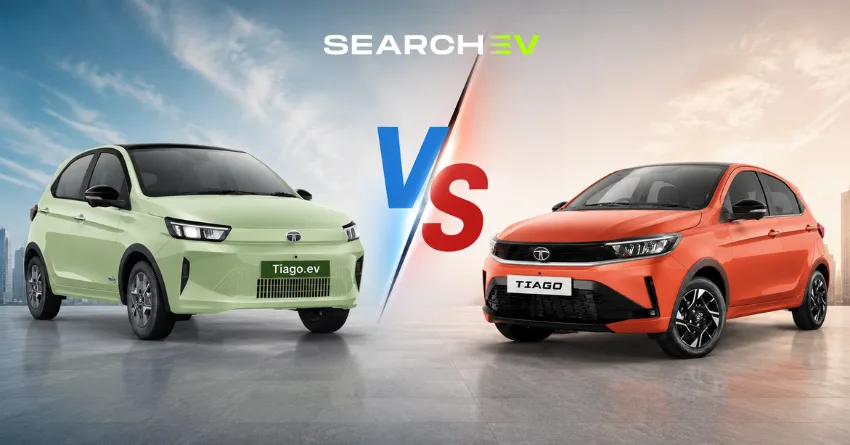
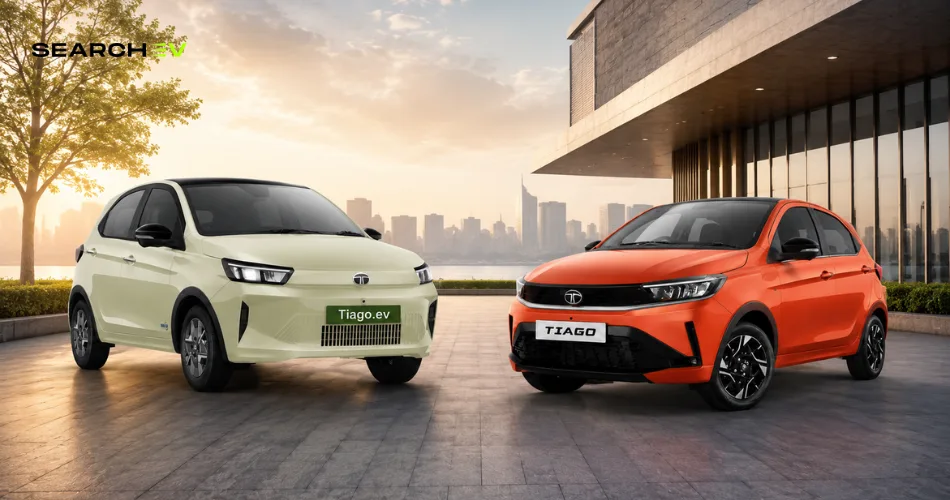
While both models share the same fundamental architecture, Tata has utilised the 2026 facelift to create stronger visual differentiation between the two powertrains.
Both the ICE and EV versions benefit from a sharper, modernised fascia featuring new, sleeker LED headlamps with eyebrow-shaped LED daytime running lamps (DRLs). The rear profiles are also largely identical, with new connected LED taillights and redesigned bumpers, which house the reverse lights.
However, the differences lie in the details:
- Tiago ICE: The petrol-powered model retains a traditional, aggressive front end characterised by a blacked-out upper grille and a black lower bumper section that houses functional air intakes and new pixel-shaped fog lamps. Along the sides, the ICE variants ride on premium 15-inch alloy wheels.
- Tiago EV: The EV variant adopts a body-coloured front grille and a matching body-coloured lower bumper. It notably skips the fog lamps entirely, utilising vertical black trims instead to manage airflow. To maximise aerodynamic efficiency and range, the EV model continues to rely on 14-inch steel wheels.
2026 Tata Tiago ICE vs EV: Interior and Safety Upgrades
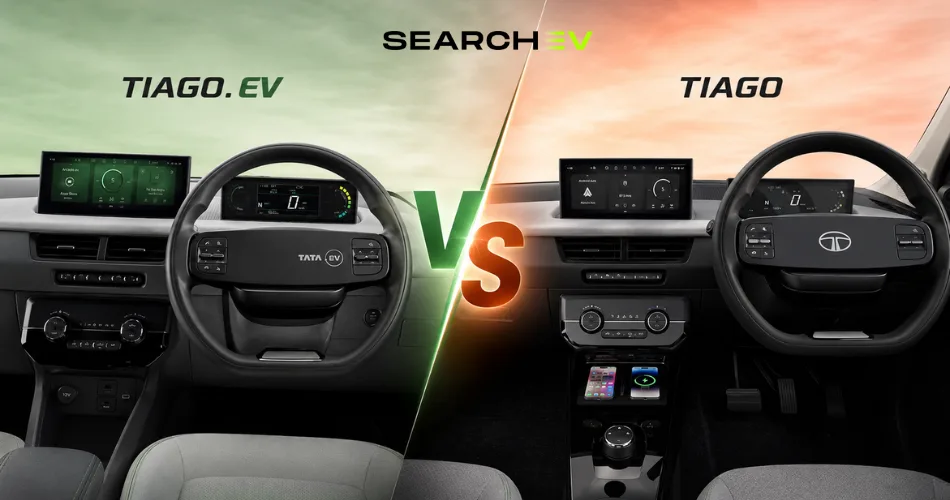
The Tata Tiago has been known for its robust build quality, and the 2026 facelift takes this a step further. Tata is expected to standardise six airbags across all variants of both the ICE and EV models, an upgrade from the dual-airbag setup of the outgoing generation.
Additionally, spy shots and teaser videos confirm the integration of camera pods on the front bumpers and ORVMs, indicating that both the Tiago and Tiago EV will become the first hatchbacks in their segment to offer a 360-degree camera system.
While the cabin layout is expected to remain familiar, the brand uses interior colour themes to separate the two. The ICE version leans toward conventional dark or dual-tone shades, while the EV retains its signature light-toned upholstery with teal blue accents.
2026 Tiago EV vs Petrol: Feature Comparison
Historically, the EV variant enjoyed a slight edge in premium features, but the 2026 facelift bridges that gap to some extent.
However, the distinct nature of the powertrains dictates that some features remain completely exclusive to their respective models. Here is a breakdown of what the top-spec variants share and where they diverge:
Features Common to Both (Top Trims)
- 6 Airbags
- 360-Degree Camera (Expected)
- ABS with EBD
- Auto Headlamps and Rain-Sensing Wipers
- 10.25-inch Harman Touchscreen with Apple CarPlay and Android Auto
- 8-Speaker Audio System
- Auto Climate Control
- Push-Button Start
- Electrically Folding ORVMs
- Digital Instrument Cluster (Expected)
- Cruise Control
- Steering-mounted Controls
Features Unique to Tiago EV
- iRA.ev Connected Suite
- Smartwatch integration for vehicle controls
- Completely flat floor for rear passengers
- Multi-level Regenerative Braking
- Rotary drive selector
Powertrain and Performance Specifications
Under the hood, the two hatchbacks cater to completely different driving dynamics.
| Specification | Tiago ICE (Petrol) | Tiago EV (Medium Range) | Tiago EV (Long Range) |
| Engine / Battery | 1.2L Naturally Aspirated | 19.2 kWh LFP Battery | 24.0 kWh LFP Battery (Larger pack expected) |
| Power Output | 64 kW (86 hp) / 56 kW (75.5 hp in CNG) | 45 kW (61 hp) | 56 kW (75 hp) |
| Peak Torque | 113 Nm | 110 Nm | 114 Nm |
| Transmission | 5-Speed MT / 5-Speed AMT | Single-Speed Automatic | Single-Speed Automatic |
While the ICE Tiago offers slightly higher peak horsepower, the Tiago EV delivers its maximum torque instantly from a standstill, making it significantly more agile and responsive in stop-and-go urban traffic. The ICE variant will also continue to offer a factory-fitted CNG option (producing 75.5 hp and 96.5 Nm) for those lacking home-charging infrastructure.
Tata might also increase the battery capacity of the Tiago EV like it did with the Punch EV by moving to prismatic cells that allows them to pack a larger number of cells without increasing the footprint. Range as a result, will also see a jump then. Currently the Tiago EV offers a claimed range of 223km (19.2 kWh) and 293km (24 kWh), respectively.
2026 Tiago Petrol vs EV: Expected Price
The outgoing pre-facelift Tiago ICE maintained a highly accessible entry point, with the base XE trim priced exactly at Rs 4.57 lakh (ex-showroom). With the mandatory inclusion of six airbags, a new digital instrument cluster, and a 360-degree camera on higher trims, buyers should anticipate a uniform price hike across the board.
Here is the projected pricing structure and the premium commanded by the EV variant:
| Variant Category | Outgoing Price (Ex-Showroom) | Expected 2026 Price | Expected Hike |
| Tiago ICE Base (XE) | Rs 4.59 Lakh | Rs 4.85 Lakh – Rs 4.95 Lakh | ~Rs 25,000 – Rs 35,000 |
| Tiago EV Base | Rs 7.99 Lakh | Rs 8.35 Lakh – Rs 8.50 Lakh | ~Rs 36,000 – Rs 51,000 |
| Tiago ICE Top (Automatic) | Rs 7.92 Lakh | Rs 8.30 Lakh – Rs 8.50 Lakh | ~Rs 38,000 – Rs 58,000 |
| Tiago EV Top (Long Range) | Rs 11.14 Lakh | Rs 11.89 Lakh | ~Rs 75,000 |
When comparing equivalent top-end trims, the Tiago EV continues to command a strict initial acquisition premium of nearly more than Rs 3 lakh over the ICE automatic.
Tata might also offer the 2026 Tiago EV with a battery-as-a-service (BaaS) model like the Punch EV, to keep the upfront cost similar to the Tiago ICE model.