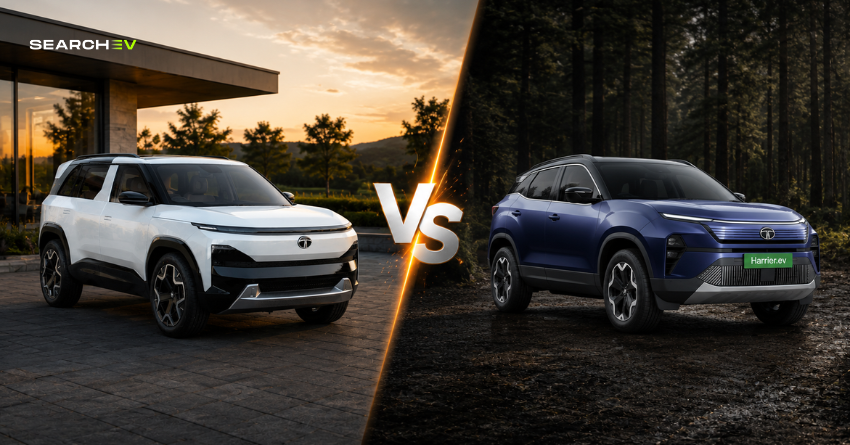
Key Takeaways
- Both SUVs are built on the same Acti.ev+ architecture and share almost battery packs, but the Sierra EV is lighter and more compact
- The Sierra EV introduces a unique three-screen dashboard layout, including a dedicated passenger screen, while the Harrier EV has a bigger 14.53-inch central display.
- The Harrier EV offers a broader cabin with a slightly larger footprint.
- Due to its lower weight, the Sierra EV squeezes out a slightly better real-world driving range from the exact same 75 kWh battery pack.
Tata Sierra EV vs Tata Harrier EV: Price and Value Comparison
With the official launch of the Sierra EV, Tata Motors now has two different options in the sub-Rs 30 lakh premium space. The Harrier EV is the established flagship model, starting at Rs 21.49 lakh for the base 65 kWh trim and stretching up to Rs 29.48 lakh for the top-end all-wheel-drive version.
On the other hand, the Sierra EV slots directly below the Harrier EV in the lineup. It starts at Rs 18.79 lakh for the base 63 kWh battery pack and goes up to Rs 25.99 lakh for the top-end awd trim with a 75 kWh battery. The same configuration costs Rs 28.99 lakh for the Harrier EV. Bookings for the Sierra EV are open, and deliveries begin from 15th July.
Ex-Showroom Price Comparison
| Variant Tier | Tata Sierra EV (Official Price) | Variant Tier | Tata Harrier EV (Actual Price) |
| Pure (63 kWh Base) | Rs 18.79 Lakh | Adventure (65 kWh Base) | Rs 21.49 Lakh |
| Pure S (63 kWh) | Rs 19.99 Lakh | Adventure S (65 kWh) | Rs 21.99 Lakh |
| Adventure (63 kWh) | Rs 20.99 Lakh | Fearless Plus (65 kWh) | Rs 23.99 Lakh |
| Adventure (75 kWh) | Rs 22.19 Lakh | Fearless Plus (75 kWh) | Rs 24.99 Lakh |
| Empowered (63 kWh) | Rs 22.79 Lakh | NA | N/A |
| Empowered (75 kWh RWD) | Rs 23.79 Lakh | Empowered (75 kWh RWD) | Rs 27.49 Lakh |
| Empowered A (75 kWh Luxury RWD) | Rs 24.79 Lakh | NA | N/A |
| Empowered A with QWD | Rs 25.99 Lakh | Empowered AWD | Rs 28.99 Lakh |
(Note: Prices are ex-showroom. Both models offer 7.2 kW AC wallbox chargers for an additional premium over the price mentioned above).
The value proposition here comes down to what you want out of your investment. If you want the sheer physical volume and status of a large flagship, the Harrier EV justifies its price. However, if your focus is on getting the maximum driving range and the latest interior tech for your money, the Sierra EV offers a strong case by providing the same battery setups at a lower entry cost.
Road Presence, Dimensions, and Practicality Comparison
The Sierra EV relies on a tall, boxy heritage look with its signature wraparound rear glass, while the Harrier EV commands attention with its wide, muscular stance.
On the outside, the styling choices separate these two cars clearly. The Sierra EV uses a very distinct tall stance, a flat clamshell tailgate, flush door handles, and unique panoramic rear windows that wrap toward the roof. Its front looks clean with a smooth, closed-off grille and a sharp, continuous, connected LED DRL bar running across the front. Around the back, a similar connected treatment is given to the tail lamps, alongside clear “EV” badging to tell the crowd it runs on electricity.
The Harrier EV is visibly wider and more muscular. It carries over the imposing, aggressive look of the standard diesel model but cleans things up for the electric version with a blanked-off grille and typical EV-style 19-inch alloy wheels.
Physical Dimensions Comparison
| Metric | Tata Sierra EV | Tata Harrier EV |
| Length | 4,340 mm | 4,600 mm |
| Width | 1,841 mm | 1,922 mm |
| Height | 1,750 mm | 1,650 mm |
| Wheelbase | 2,730 mm | 2,850 mm |
| Ground Clearance | 205 mm | 205 mm |
| Boot Space | 622 Litres | 502 litres |
| Frunk (Front Trunk) | 35 Litres (AWD) / 55 Litres (RWD) | 35 Litres (AWD) / 67 Litres (RWD) |
The Harrier EV has a larger physical footprint, which translates directly into a wider cabin and a slightly more spacious boot for family luggage.
Tata Sierra EV vs Tata Harrier EV: Which EV Offers More Features?
The Harrier EV uses a high-end 14.53-inch Samsung Neo QLED central touchscreen that controls almost everything, paired with a 10.25-inch digital driver’s display. The Sierra EV completely shifts the layout by using a triple-screen setup, giving the front passenger their own dedicated entertainment screen.
Tech and Comfort Features Comfort Matrix
| Feature | Tata Sierra EV | Tata Harrier EV |
| Panoramic Sunroof | Yes (Voice Controlled) | Yes (Voice Assisted) |
| Main Infotainment Display | 12.3-inch Touchscreen | 14.53-inch Samsung Neo QLED Screen |
| Digital Driver Display | 10.25-inch Cluster (with Map mirroring) | 10.25-inch Cluster (with Map mirroring) |
| Front Passenger Screen | 12.3-inch Dedicated Screen | No |
| Sound System | 12-Speaker JBL with Dolby Atmos | 10-Speaker JBL with Dolby Atmos |
| Driver Seat | Powered, Ventilated with Memory | Powered, Ventilated with Memory |
| Summon Mode | Yes | Yes |
| Camera View | 540 Degree Off-Road View Camera | 540 Degree Off-Road View Camera |
| Safety Net | Level 2 ADAS, 6 Airbags | Level 2 ADAS (22 functions), 5-Star BNCAP |
Performance, Range, and Charging Speed Comparison
Because the Sierra EV carries less physical weight, it squeezes more real-world range out of the exact same battery packs used by the Harrier EV.
Both cars share the same mechanical underpinnings, utilising the same battery packs as well: a base 65 kWh pack and a larger 75 kWh pack. They also offer identical motor choices, ranging from a standard rear-wheel-drive motor to a dual-motor setup that provides all-wheel-drive capability.
Powertrain & Charging Specifications
| Parameter | Tata Sierra EV | Tata Harrier EV |
| Battery Sizes | 63 kWh & 75 kWh | 65 kWh & 75 kWh |
| Official Claimed Range | 565 km (63 kWh) / 665 km (75 kWh) | Up to 627 km (RWD) / 622 km (AWD) |
| Real-World Range (C75 estimate) | 440–460 km (63) / 510–530 km (75) | 420–440 km (65) / 480–505 km (75) |
| Peak Power | 238 hp (RWD) / 390 hp (AWD) | 238 hp (RWD) / 390 hp (AWD) |
| Peak Torque | 340 Nm (RWD) / 504 Nm (AWD) | 315 Nm (RWD) / 504 Nm (AWD) |
| DC Fast Charging Speed | Up to 120 kW | Up to 120 kW |
| DC Fast Charge Time | 20% to 80% in 26 minutes | 20% to 80% in 25 minutes |
Even though the motors and batteries are identical, they do not behave exactly the same way on the road. The Sierra EV is lighter than the 2.3-tonne Harrier EV. Because it doesn’t have to push as much mass, its energy efficiency is slightly better. While the Harrier EV realistically delivers around 400 km on a single charge in mixed highway and city conditions, the Sierra EV pushes closer to a dependable 450 km real-world range from the 75 kWh pack.
Both SUVs are quick off the line, with the all-wheel-drive versions hitting 0–100 km/h in just about 6 seconds. They both feature multiple regenerative braking modes (1, 2, 3, and off) as well as offer multiple terrain modes (AWD) like Snow, Sand, and Mud to manage traction automatically.
Tata Sierra EV vs Tata Harrier EV: Which Electric SUV is the Better Buy?
Tata Sierra EV Pros and Cons
- Pros: Clean retro-modern look; better real-world efficiency and range due to lower weight; triple-screen dash and modern interior design not seen on any Tata.
- Cons: Shorter wheelbase means slightly less space than the Harrier; the boxy clamshell design might not be for everyone.
Tata Harrier EV Pros and Cons
- Pros: Imposing, muscular road presence; massive 14.53-inch Samsung screen is excellent to look at; larger cabin width make it highly practical for five adults.
- Cons: Carries a higher price premium across all variants; heavier body means you lose out on a few kilometres of real-world range.
Expert Take on the Best Electric SUV for You
If your primary requirement is a traditional, large family vehicle with maximum cabin width, great luggage space, and an authoritative road presence, the Tata Harrier EV remains the definitive flagship option. It handles its weight well, keeps the cabin isolated from road noise, and delivers a comfortable, stable highway ride.
However, if you don’t strictly need the extra length of the Harrier, the Tata Sierra EV stands out as the smarter, more efficient buy. It offers the exact same mechanical reliability, battery configurations, and dual-motor performance, but packages them into a lighter frame that naturally yields better real-world range. When you factor in the passenger-friendly triple screens and the lower price tag across comparable trims, the Sierra EV delivers a value package that is tough to overlook.