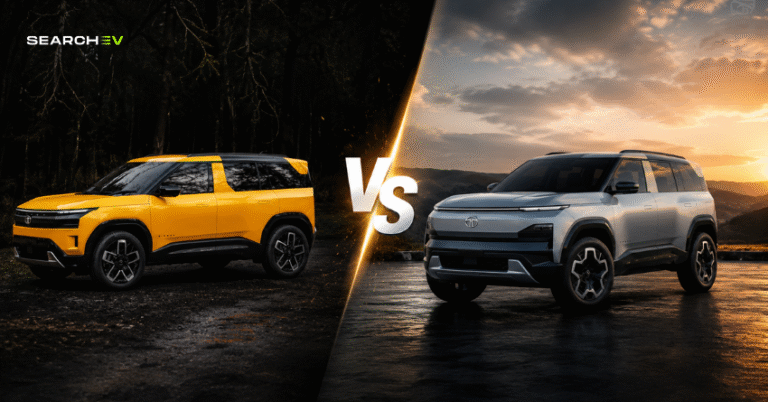
Key Takeaways
- The Mahindra BE 6 relies entirely on a rear-wheel-drive setup; meanwhile, the Tata Sierra EV distinguishes itself by offering both a standard RWD format and a Quad-Wheel Drive (QWD) dual-motor configuration.
- Backed by massive battery capacities of up to 79 kWh, both premium SUVs promise extensive highway touring, realistically translating to a real-world mileage comparison of 400–470 km per charge.
- The Sierra EV prioritises occupant luxury with its features like boss mode, whereas the BE 6 doubles down on a driver-centric, concept-car cockpit with fast performance.
Tata Sierra EV vs Mahindra BE 6: Price and Value Comparison
Value in the premium EV segment is defined not just by the starting price but also by the battery capacity and features offered in the mid-to-top tiers.
The Mahindra BE 6 is currently available with aggressive pricing, which starts at Rs 18.90 lakh for the base 59 kWh Pack One variant, stretching up to Rs 28.49 lakh for the exclusive 79 kWh Batman Edition.
The Sierra EV is underpinned by the advanced acti.ev+ architecture, and is priced competitively compared to its Mahindra rival.
Ex-Showroom Price Comparison Table
| Variant Tier / Battery Setup | Tata Sierra EV | Mahindra BE 6 |
| Base | Rs 18.79 Lakh (Pure) | Rs 18.90 Lakh (Pack One – 59 kWh) |
| Mid-Tier (Feature-Focused) | Rs 20.99 Lakh – Rs 22.19 Lakh (Adventure 63 kWh – 75 kWh) | Rs 21.90 Lakh – Rs 24.25 Lakh (Pack Two) |
| Top-Spec | Rs 24.79 Lakh – Rs 25.99 Lakh (Empowered A RWD – AWD) | Rs 26.90 Lakh – Rs 27.65 Lakh (Pack Three) |
While the entry-level variants are priced neck-and-neck, the value definitions diverge at the top end. Mahindra attempts to justify its premium with a massive 79 kWh BYD-sourced blade battery and blistering rear-wheel-drive dynamics. Conversely, the top-tier Sierra EV positions its value around an advanced dual-motor all-wheel-drive mechanical layout, offering a more versatile drivetrain for varied Indian terrains.
Road Presence, Dimensions, and Practicality Comparison
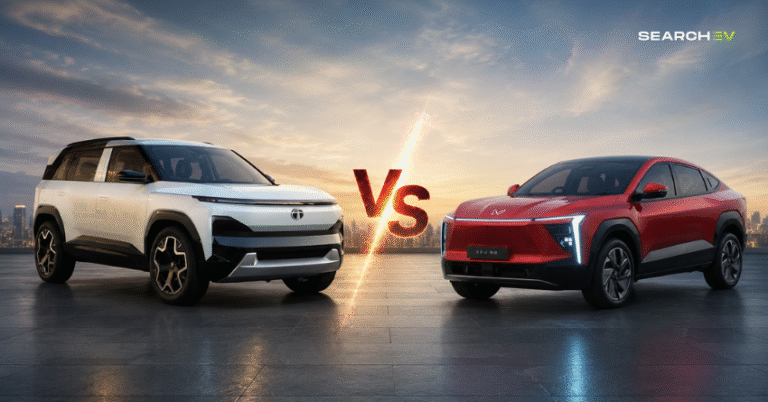
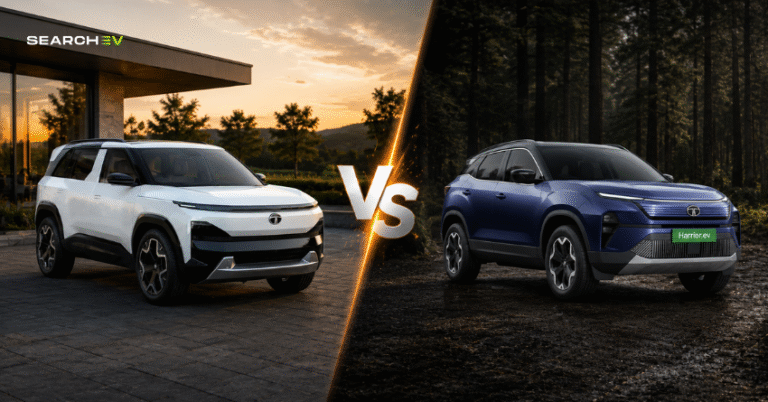
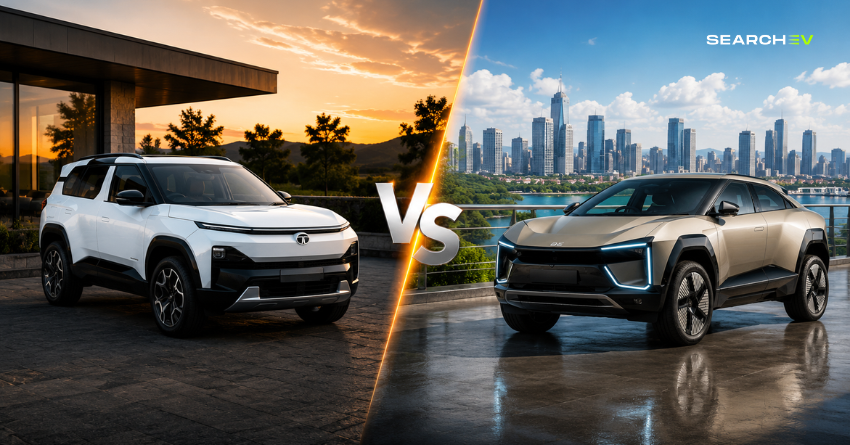
The Sierra EV revives a commanding, upright, boxy SUV, while the BE 6 stands out as an aggressive, low-slung, aerodynamic coupe.
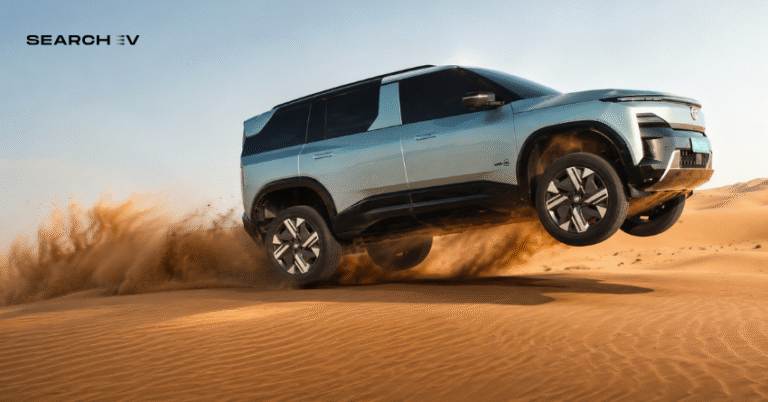
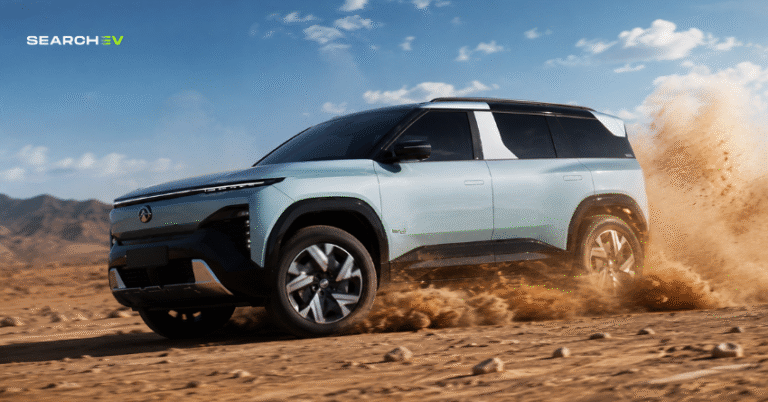
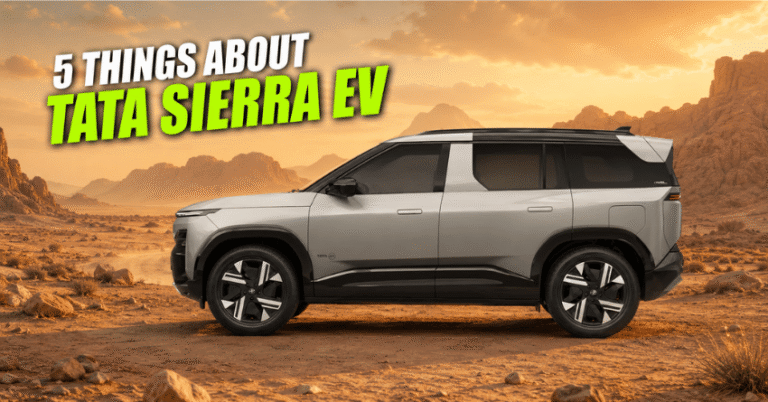
Visually, these two vehicles represent entirely opposing schools of thought. The Tata Sierra EV uses a clean, tall stance, flat clamshell tailgate, and sleek flush-door handles. Its front fascia is visually separated from its internal combustion counterpart through a smooth, closed-off grille (body-coloured) and a continuous, connected LED DRL bar across the nose. The side profile proudly retains the hallmark of the 1991 classic: a thick, body-coloured B-pillar flanking large, blacked-out panoramic rear windows.
The Mahindra BE 6 is an unconventional, polarising head-turner that looks like a concept car brought directly to life. It starts with an aggressive, forward-tilted hood featuring a prominent air scoop, framed by prominent, C-shaped LED DRLs. Its side profile is defined by sharp geometric lines, flared wheel arches covered in gloss-black cladding, and an aggressively sloping coupe roofline riding on massive 19-inch wheels.
Physical Dimensions & Capacity
| Metric | Tata Sierra EV | Mahindra BE 6 (Official Specification) |
| Overall Length | 4,340 mm | 4,371 mm |
| Overall Width | 1,841 mm | 1,907 mm |
| Overall Height | 1,750 mm | 1,627 mm |
| Wheelbase | 2,730 mm | 2,775 mm |
| Ground Clearance (Unladen) | 205 mm | 207 mm |
| Main Boot Space | 622 Litres | 455 Litres |
| Frunk (Front Trunk) Space | 35 Litres (AWD) / 55 Litres (RWD) | 45 Litres |
Practicality & Cabin Ergonomics Analysis
The dimensional differences significantly impact daily usability. The Mahindra BE 6 uses a longer 2,775 mm wheelbase, which translates to more knee room. However, due to the combination of a high floor and that swooping coupe roofline, passengers have to slouch slightly to enter the rear cabin, and headroom is strictly limited for taller occupants. Furthermore, its thick door pads intrude into the cabin space, making sitting three adults side-by-side uncomfortably snug.
The Tata Sierra EV uses its traditional, boxy SUV proportions to maximise vertical headroom and passenger comfort. Its large panoramic rear windows allow immense light into the cabin, completely eliminating the claustrophobic feel caused by the BE 6’s thick pillars and restricted rear visibility. In terms of cargo, while both main boots hover around 450 litres, the BE 6’s sloping rear glass limits vertical stacking for large suitcases, though it claws back utility with a handy 45-litre frunk.
Tata Sierra EV vs Mahindra BE 6: Which EV Offers More Features?
Tata focuses heavily on digital real estate and round luxury, while Mahindra delivers an immersive, driver-centric audio and tech cockpit.
Step inside either vehicle, and you are greeted by an array of high-end equipment. Both manufacturers have deployed large screens, panoramic glass roofs, and premium safety nets. However, there are some drastic differences.
Tech and Comfort Equipment Comparison
| Feature | Tata Sierra EV | Mahindra BE 6 |
| Panoramic Roof | Yes (Sunroof format) | Yes (Fixed glass roof with integrated pattern LEDs) |
| Primary Infotainment Screen | 12.3-inch Central Touchscreen | 12.3-inch Touchscreen (Fluid UI) |
| Digital Driver’s Cluster | 10.25-inch Cluster | 12.3-inch Integrated Unit |
| Co-Driver / Passenger Display | 12.3-inch Dedicated Screen | No |
| Premium Audio Brand | 12-Speaker JBL with Dolby Atmos | 16-Speaker Harman Kardon with Dolby Atmos |
| Front Seat Comfort | Powered, Ventilated with Memory | Sporty side-bolstering, Narrow profiling |
| Autonomous Driving Net | Level 2+ ADAS (With Self-Parking) | Level 2+ ADAS (With Self-Parking) |
| Standard Airbag Net | 6 Airbags standard across range | 6 Airbags standard (7 Knee Airbag on top trims) |
Unique Selling Features: Tata Sierra EV
- Triple-Screen Dashboard: Integrates a separate 12.3-inch display panel explicitly for the front passenger’s entertainment and navigation control.
- Chauffeur “Boss Mode”: Allows passengers to stretch out by pushing the front passenger seat forward..
Unique Selling Features: Mahindra BE 6
- Fixed Glass Roof Ambient Lighting: Features custom-patterned LED lighting elements etched directly into the glass roof panel.
- 16-Speaker Audio Powerhouse: A massive Harman Kardon surround system that completely envelops the cabin.
Performance, Range, and Charging Speed Comparison
The Mahindra BE 6 is built on the born-electric INGLO skateboard architecture, and it uses BYD-sourced LFP Blade battery packs. It sends power exclusively to the rear wheels via a single motor.
The Tata Sierra EV relies on the acti.ev+ platform and uses either a RWD single-motor configuration or a dual-motor QWD (Quad-Wheel Drive) all-wheel setup.
Powertrain & Battery Specification Table
| Technical Parameter | Tata Sierra EV Specifications | Mahindra BE 6 Specifications |
| Battery Capacities Available | 63 kWh & 75 kWh | 59 kWh & 79 kWh |
| MIDC Claimed Driving Range | 565 km (63 kWh) / 665 km (75 kWh) | 557 km (59 kWh) / 683 km (79 kWh) |
| Peak Torque Output | 340 Nm (RWD) / 504 Nm (QWD) | 380 Nm |
| Top DC Fast Charging Speed | Up to 120 kW | Up to 175 kW |
| DC Fast Charge Time (Optimal) | 20% to 80% in 26 minutes | 20% to 80% in 20 minutes |
In typical Indian driving conditions with climate control active, the 79 kWh Mahindra BE 6 delivers realistically between 430 and 470 km per charge. Because the Sierra EV is structurally lighter than its larger sibling, the Harrier EV, its top-spec 75 kWh variant delivers a real-world highway range of roughly around 450 km as well.
The real difference lies in how they drive. The BE 6 behaves more like a sports car, delivering ferocious, instantaneous acceleration that pins you to your seat, achieving 0-100 km/h in 6.7 seconds. Its stiffer suspension setup and low center of gravity give it incredible high-speed stability, though sharp potholes will cause a noticeable thud inside the cabin.
The Sierra EV balances performance pretty well. Its top-end QWD variants use dual electric motors to deliver explosive torque, resulting in an even quicker 0 to 100 km/h time of 5.8 secs, though the power delivery still feels more controlled. It also gets dedicated Terrain Modes..
Tata Sierra EV vs Mahindra BE 6: Which Electric SUV is the Better Buy?
Tata Sierra EV Pros and Cons
- Pros: Iconic, retro-modern aesthetics; QWD system with terrain modes for rough environments; loads of creature comforts.
- Cons: Charging speed tops out lower at 120 kW compared to Mahindra’s; boxy rear clamshell design can be polarising.
Mahindra BE 6 Pros and Cons
- Pros: Stunning, concept-car road presence; blistering real-world performance; incredible list of features.
- Cons: Swooping roofline restricts rear headroom and cargo height; lack of physical dashboard buttons makes adjusting climate controls on the fly frustrating.
Expert Take on the Best Electric SUV for You
The Mahindra BE 6 is an uncompromised, enthusiastic indulgence. If you want a vehicle that functions as an absolute tech and styling powerhouse, reaches speed effortlessly, and offers solid safety, it is a magnificent product.
However, if you view your premium EV as a complete, all-rounder family car, the Tata Sierra EV emerges as the more balanced choice. It delivers a deeply practical, highly refined luxury touring experience perfectly suited for Indian conditions.