Maruti Suzuki has formally revealed their EV adoption strategy. Following the success of the e-Vitara, the company will launch three more all-electric vehicles before the end of the decade (FY 2030–31), according to a significant revelation made by Partho Banerjee, Senior Executive Officer (Marketing and Sales), during a media conference in Hyderabad. This action is a component of Maruti’s “Maruti 3.0” strategy, which aims to take the top spot in the Battery Electric Vehicle (BEV) sector and dominate the Indian EV market.
Maruti Suzuki YMC (Electric MPV)
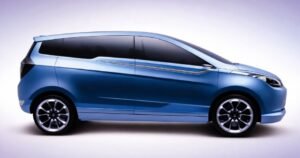
This will be Maruti Suzuki’s first mass-market electric MPV, the YMC will share its architecture with e-Vitara. We can expect the Maruti Suzuki YMC to launch around Diwali this year. It is likely to come with a 60kWh battery pack, offering an approximate range of 500 km on a full charge. Designed for large families, this model will focus on cabin space and modularity. We expect it to be priced between ₹18 lakh – ₹25 lakh, rivaling directly with the BYD eMAX 7, Kia Carens EV, and the recently launched VinFast VF MPV 7. It will also compete with the nation’s favourite MPV, the Toyota Innova Hycross Hybrid. We can also expect a Toyota-badged YMC in the first half of 2027.
Maruti Suzuki eWX-based Hatchback
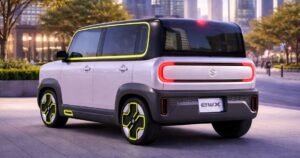
This “born-EV” hatchback is targeted at the entry-level market and was inspired by the eWX concept on display at the Japan Mobility Show. You might expect a small 25–35kWh battery pack with a reasonable range of 230–250 kilometers for city transportation. In an effort to make EVs accessible to the general population, Maruti is expected to aggressively price this car between ₹6 lakh and ₹10 lakh, competing with the Tata Tiago EV and the MG Comet EV. The Maruti Suzuki eWX is expected to launch in India later in 2027.
Maruti Suzuki Fronx EV or Brezza EV(YTB EV)

The stylish compact crossover, the Fronx EV will bridge the gap between the budget hatchback and premium e-Vitara. We can also expect the YTB EV to be the electric version of the popular Brezza. They are anticipated to come with multiple battery options, including a 35-40kWh pack delivering a range of roughly 350-400 km. With SUV-inspired styling and tech-heavy interior, either of them are expected to retail in the ₹12 lakh to ₹16 lakh price bracket. We can expect one out of these to be launched in early 2028.
A Milestone Day: 108 e-Vitara Deliveries in Hyderabad

To signal the beginning of this new era, Maruti Suzuki celebrated a massive milestone in Hyderabad. On a single day, the company completed the delivery of 108 units of the e-Vitara. This event wasn’t just a sales achievement but a demonstration of the high consumer interest in Maruti’s first global electric SUV. Partho Banerjee noted that the response in Telangana has been exceptionally strong, setting a positive tone for the brand’s nationwide EV rollout.
Maruti Suzuki: A Late Bloomer Or A Planned Entrant In EV Space?
For years, Maruti Suzuki was criticised for being a “late bloomer” in the EV race. However, this official roadmap proves that the company was simply waiting to build a localised, cost-effective ecosystem. By targeting multiple segments, from budget hatchbacks to MPVs, and aiming for 100,000 charging points by 2030, Maruti Suzuki is not just entering the EV market; it is playing to win. If they can maintain their signature value-for-money pricing, the “Maruti of EVs” might soon become a reality.