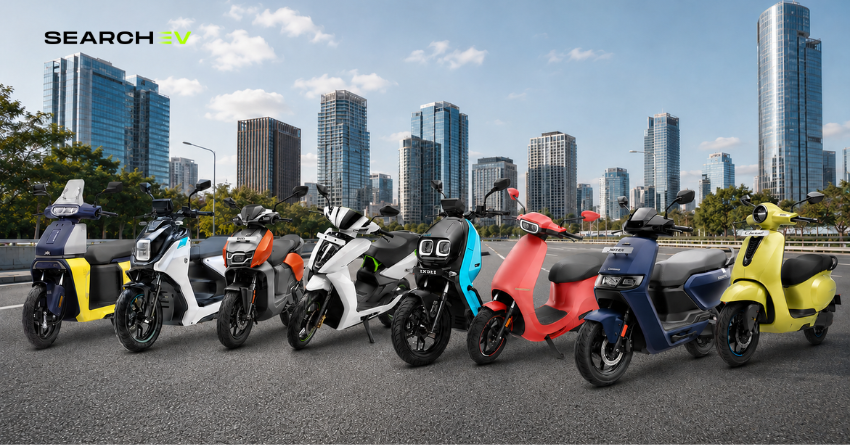
Searching for an electric scooter that can genuinely do 150 km on one charge? You’re not the only one. It’s one of the most asked questions in the EV scooter space right now, and for good reason. Nobody wants to plug in their scooter every single evening.
Here’s the good news. India actually has a decent list of scooters in this range today. Here’s the catch, though. Every brand throws around a different number, and what’s printed on the spec sheet is almost never what you’ll get on the road.
So we skipped the listing sites this time and went straight to the source. Every price and range figure below comes from the scooter’s own official brand website. Not a reseller page, not a dealer estimate. Straight from the company.
Quick Answer: Cheapest to Priciest
Short on time? Here’s the gist. Prices are ex-showroom and can move a bit depending on your state and whatever subsidy is active at the moment.
- Cheapest: TVS Orbiter — ₹99,250 (subsidy already included in Bengaluru)
- Best value: Bajaj Chetak — starts near ₹1,02,400, tops out at ₹1.52 lakh (ex-showroom)
- Best range for the money: Ola S1 Pro — the 3kWh variant starts at ₹1,02,499 and claims 176 km
- Most premium here: Ather 450 Apex — around ₹1.90 lakh
Full Comparison Table (Verified From Official Brand Sites)
| Scooter | Price (Ex-showroom) | Claimed Range (IDC) | Top Speed | Charging (0-80%) |
| TVS Orbiter | ₹99,250 – ₹1.05 lakh | 158 km | 68 kmph | 4 hr 10 min |
| Bajaj Chetak | Starts at ₹1,02,400 | Up to 153 km (varies by variant) | 63–80 kmph (variant-wise) | 3 hr |
| Vida V2 Plus | ₹1,30,990 (Effective Price) | 143 km | 80 kmph | 5 hr 15 min |
| Vida V2 Pro | ₹1,15,300 (starts from) | 165 km | 90 kmph | 5 hr 55 min |
| Ola S1 Pro (3 kWh) | ₹1,02,499 | 176 km | 117 kmph | 4 hr 50 min |
| Ola S1 Pro (4 kWh) | ₹1,43,999 | 242 km | 125 kmph | 4 hr 50 min |
| Ather Rizta S 2.9 kWh | Starts at ₹1,21,499 | 123 km | 80 kmph | 6 hr 30 min |
| Ather Rizta Z 3.7 kWh | Starts at ₹1,57,999 (may vary by city) | 159 km (IDC) | 80 kmph | 5 hr 45 min |
| River Indie | Starts from ₹1.47 lakh (city-dependent) | 160 km | 90 kmph | 5 hr |
| Ather 450X | Starts at ₹1,52,498 | 126–161 km (IDC) | 90 kmph | 3 hr (2.9 kWh) / 3 hr 12 min (3.7 kWh) |
| Yamaha EC-06 | ₹1.68 lakh | 169 km | 79 kmph | 8 hours |
| Ather 450 Apex | Starts at ₹1,94,99 | 157 km | 100 kmph | 5 hr 27 min |
What The Official Sites Don’t Put in Big Letters
This part is worth reading before you get fixated on price and range alone.
Bajaj actually admits its real-world range is lower. Dig into Chetak’s official FAQ page and you’ll find it says real-world range sits at 110 to 130 km. That’s despite top variants claiming up to 153 km. Honestly, that’s one of the more refreshing admissions you’ll find straight from a manufacturer.
TVS says more or less the same about the Orbiter. Its official blog puts real-world range at 120 to 130 km against a claimed 158 km. Funny enough, the two cheapest scooters on this list are also the two most upfront about the gap between claim and reality.
Ather splits its numbers by battery size, not just model name. Both the Rizta and the 450X come in two battery options. So if an ad says “up to 161 km,” that’s the bigger, pricier battery talking. The base variant gives you noticeably less, and it’s easy to miss that detail if you’re skimming.
The Real Range vs Claimed Range Gap
That number on every spec sheet comes from a lab test called IDC, short for Indian Driving Cycle. It assumes flat roads, one rider, steady speed, and zero traffic. Basically, a version of India that doesn’t exist.
Real roads mean signals, potholes, a passenger on the back seat, and stop-start traffic that eats into your battery. All of that can shave off 20 to 35 percent of your range. So a scooter claiming 150 to 160 km will probably give you somewhere between 100 and 130 km day to day, which lines up almost exactly with what Bajaj and TVS admit on their own sites.
Top 6 Electric Scooters With 150 KM Range: Explained One by One
A table only tells you so much, so let’s break down the six best picks in plain language. No jargon, just what you’re actually getting for your money.
1. TVS Orbiter — Best for Tight Budgets
Price: ₹99,250 | Claimed range: 158 km | Expected Real range: 110-125 km
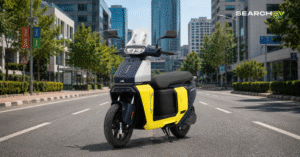
Cheapest scooter on this list, but it doesn’t ride like a budget option. TVS gave it a massive 34-litre boot, cruise control, and a genuinely comfortable seat. The design is a little different too, more boxy and modern than your typical scooter, and honestly, it works.
Who should buy it: First-time EV buyers, students, anyone trying to keep costs down. Also a smart pick if you mostly stick to city roads and don’t need blistering speed.
2. Bajaj Chetak — Best for Long-Term Reliability
Price: Starts at ₹1,02,400 | Claimed range: up to 153 km | Expected Real range: 110-130 km
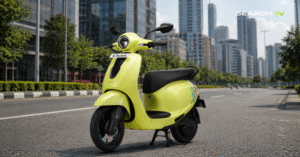
Bajaj has been building scooters in India for decades, and it shows here. The Chetak uses a solid metal body instead of plastic panels, so it ages better than most. Bajaj also runs one of the biggest service networks of any EV brand in the country, which matters a lot more than people realize until something needs fixing.
Who should buy it: Riders who value durability and easy servicing over chasing top speed or the flashiest screen. This is the scooter your dad would approve of.
3. Ather Rizta — Best for Families
Price: Starts at ₹1,21,499 lakh | Claimed range: 123 to 160 km (depends on battery) | Expected Real range: roughly 90-125 km
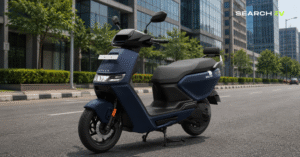
Built with families in mind, and it shows in the details. Massive storage, a wide comfortable seat, and safety features like fall alert and hill hold that make life easier for newer riders. You can go with the smaller battery to save money, or pay more for the bigger one and get extra range.
Who should buy it: Families running the daily school drop, grocery trips, and office commute off one scooter, without feeling cramped doing it.
4. Ola S1 Pro — Best for Range and Speed
Price: ₹1,02,499 (3 kWh) to ₹1,43,999 (4 kWh) | Claimed range: 176 to 242 km | Expected Real range: roughly 130-170 km
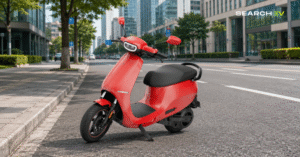
If you want more range without jumping straight to Ola’s most expensive lineup, this is the sweet spot. The 4 kWh version claims 242 km, so even after real-world losses, you should clear 150 km without much stress. It’s quick too, with a top speed touching 125 kmph.
Who should buy it: Anyone covering longer distances regularly, or riders who just want extra range as a buffer so they’re not charging every night.
5. River Indie — Best for Bad Roads and Big Storage
Price: Starts from ₹1.47 lakh (city-dependent) | Claimed range: 160 km | Expected Real range: roughly 100-120 km
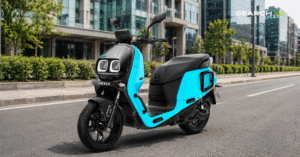
River built the Indie to handle actual Indian roads, not just glide around smooth city streets. Think higher ground clearance, a sturdy frame, and a huge 43-litre underseat space that fits two helmets with room to spare. It rides more like a rugged all-rounder than your typical city scooter.
Who should buy it: Riders facing rough patches, potholes or waterlogging-prone areas, and anyone who’d rather have storage space than tech features.
6. Ather 450X — Best for Performance Riders
Price: Starts from ₹1,52,498 (variant-dependent) | Claimed range: 126 to 161 km | Real range: roughly 90-125 km
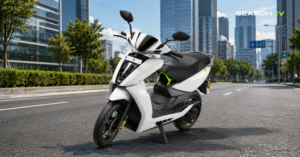
This is Ather’s sportier option, made for riders who enjoy sharper handling and quicker acceleration. It comes with a big touchscreen with built-in maps, and charges fairly fast, just over 5 hours for a full charge. Yes, it costs more than the Rizta, but you’re paying for performance and tech here, not just A-to-B transport.
Who should buy it: Riders who want their scooter to feel genuinely fun to ride, not just functional, and don’t mind paying a little extra for that.
What About Running Cost?
Bajaj actually does the math for you on its own site. Charging a Chetak works out to roughly ₹6.47 per unit of electricity by their own calculation, a fraction of what you’d spend running a petrol scooter the same distance. TVS makes a similar claim for the Orbiter, saying it’s about 10 times cheaper to run than petrol, with yearly maintenance around ₹1,000 to ₹2,000 compared to ₹4,000 to ₹5,000 on a petrol scooter.
Add that up over a year of daily riding, and the savings are real, even before you factor in the higher price you pay upfront for an EV.
Do State Subsidies Affect the Price?
Yes, and more than most people expect. TVS’s official ₹99,250 price for the Orbiter already has the PM e-Drive subsidy baked into it for Bengaluru. River Indie’s ₹1.47 lakh price does the same thing. Which means the same scooter can show up at a different “starting price” depending on which state you’re buying in. Always check the price listed for your own city, not some generic all-India number floating around online.
Final Word
Once you look past the marketing number and see what these brands quietly admit on their own websites, things get a lot clearer. Bajaj and TVS deserve credit here, being upfront about real-world range in a way most brands aren’t, and that honesty is worth weighing just as much as the price tag.
For daily commuters in cities like Bengaluru, the Ather Rizta and Bajaj Chetak remain the safest picks. Want more range as a cushion and don’t mind paying for it? The Ola S1 Pro 4 kWh is the strongest option on this entire list.
Frequently Asked Questions
1. Which electric scooter has the highest range in the 150 km segment?
Based on verified official listings, the Ola S1 Pro 4 kWh claims 242 km, the highest of the group. Its Pro+ variant with a 5.2 kWh battery pushes even further to 320 km, though that lands you in a pricier bracket.
2. What is the cheapest electric scooter with close to 150 km range?
The TVS Orbiter, priced at ₹99,250 ex-showroom with the subsidy included in Bengaluru, claims a range of 158 km. That’s the lowest entry price in this list for a scooter in that range.
3. Is 150 km claimed range enough for daily use in India?
For most riders, yes. Going by numbers Bajaj and TVS publish themselves, a scooter claiming 150 to 160 km typically delivers 100 to 130 km in actual city riding. That’s enough for 3 to 5 days of average commuting before you need to plug in again.
4. How long does it take to charge a 150 km range electric scooter?
Most scooters in this range take 4 to 5 hours to reach an 80 percent charge, going by official specs. Ather’s 3.7 kWh Rizta is on the faster end at under 5 hours, while the Yamaha EC-06 lags behind at around 10 hours for a full charge.
5. Do range numbers change with heat or cold?
They do. Extreme heat and cold both affect battery efficiency to some degree. If you’re riding through a hot city in peak summer, don’t be surprised by a slightly shorter real-world range.