Bajaj Chetak C3001 Expert Review
- Electric
- Scooter
- 2 Seater
What's good
-
Agreeable design and all-metal body construction, which many buyers appreciate
-
35-litre underseat storage that comfortably fits a full-face helmet
-
Stable, easy-to-manage handling with a turning radius tight enough for narrow city lanes
-
Backed by Bajaj’s wide network across India
What's not so good
-
The monochrome LCD display is not only basic but also hard to read while riding
-
No navigation at all, even as a paid TecPac add-on, unlike several similarly priced rivals
-
Braking hardware is basic, with drums at both ends rather than a front disc
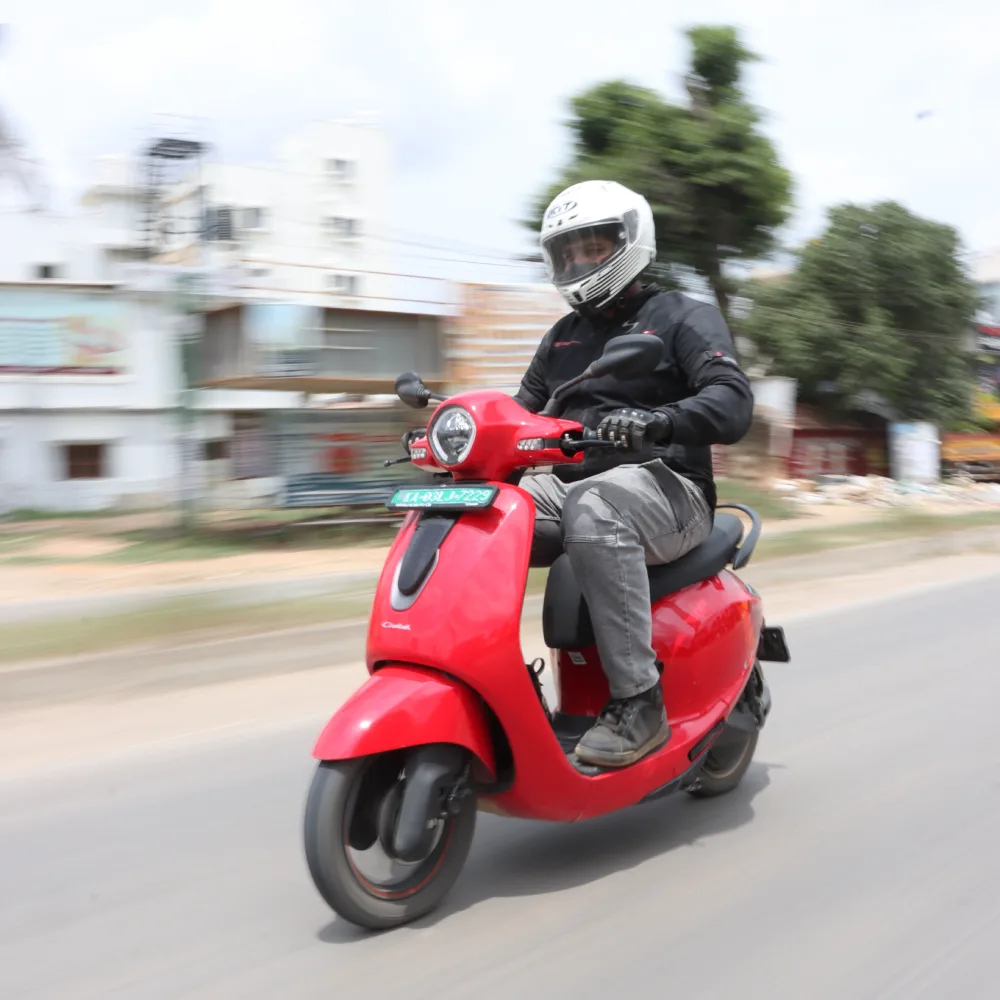
The Bajaj Chetak C3001 is worth evaluating as an everyday electric scooter rather than judging it solely by its claimed range or retro styling. Its metal body construction, 35-litre under-seat storage and 3.0 kWh battery are relevant to buyers who want a practical commuter. With a claimed IDC range of 127 km and a listed top speed of 70 km/h, the C3001 is positioned for urban use, although its suitability will depend on the distance travelled and the riding conditions.
The scooter’s strengths and trade-offs need to be considered together. Storage, ride comfort, build quality and low-speed usability can matter as much as outright performance for daily travel. Buyers should also account for charging time, the scooter’s weight and the differences between standard equipment and optional connected functions. A test ride is particularly useful for assessing seat comfort, handling and how easily the scooter can be moved in tight spaces.
This expert review examines the Bajaj Chetak C3001 from a buyer’s perspective, covering design, features, performance and range, ride and handling, safety, comfort, charging and ownership considerations. The aim is to help prospective buyers decide whether the C3001 fits their needs and whether another Chetak variant may be a better match.
What's good
-
Agreeable design and all-metal body construction, which many buyers appreciate
-
35-litre underseat storage that comfortably fits a full-face helmet
-
Stable, easy-to-manage handling with a turning radius tight enough for narrow city lanes
-
Backed by Bajaj’s wide network across India
What's not so good
-
The monochrome LCD display is not only basic but also hard to read while riding
-
No navigation at all, even as a paid TecPac add-on, unlike several similarly priced rivals
-
Braking hardware is basic, with drums at both ends rather than a front disc
The Bajaj Chetak C3001 is worth evaluating as an everyday electric scooter rather than judging it solely by its claimed range or retro styling. Its metal body construction, 35-litre under-seat storage and 3.0 kWh battery are relevant to buyers who want a practical commuter. With a claimed IDC range of 127 km and a listed top speed of 70 km/h, the C3001 is positioned for urban use, although its suitability will depend on the distance travelled and the riding conditions.
The scooter’s strengths and trade-offs need to be considered together. Storage, ride comfort, build quality and low-speed usability can matter as much as outright performance for daily travel. Buyers should also account for charging time, the scooter’s weight and the differences between standard equipment and optional connected functions. A test ride is particularly useful for assessing seat comfort, handling and how easily the scooter can be moved in tight spaces.
This expert review examines the Bajaj Chetak C3001 from a buyer’s perspective, covering design, features, performance and range, ride and handling, safety, comfort, charging and ownership considerations. The aim is to help prospective buyers decide whether the C3001 fits their needs and whether another Chetak variant may be a better match.
Bajaj Chetak C3001 Expert Review
SEV Score

Samarth Kudale
Tested and reviewed by SEV Experts on 8 parameters
SEV Score

Samarth Kudale
Tested and reviewed by SEV Experts on 8 parameters
Expert Verdict
The Bajaj Chetak C3001 sits in the middle of the current Chetak range, priced close to entry offerings from Ather, TVS, and Hero. That positioning works in its favour on build and handling, where the all-metal Chetak still feels like a sturdy, well-built machine against many rivals asking similar money. It works against the C3001 on features, where a thin TecPac and the complete absence of navigation, even as a paid add-on, leave it behind rivals charging about the same amount. Buy this for a no-nonsense, practical electric scooter with the Bajaj badge, offering reliable range, fast charging time, and a strong dealer network.
Bajaj Chetak C3001 Design
Exterior
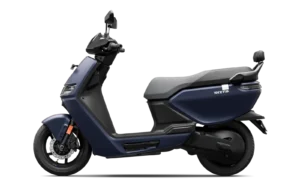
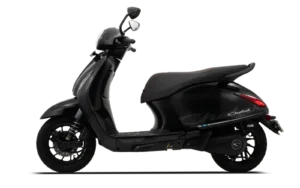
The C3001 carries the retro silhouette that has defined every electric Chetak since launch: a rounded headlamp, a flat floorboard, and handlebar-mounted mirrors that echo the original petrol scooter’s era. LED lighting on the front and rear keeps the look up to date despite the vintage cues, and the whole scooter still reads as a period piece rather than a generic commuter shape. Compared to the chrome finishes on the C35 Series, the 3001 features a blacked-out finish around the headlamp and the edges of the front apron.
Other details that separate the C3001 from the pricier C3501 above it include blacked-out mirrors instead of body-coloured ones, a simpler mechanical key replacing the keyless fob, and most importantly, a circular monochrome LCD display instead of a TFT one.
Build Quality & Fit and Finish
Panel gaps, paint finish, and general assembly quality are quite robust, and the steel body further adds a feeling of solidity.
Bajaj Chetak C3001 Features
The instrument cluster on the C3001 is a monochrome LCD, a step down from the colour panel on the C3503 and the 5-inch TFT on the range-topping C3501 and C3502. The display itself is not adequately bright; hence, seeing speed, battery percentage, range, and the active ride mode clearly while riding during the day is not really easy. Bluetooth pairing to the Chetak app adds call and message alerts to the cluster, so incoming calls can be accepted or rejected without reaching for a phone.
Two ride modes, Eco and Sport, come standard, along with hill hold assist, a reverse function backed by an audible alert, and auto hazard lights that trigger under hard braking.
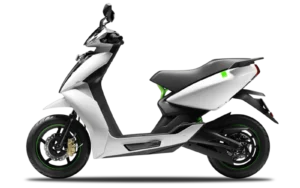
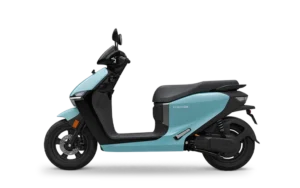
Where the C3001 falls behind is everything gated by TecPac and the annual connectivity pack. Buying TecPac on this variant does not unlock navigation at all. Features like sequential blinkers and an on-cluster document storage stay locked as well even with the pack fitted. The annual data plan, which brings features such as remote immobilisation, over-speed alerts, and geofencing on the pricier C3501 and C3502, is not available on the C3001. That is a meaningful gap against similarly priced rivals: base variants of the TVS iQube and the Hero Vida VX2 Go, all include turn-by-turn navigation as standard without an extra purchase, and TVS keeps geofencing and over-the-air update support on its own entry-level iQube. The C3001 has no over-the-air update support at all, so any future software fix needs a service visit rather than arriving overnight.
Switchgear is simple and easy to learn: a horn, indicator switch, and headlamp control on the left, with the reverse toggle and hazard button on the right, and nothing about the layout demands much of a learning curve.
Bajaj Chetak C3001 Performance & Range
Bajaj doesn’t officially publish motor power or torque figures for the C3001. What they do claim is a 70 km/h top speed and an IDC-certified range of 131 km from the 3.0 kWh pack. Bajaj has reserved the 80 km/h top speed for the pricier C3501 and C3502.
Around town, power delivery is smooth and linear, with the low-speed responsiveness, the electric motors known for. The scooter reaches speeds of up to 60 km/h easily, after which the power tapers off rather sharply. Eco and Sport modes, now standard, give a reasonable spread between stretching the range and picking up the pace a little for overtakes.
On range, the gap between the claimed 131 km and what you would actually see in the real world is not extremely wide. Figures in the 90 to 100 km bracket come up repeatedly, with mixed city riding with regular use of Sport mode.
Bajaj Chetak C3001 Ride & Handling
At a kerb weight of around 123 kg, with the battery pack sitting low in the floorboard, the C3001 carries its weight close to the ground, and that shows in how manageable it feels at low speed. Filtering through traffic, holding a line at a stop light on a slope thanks to hill hold, and turning it around in a tight lane all feel easier than the scooter’s retro bulk suggests, and the turning radius is tight enough to make U-turns straightforward on typical Indian street widths.
Suspension is a leading-link setup at the front paired with a rear mono-shock, tuned on the softer side. That tune works well over the potholes and broken patches common on city roads, with the Chetak’s suspension not bottoming out easily. However, the softer setup can make the rear slightly unsettled on sharp, repeated bumps while riding through rougher rural or hilly stretches.
Bajaj Chetak C3001 Safety
Core safety equipment on the C3001 covers hill hold assist, a reverse alert, auto hazard lights under hard braking, and a combined braking system working the drum brakes at each end. None of that is unusual for an electric scooter in this price bracket.
The one area where the C3001 lands behind a directly comparable rival is the front disc brake carried by the TVS iQube 3.1 kWh, which sits close to the same price and offers a shorter stopping distance at speed.
The steel body doesn’t bring a direct safety benefit, though owners tend to get more confidence with this setup, especially in terms of a lower chance of a cracked panel in a low-speed tip-over.
Bajaj Chetak C3001 Space & Comfort
The 35-litre underseat boot is the C3001’s strongest practical argument. It comfortably swallows a full-face helmet along with a small bag, more than several rivals in this price range manage.
Front storage is a simpler open cubby rather than the lockable glovebox fitted to the range-topping C3501, so there is nowhere secure up front to leave a wallet or documents; anything placed there stays visible and reachable by anyone standing next to the parked scooter. The flat floorboard has enough room for a bag between your feet, and the seat width and padding suit both rider and pillion for typical city-length rides, though taller riders may find the reach to the floorboard more upright than relaxed over longer stints.
Bajaj Chetak C3001 Charging & Warranty
Charging runs through a 750W off-board charger, taking the battery from empty to 80 per cent in roughly 2 hours 55 minutes, which is pretty quick for the class. There is no fast-charging option, though, so charging stays strictly an at-home or at-work overnight or workday routine rather than something you can top up at a public charger.
Compared to rivals, the Hero Vida VX2, a similarly priced rival, features a removable battery aimed at buyers who cannot park within reach of a plug. Anyone in that situation can look at the difference between Vida and Chetak in this aspect.
The standard warranty covers 3 years or 50,000 km, in line with the rest of the segment, and Bajaj offers optional extended warranty and annual roadside assistance plans on top, similar to what most rivals sell as paid add-ons rather than anything bundled in from the factory.
Bajaj Chetak C3001 Service & Network
Bajaj sells and services the Chetak through a large dealer network. That gives it service reach well beyond the metro cities where most electric-scooter-only brands are still concentrated, which helps buyers in smaller towns where an Ather or Simple experience centre may not exist yet.
What Bajaj has not built is a dedicated public fast-charging network to match Ather’s or Vida’s shared charger grid, or Ola’s own charging stations. Chetak ownership, including the C3001, still runs on a home-charging-first model, with the off-board charger doubling as the main charging solution and third-party AC points as an occasional backup. For most owners doing a daily commute well within the scooter’s range, that is not a practical problem, but longer trips beyond the battery’s reach need more planning than they would on a scooter backed by a public charging grid.
Who should buy this?
The Chetak C3001 suits a buyer who wants Bajaj’s brand backing, an all-metal build, and straightforward city commuting without much interest in a fancier screen or connected features. Riders in smaller towns who value a simple, no-nonsense, practical scooter over a flashier package especially have a solid case for it.
What's good
-
Agreeable design and all-metal body construction, which many buyers appreciate
-
35-litre underseat storage that comfortably fits a full-face helmet
-
Stable, easy-to-manage handling with a turning radius tight enough for narrow city lanes
-
Backed by Bajaj’s wide network across India
What's not so good
-
The monochrome LCD display is not only basic but also hard to read while riding
-
No navigation at all, even as a paid TecPac add-on, unlike several similarly priced rivals
-
Braking hardware is basic, with drums at both ends rather than a front disc
Bajaj Chetak C3001 Price
What's good
-
Agreeable design and all-metal body construction, which many buyers appreciate
-
35-litre underseat storage that comfortably fits a full-face helmet
-
Stable, easy-to-manage handling with a turning radius tight enough for narrow city lanes
-
Backed by Bajaj’s wide network across India
What's not so good
-
The monochrome LCD display is not only basic but also hard to read while riding
-
No navigation at all, even as a paid TecPac add-on, unlike several similarly priced rivals
-
Braking hardware is basic, with drums at both ends rather than a front disc
Connect Now