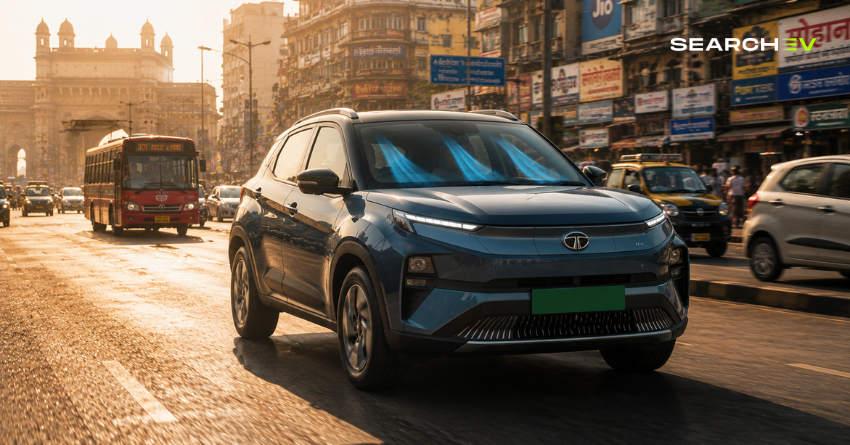
Ask any new EV owner in India what they worry about most, and it usually comes down to two things — range and the AC. And not separately. Together. As in, “if I run the AC the whole way, am I going to make it?”
It’s a fair concern. Indian summers are not gentle. May in Delhi, June in Chennai, pretty much any month in Hyderabad — the AC isn’t optional. It’s survival. So if running it is going to wipe out your range, that’s a real problem worth understanding.
Here’s the honest answer — and it’s probably better than you’ve been led to believe.
What the AC Is Actually Doing to Your Battery
Unlike a petrol car where the AC runs off a belt connected to the engine, your EV’s air conditioning pulls power directly from the battery. That part is true. It’s an extra draw on top of what’s already being used to move the car.
A typical EV AC system draws around 3 to 4 kW to run. To put that in perspective — a mid-size electric car might use 15 to 18 kW to drive at city speeds. So the AC is adding roughly 20 to 25% on top of your driving load. That’s meaningful, but it’s not catastrophic.
Now here’s where it gets interesting for Indian conditions specifically.
The Data — And Why It’s More Reassuring Than You’d Think
A study by Recurrent analysing over 7,500 electric vehicles found that at temperatures around 27°C, AC use caused an average range loss of just 2.8%. At 32°C — a perfectly normal Indian morning — that crept up to 5%. At 38°C and above, range loss from AC use can hit 17 to 20%.
So yes, in peak Indian summer — 40°C, sitting in traffic, AC on full blast — you will feel a real hit. Somewhere between 15 and 20% of your range. On a 300 km EV, that’s 45 to 60 km gone to cabin cooling in extreme conditions.
But here’s the part that gets missed in most conversations: your petrol car is losing too. It’s just that petrol cars produce a huge amount of engine waste heat that the AC has to fight constantly. Your EV motor produces far less heat — so the AC isn’t working against a furnace under the bonnet. It’s managing a much smaller temperature differential, and that makes it inherently more efficient at the same job.
The AC in your EV is also doing something else quietly — it’s helping regulate battery temperature alongside cabin temperature. In extreme Indian heat, the thermal management system and cabin AC work together to keep both you and the battery in a safe range. Switch the AC off entirely and you might save 5% range while the battery runs hotter than it should. That’s not a trade worth making. We’ve covered this in detail in our guide on protecting your EV in Indian summer — the AC is part of the solution, not just a drain.
The One Habit That Changes Everything
There’s a feature on almost every modern EV that most owners never use — preconditioning.
It lets you cool the cabin while the car is still plugged in, using grid electricity rather than battery power. You activate it through the app 10 to 15 minutes before you leave, and by the time you walk to the car, it’s already at a comfortable temperature.
This matters more than most people realise. The most energy-intensive moment for AC is the initial cool-down — pulling a 50°C cabin down to 24°C. That can draw 3 to 5 kW during that window alone. Once the cabin is at temperature, maintaining it only needs around 1 kW.
Precondition while plugged in, and that entire energy-intensive cool-down phase costs you nothing from the battery. You start driving with a cool cabin and a full charge. The AC barely has to work for the first 20 minutes of your journey because it’s just maintaining, not fighting.
A Few Small Habits That Add Up
Beyond preconditioning, a few things genuinely help:
- Park in shade whenever possible. A car parked under direct sun for three hours needs far more energy to cool down than one in a covered spot. The AC works less, range loss is lower.
- Use the recirculation mode. Once the cabin is cool, recirculating the already-cool air inside is far more efficient than constantly pulling in hot outside air and cooling it from scratch.
- At slow city speeds, windows down works. Below 40 km/h, opening the windows creates negligible aerodynamic drag and can substitute for AC entirely in moderate weather. Above highway speeds, the drag from open windows actually costs more range than the AC would.
Understanding how your EV manages energy while driving — including regenerative braking feeding power back to the battery — helps put the AC load in perspective. Every time you slow down, you’re recovering energy. The AC is drawing some of it back out. In stop-go city traffic, these two forces are constantly interacting.
The Bottom Line
No, the AC is not killing your range. Not even close to the way the fear around it suggests.
In moderate Indian temperatures — the kind you get for most of the year — AC impact is small enough that most owners won’t notice it unless they’re watching the numbers closely. In peak summer above 40°C, yes, you’ll see a 15 to 20% hit in extreme conditions. That’s real, and worth planning around on longer drives.
But switch off the AC entirely to save range? Don’t. Use preconditioning, park smart, and let the system do what it was designed for. Your comfort and your battery health both benefit from it running properly.
Stay on top of every EV ownership tip and real-world guide — SearchEV covers what actually matters for Indian EV owners.