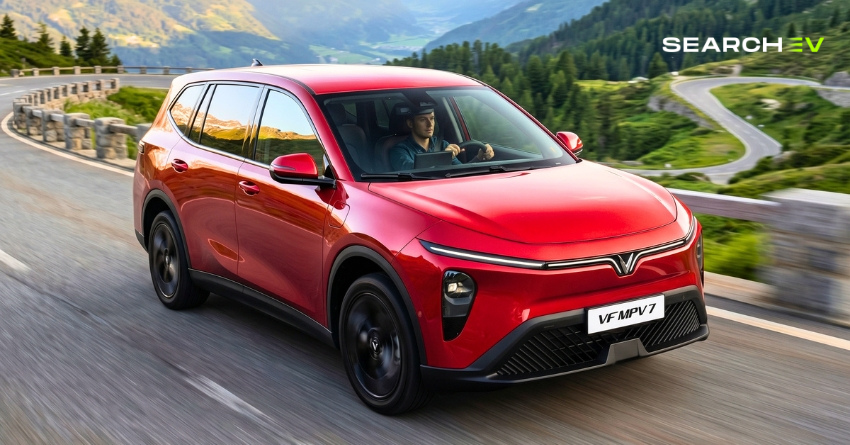
Vinfast has officially launched its three-row electric MPV in the Indian market today at a price of ₹24.49 lakh. While aggressive pricing and a spacious seven-seat layout are excellent tools for drawing buyers into showrooms, the true measure of an electric vehicle’s longevity and daily usability lies in its electric powertrain.
As the VF MPV 7 prepares to battle the Kia Carens Clavis EV, BYD eMax 7, and Mahindra XEV 9S, here’s a deep dive into its spec sheet to understand exactly how sensible it is for people looking for a family electric car.
The Battery and Range Reality Check
At the heart of the VF MPV 7 is a 60.13 kWh battery pack, which is what it gets globally as well (Limo Green).
The battery pack uses Lithium Iron Phosphate (LFP) cell technology, which has become the global standard in the current EV market. LFP LFP packs are inherently more stable than NMC (Nickel Manganese Cobalt) batteries, while also being less prone to thermal degradation (a crucial safety standard for harsh Indian summers).
Compared to its classmates in the ₹25-lakh range, the MPV 7 offers significantly more energy storage than the Kia Carens Clavis EV (51.4 kWh) and the base BYD eMax 7 (55.4 kWh). However, it still falls short of the massive 70 kWh and 79 kWh battery options offered by the long-range focused Mahindra XEV 9S.
Talking about range, The VinFast VF MPV 7 holds an ARAI-certified range of 517 km or 450 kilometres as per the NEDC cycle. Factoring in real-world Indian driving conditions, including dense stop-and-go traffic, consistent AC usage, and the heavy payload of a full family, owners can realistically expect a true driving range of 350 km to 400 km on a full charge. This makes it a reliable urban commuter which can also handle weekend inter-city trips without immediate highway charging anxiety. In comparison, a Kia Carens Clavis EV achieves a range of roughly 310-360 km in the real world.
Power Delivery and Fast Charging Capability
Powering the front wheels of the MPV 7 is a single Permanent Magnet Synchronous Motor (PMSM). The setup produces 201 bhp of maximum power and 280 Nm of instant torque, enabling the heavy 4,740 mm-long seven-seater to sprint from 0 to 100 kmph in under 9 seconds.
In the context of its immediate front-wheel-drive competitors, the VinFast easily out-punches the Carens Clavis EV (169 bhp / 255 Nm) and the BYD eMax 7 Premium (161 bhp / 310 Nm). Only the rear-wheel-drive Mahindra XEV 9S is more powerful with a solid 242 bhp and 380 Nm of torque.
When the battery does run low, the VF MPV 7 is well-equipped to utilise India’s rapidly expanding DC fast-charging infrastructure. The vehicle supports up to 80 kW high-speed charging that allows the battery to surge from 10% to 70% in just 30 minutes.
It means that during a standard highway road trip, a quick coffee or lunch break is all it takes to add over 230 km of real-world driving range back into the battery, making the transition to electric family travel smoother.